

A fraction number line is a horizontal line that shows fractions in their place among whole numbers, with equal spacing marking their exact value. To plot a proper fraction, divide the space between 0 and 1 into as many equal parts as the denominator shows, then count that many steps from 0 using the numerator. Printable practice sheets for this exact skill are coming up.
TL;DR:
- Students need to divide the segment between 0 and 1 into equal parts based on the denominator to accurately plot fractions.
- Equivalent fractions occupy the same point on a number line because they represent the same value, regardless of their numerator and denominator.
- Comparing fractions visually involves plotting them on a common scale and checking which point is farther to the right.
- Placing improper fractions involves converting them to mixed numbers and splitting the interval between the relevant whole numbers.
- Using physical activities like hopping or standing on a taped line enhances understanding and retention of fraction positions.
Table of Contents
- Step-by-Step: Plotting Unit and Proper Fractions Between 0 and 1
- Why Do Equivalent Fractions Land on the Same Point?
- How to Compare Two Fractions on a Number Line
- Placing Mixed Numbers and Improper Fractions Without Confusion
- Number-Line Teaching Activities That Actually Work in Class
- Which Printable Number-Line Sheets Should You Use?
- Fractions as Numbers Between Whole Numbers
- How Fraction Size Relates to 0 and 1 on the Number Line
- Common Misconceptions When Plotting Fractions on Number Lines
- Using Number Lines to Add and Subtract Fractions
- Introduction to Decimal Equivalents on the Fraction Number Line
- Why Number-Line Visuals Change How Kids Understand Fractions
- Give Kids More Practice With Edhed Learning’s Printable Packs
- Sources
Step-by-Step: Plotting Unit and Proper Fractions Between 0 and 1
You don’t need fancy materials to teach this well. A ruler, a pencil, and a clear sequence of steps will get most students plotting fractions confidently within a single lesson.
- Draw the line and mark the endpoints. Draw a straight horizontal line. Label the left end 0 and the right end 1.
- Divide by the denominator. If the fraction is fourths, split the line into 4 equal sections using tick marks. If it’s fifths, split it into 5.
- Count from 0 using the numerator. For 3/4, count three tick marks to the right of 0 and mark that point.
- Label the point. Write the fraction directly above or below its mark so the visual and the symbol connect.
When you’re scripting this out loud for a class, two phrases do a lot of work: “count the intervals, not the tick marks,” and “start at zero every time.” Kids often miscount by treating the first tick mark as position one instead of counting the space itself, so naming the intervals explicitly heads off a lot of confusion.
Worked example 1: Plot 2/3. Divide 0 to 1 into 3 equal parts. Count 2 parts from 0. That point is 2/3, sitting two thirds of the way to 1.
Worked example 2: Plot 4/5. Divide the line into 5 equal parts. Count 4 parts from 0. The point lands just shy of 1, which is a good visual cue that 4/5 is close to a whole.
Pro Tip: Keep a reusable blank strip on hand, with a printed 0 and 1 and removable tick marks or a wipeable surface. You can switch from fourths to sixths in seconds without redrawing the whole line, which makes quick formative checks painless during a lesson.
Why Do Equivalent Fractions Land on the Same Point?
Equivalent fractions occupy the exact same spot on a number line because they represent the same amount, just sliced differently. Redraw the interval between 0 and 1 with more divisions and you’ll see 1/2, 2/4, and 4/8 all stack up at the identical point, halfway across.
A simple activity makes this stick: hand students pairs of fractions like 1/3 and 2/6, ask them to plot both on separate lines of the same length, then hold the lines up to the light or against a window. If the points align, the fractions match.
- Multiplying the numerator and denominator by the same number creates a finer partition without moving the point.
- Simplifying does the reverse: it collapses a finer partition back to fewer, larger sections.
- Either direction, the physical location on the line never changes, only how many slices you’re looking at.
How to Compare Two Fractions on a Number Line
The rule is simple once it’s visual: whichever fraction sits farther to the right is larger. That single idea replaces a lot of memorized cross-multiplication tricks, especially for students who aren’t ready for that abstraction yet.
- Same denominator, easy read. Comparing 3/8 and 5/8 on one line, 5/8 sits farther right, so it wins.
- Different denominators, rescale first. Comparing 2/3 and 3/4 means plotting both on lines split into a common denominator, like twelfths (8/12 versus 9/12), so the tick marks line up for a fair comparison.
- Read the position, not the numbers. Once both fractions sit on the same scale, the comparison is just “which point is farther from 0.”
Worked example: Ask students to compare 1/2 and 3/5. Script it as: “Let’s rebuild both on a line of tenths. 1/2 becomes 5/10, and 3/5 becomes 6/10. Which one is farther right?” That question does more teaching than any rule chanted from memory.
Placing Mixed Numbers and Improper Fractions Without Confusion
Improper fractions trip students up mainly because they’re not sure which whole numbers to draw first. The fix is to convert the improper fraction to a mixed number before touching the pencil to the paper.
- Identify the two whole numbers the fraction falls between (for 7/4, that’s 1 and 2).
- Divide that specific interval, not the whole line, into the denominator’s equal parts.
- Count the remainder from the lower whole number to place the point.
Worked example: 7/4 converts to 1 3/4. Draw the segment between 1 and 2, split it into 4 parts, and count 3 parts from 1. The point sits close to 2, which makes intuitive sense since 7/4 is almost two wholes.
Pro Tip: Label the whole-number anchors, like 1 and 2, before you divide anything. Students who skip labeling the anchors are far more likely to count into the wrong interval entirely.
Number-Line Teaching Activities That Actually Work in Class
A logical progression keeps fraction lessons from feeling like a grab bag of disconnected skills. Start with unit fractions (1/2, 1/3, 1/4), move to general proper fractions, then equivalence, and finish with mixed and improper numbers. Each stage builds directly on the interval-counting skill from the one before it, so starting with unit fractions before adding denominator complexity keeps the cognitive load manageable.
Movement helps more than most teachers expect. A few tested approaches:
- Human number line: tape a line on the floor, assign fraction cards, and have students physically stand at their value.
- Fraction hop: call out a fraction and have a student hop along a floor-taped line to the correct point.
- Partner matching: one student plots a fraction, the partner has to name an equivalent fraction that lands on the same spot.
These kinesthetic activities strengthen retention because students feel the distance between points instead of just calculating it.
For a quick check on understanding, a three-question exit ticket works well: plot one proper fraction, identify the larger of two given fractions, and place one improper fraction. If a student stumbles, drop the denominator size (try fourths instead of sevenths) and hand them physical counters to move along the line before going back to pencil work.
Pro Tip: For students who consistently miscount intervals, cover the tick marks with sticky notes and have them “walk” the line with a finger, saying each fraction out loud as they go. Removing the visual clutter of numbers often fixes the counting error faster than more explanation does.
Which Printable Number-Line Sheets Should You Use?
Not every printable sheet fits every stage of learning, and pairing explanations with downloadable practice pages works best when the sheet matches the skill you’re targeting that day.
- 0 to 1 portrait sheets work well for warm-up drills on unit and proper fractions, quick and low-pressure.
- 0 to 1 landscape sheets give more room for labeling multiple points, useful for guided practice where students plot several fractions at once.
- 0 to 2 or mixed-number lines are built for independent practice once students are comfortable crossing whole-number boundaries.
- Blank, open-ended lines let you adapt on the fly, perfect for differentiating between students who need fourths and students ready for twelfths.
To adapt any of these for mixed-number practice, just extend the printed range past 1 and pre-mark the whole-number anchors before handing it out. That small adjustment removes one layer of difficulty and lets students focus on the partitioning step alone.
Fractions as Numbers Between Whole Numbers
Many students arrive at fractions thinking of them as two separate whole numbers stacked on top of each other, a top number and a bottom number, rather than a single value in its own right. The number line breaks that habit fast because it forces the fraction to occupy one specific point, not two.
Once a fraction has a fixed spot between, say, 0 and 1, or between 3 and 4, it stops being an abstract instruction (“divide these two numbers”) and becomes a location you can point to. That’s the real shift a number line creates: fractions join whole numbers on the same continuous scale, instead of living in a separate mental category with separate rules.
This matters most for students moving into mixed numbers, because they need to accept that 2 3/4 isn’t “two, then some other unrelated number.” It’s a single point sitting between 2 and 3, closer to 3. Number lines make that single-point idea visible in a way that stacked fraction notation never quite manages on its own. Once students internalize that fractions are numbers, not just division problems, comparison and addition both get noticeably easier to teach.

How Fraction Size Relates to 0 and 1 on the Number Line
Position on the line tells you everything about size at a glance, which is exactly why this tool works so well for building number sense. A fraction close to 0 is small. A fraction close to 1 is nearly a whole. A fraction sitting right in the middle is close to one half.
This becomes a powerful mental shortcut once students trust it. Show a fraction like 9/10 and ask, “Is this closer to 0 or closer to 1?” A student who understands the number line will say “close to 1” almost instantly, without needing to calculate anything. Compare that to 1/9, which sits nearly on top of 0.
Benchmarking against 1/2 works the same way. Fractions like 4/9 or 5/11 both hover near the halfway mark, and recognizing that visually saves students from awkward, error-prone arithmetic every time they need a rough estimate. It’s also the foundation for later estimation skills in adding fractions, where knowing that 5/8 is “a bit more than half” helps a student sanity-check an answer before they’ve even finished the calculation. The number line turns an abstract sense of magnitude into something they can see and predict.
Common Misconceptions When Plotting Fractions on Number Lines
A few errors show up so consistently across classrooms that they’re worth naming directly, so you can watch for them before they harden into habits.
Counting tick marks instead of intervals. A line divided into fourths has 5 tick marks but only 4 intervals. Students who count marks instead of spaces are consistently off by one.
Assuming a bigger denominator means a bigger fraction. Without a visual, students sometimes think 1/8 is larger than 1/2 because 8 is a bigger number than 2. The number line corrects this instantly, since 1/8 visibly sits much closer to 0.
Ignoring the whole-number boundary in improper fractions. Students often try to divide the entire 0 to 3 stretch into equal parts for a fraction like 7/4, instead of isolating just the 1 to 2 segment. That produces a wildly wrong placement.
Forgetting to relabel after simplifying. When a student reduces 4/8 to 1/2 to plot it, they sometimes forget the point represents both fractions equally and treat them as different values needing separate marks.
Naming these mistakes out loud in class, before students make them, tends to cut down on repeat errors more than correcting them after the fact.
Using Number Lines to Add and Subtract Fractions
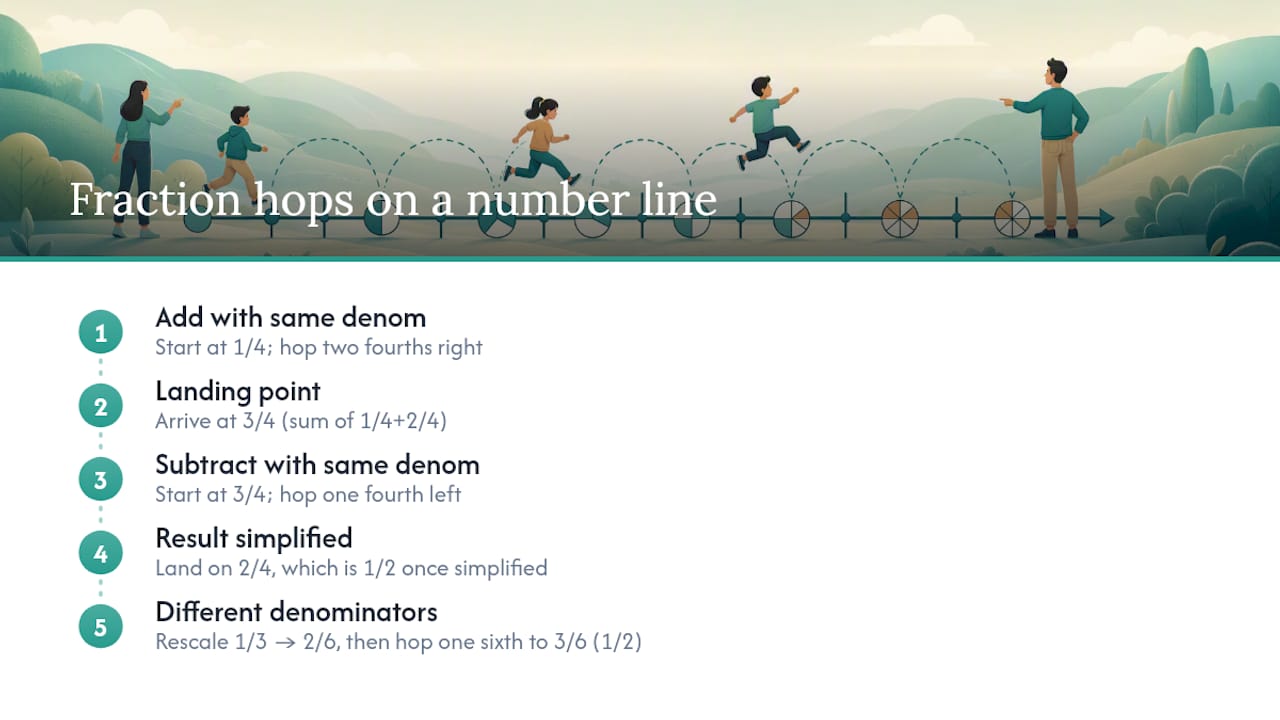
A number line turns fraction addition into a physical hop instead of an abstract rule about common denominators, which makes it a natural bridge for students who find the algorithm alone confusing.
To add 1/4 + 2/4, start at the point for 1/4, then hop two more fourths to the right. The landing point is 3/4, and students can see the addition happening rather than just trust a rule about numerators. Subtraction works the same way in reverse: for 3/4 minus 1/4, start at 3/4 and hop one interval to the left, landing on 2/4, or 1/2 once simplified.
The trickier case is adding fractions with different denominators, like 1/3 + 1/6. Here the number line forces a useful habit: you have to rescale one fraction so both sit on the same set of intervals before hopping makes any sense. Rebuild 1/3 as 2/6, then hop one more sixth to land on 3/6, which simplifies to 1/2. That rescaling step is the same skill used in comparing fractions, so number-line practice reinforces both concepts at once instead of teaching them as isolated procedures.
Introduction to Decimal Equivalents on the Fraction Number Line
Once a fraction has a fixed point on the line, its decimal equivalent is just a different label for that same spot, not a separate value to calculate from scratch. This connection tends to click for students faster on a number line than it does through long division alone.
Mark a line from 0 to 1 with tenths, and the decimal connection becomes almost automatic: 1/10 sits at 0.1, 5/10 sits at 0.5, and 9/10 sits at 0.9. Fractions that don’t have a denominator of 10 take one extra step, converting to an equivalent fraction that does. For 1/4, rebuilding it as 25/100 shows students exactly why it lands at 0.25, rather than asking them to accept the decimal on faith.
This is also where benchmarking pays off again. A student who already knows 1/2 sits at the halfway point can predict that its decimal form, 0.5, will too. That kind of cross-checking between fraction and decimal representations builds real number sense, the kind that holds up later when decimals start appearing in measurement, money, and data work without a fraction anywhere in sight.
Why Number-Line Visuals Change How Kids Understand Fractions
Watching a student go from guessing fraction size to confidently placing 5/8 on a blank line, without hesitation, is one of the clearest breakthroughs you can see in a math lesson. Edhed Learning builds its worksheet packs around that exact moment, prioritizing visual, hands-on practice because teachers and parents consistently report it’s what makes fractions finally make sense. You’ll find related printable packs referenced throughout this guide.
— Shaun
Give Kids More Practice With Edhed Learning’s Printable Packs
Once a student can plot a fraction on a number line, the next challenge is keeping that skill sharp across grade-level content, and that’s exactly where a structured worksheet pack earns its place on your shelf. Edhed Learning builds its printable packs around the same visual-first approach used throughout this guide, so kids move from number-line basics into full grade-level fraction work without a jarring style change between resources.
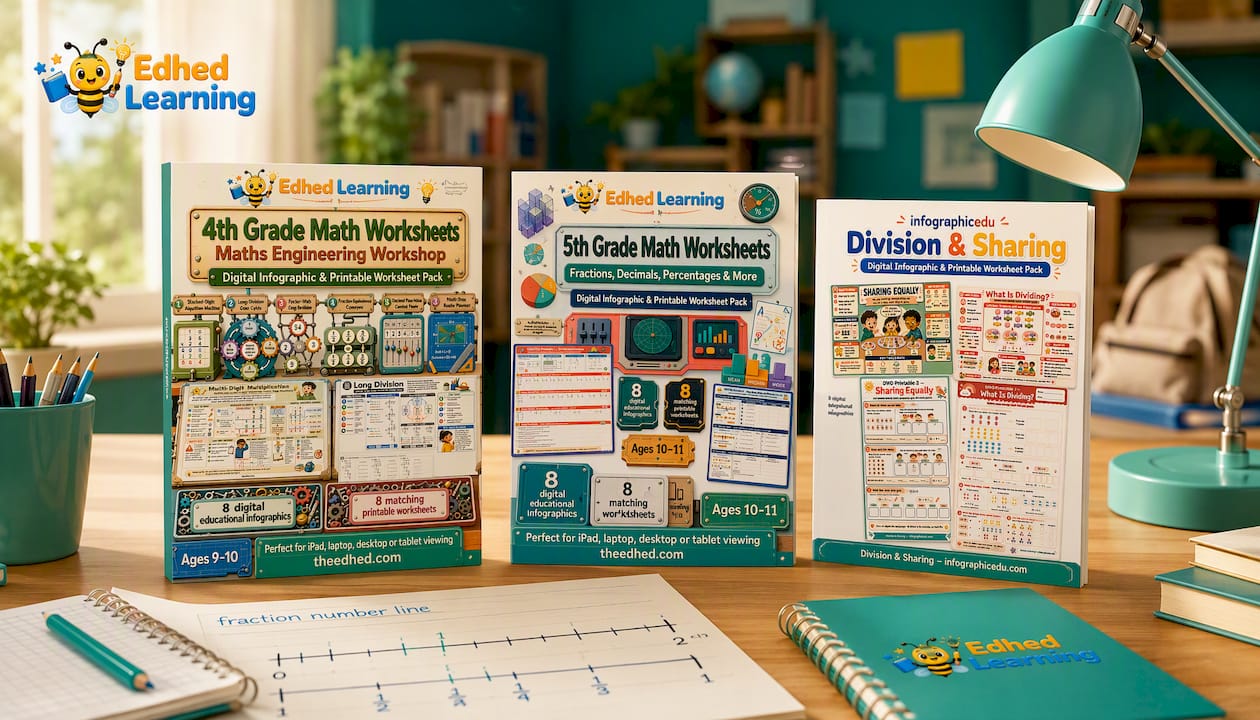
The 4th Grade Math Worksheets pack includes guided number-line lessons paired with worked examples, built for students just moving past unit fractions into general proper-fraction practice. The 5th Grade Math Worksheets pack steps up to mixed numbers, improper fractions, and comparison problems, with printable practice sequences that scaffold difficulty the same way this guide does. And because fraction understanding leans heavily on division concepts, the Division & Sharing pack reinforces the sharing and partitioning logic that makes denominators click in the first place.
Every pack arrives as an instant digital download, ready to print at home or across a classroom set. If you’d like to see the visual style before you commit, preview a free sample and check whether it fits your student’s current level before choosing a pack to buy.
Sources
For further study on evidence-based fraction instruction, BBC Bitesize and MathsIsFun offer clear interactive explanations, while GeeksforGeeks covers mixed and improper fraction placement in more depth. For printable banks, Math Salamanders offers a range of ready-to-use sheets, and schools coordinating fraction lessons across grade levels may find Trailmark’s elementary school resources useful for broader classroom planning.
- Fractions on a number line - BBC Bitesize
- Fraction number line - MathsIsFun
- Fractions on Number Line : Representation , Examples and Practice problems - GeeksforGeeks
- Understood


