

The best math posters right now come from three types of sources: professional organizations like the American Mathematical Society, pedagogy-driven projects like YouCubed, and teacher-created printable packs from sites like Math for Love. For grade-specific classroom sets, some printable packs round out the mix with growth-mindset visuals built for instant download. Grab a PDF, size it to your wall, and print it today.
TL;DR:
- Most high-quality posters are available for free from professional organizations, pedagogy projects, or teacher-created packs, suitable for various classroom purposes.
- When selecting posters, match the type to your goal, whether it is teaching specific skills, building mindset, or decorating with geometric art, and ensure they fit your students’ reading level.
- Print posters at at least 300 DPI for clarity, and consider large-format printing or tiling for oversized displays, with options to laminate or use heavier stock for durability.
- Use posters actively in class by incorporating them into lessons, problem-solving prompts, student references, or scavenger hunts to increase engagement and retention.
- Accessible resources include AMS for inspiration, YouCubed for growth mindset visuals, and low-cost concept-specific packs like those from Math for Love or Theedhed for easy classroom integration.
Table of Contents
- Where to find the best math posters (free and paid)
- How do you choose the right math posters for your space?
- Printing and sizing tips for math wall art
- How teachers actually use posters in the classroom
- Why Edhed Learning’s printable resources fit right in
- Get classroom-ready poster packs from Theedhed
- Quick reference: where to find quality math posters
- A note on visuals and math confidence
- Sources
Where to find the best math posters (free and paid)
You don’t need to spend hours hunting for quality visuals. A handful of sources cover almost every need, from decorative math art to classroom-tested pedagogy tools.
Start with the professionals. The American Mathematical Society maintains a free poster collection built to inspire curiosity about mathematics, and the print quality holds up in hallways and department lounges alike. If your goal is shaping classroom culture rather than teaching a specific skill, YouCubed’s poster set covers norms like “Mistakes and challenges” and “Everyone can learn math,” backed by research on student mindset.
Teacher creators fill the gap between institutional resources and classroom reality. Math for Love’s Prime Climb hundreds chart poster turns a basic number chart into a color-coded factorization tool kids actually want to study. MathEqualsLove and MathCuriosity host large free printable libraries, and Plus Magazine covers more advanced, discussion-worthy topics for older students.
For something less conventional, individual academics sometimes publish research posters worth framing. Joel David Hamkins’ counting to infinity poster turns ordinal numbers into a genuinely beautiful visual, the kind of piece that works as decor in a math department as easily as it works in a lesson.
- AMS: free, professional, best for hallway inspiration
- YouCubed: free, mindset and classroom norms
- Math for Love / MathEqualsLove: free and low-cost, concept-specific and highly printable
- Hamkins and similar research posters: often free PDFs, best for advanced or decorative use
How do you choose the right math posters for your space?
Not every poster serves the same job. Sorting by purpose first saves you from ending up with a wall full of pretty visuals that never actually get used.
Anchor charts teach a specific process (long division steps, order of operations). Concept posters explain an idea (what a prime number is, how fractions relate to decimals). Inspirational posters build mindset and culture. Decorative math art, like fractal prints or geometric designs, exists purely to spark curiosity. Mixing all four types across a room tends to work better than committing to just one.
Match reading level to the room. A poster with dense paragraph text belongs in a high school hallway, not a second-grade classroom, where bold numerals and simple icons do the heavier lifting.
Here’s a simple evaluation checklist:
- Does the poster match a specific grade band or skill you’re actually teaching?
- Is the file a high-resolution PDF, not a blurry screenshot?
- Does the source specify classroom use rights, or is licensing unclear?
- Will the paper weight and finish survive tape, thumbtacks, or humidity?
Pro Tip: Before printing anything full-size, print one test page on regular paper and hold it at the distance your back-row students sit. If you can’t read it from there, size up before committing to expensive cardstock.
Printing and sizing tips for math wall art
Most high-quality poster sources deliver files as PDFs specifically because of the flexibility that format gives you. One file can become a full wall display, a tiled mural spanning several sheets, or a shrunk-down handout for a student binder.
For large-format prints, aim for at least 300 DPI so lines and text stay crisp instead of pixelating. Vector-based PDFs scale especially well for anything visually complex, like fractal art or annotated geometric proofs, since the resolution never degrades no matter how large you print.
- Tile-print across four or six letter-size pages for oversized murals without a plotter printer
- Use your school’s print shop or a local copy center for large single-sheet posters
- Laminate or print on heavier stock (100 to 130 lb) if the poster stays up all year
- Rotate placement every quarter so the same three posters don’t fade into background noise
Print shops and office supply stores often charge less per square foot than home inkjet printing once you’re producing anything larger than standard paper, so a bulk order can be worth the trip.
How teachers actually use posters in the classroom
A poster on the wall only works if students look at it. The best classroom uses treat posters as active teaching tools, not permanent wallpaper.
Pre-made anchor charts save prep time and look polished immediately. Collaborative anchor charts, where students help build the chart during a lesson, tend to stick in memory better because ownership improves retention. The strongest classrooms often do both: hang one strong reference poster, then build a second one together as a class.
- Use a poster as a weekly “problem of the week” prompt near the door
- Shrink posters to quarter-page size for student reference binders
- Turn a concept poster into a scavenger hunt, sending students to find the answer displayed somewhere in the room
- Add a QR code linking to a follow-up task, keeping the poster itself uncluttered
Pro Tip: Swap one bulletin board poster each grading period instead of leaving the same set up all year. Novelty alone brings student eyes back to material they’d stopped noticing.
Why Edhed Learning’s printable resources fit right in
Some printable packs are built around principles that make the sources above work: bright visuals, hands-on structure, and a growth-mindset framing that treats mistakes as part of learning rather than something to avoid. Many packs are available as instant digital downloads, so there’s no shipping wait between deciding you need a resource and having it on your printer.
Three packs map directly onto common classroom needs. The 6th Grade Math Worksheets pack suits middle school teachers moving into ratios, percentages, and pre-algebra concepts. The Maths Word Problem Worksheets Bundle for Grades 1 to 5 works across a wide span of elementary levels, useful for mixed-ability groups or multi-grade tutoring. The 3rd Grade Math Worksheets pack targets the multiplication and fraction foundations that grade typically covers.
Author Shaun’s parent guide on helping kids love math reflects the same visual-first approach running through every product.
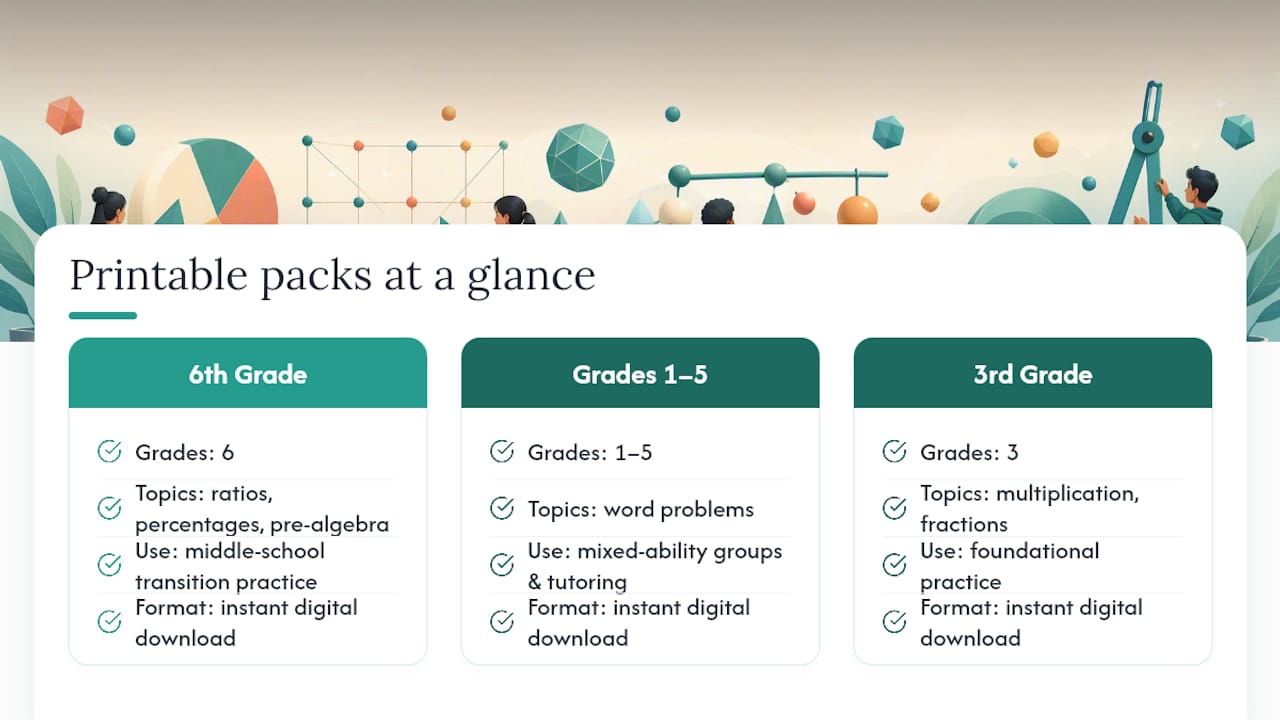
Get classroom-ready poster packs from Theedhed
Some services provide packs as ready-to-print PDFs, already sized for classroom display, to help save prep time on formatting.
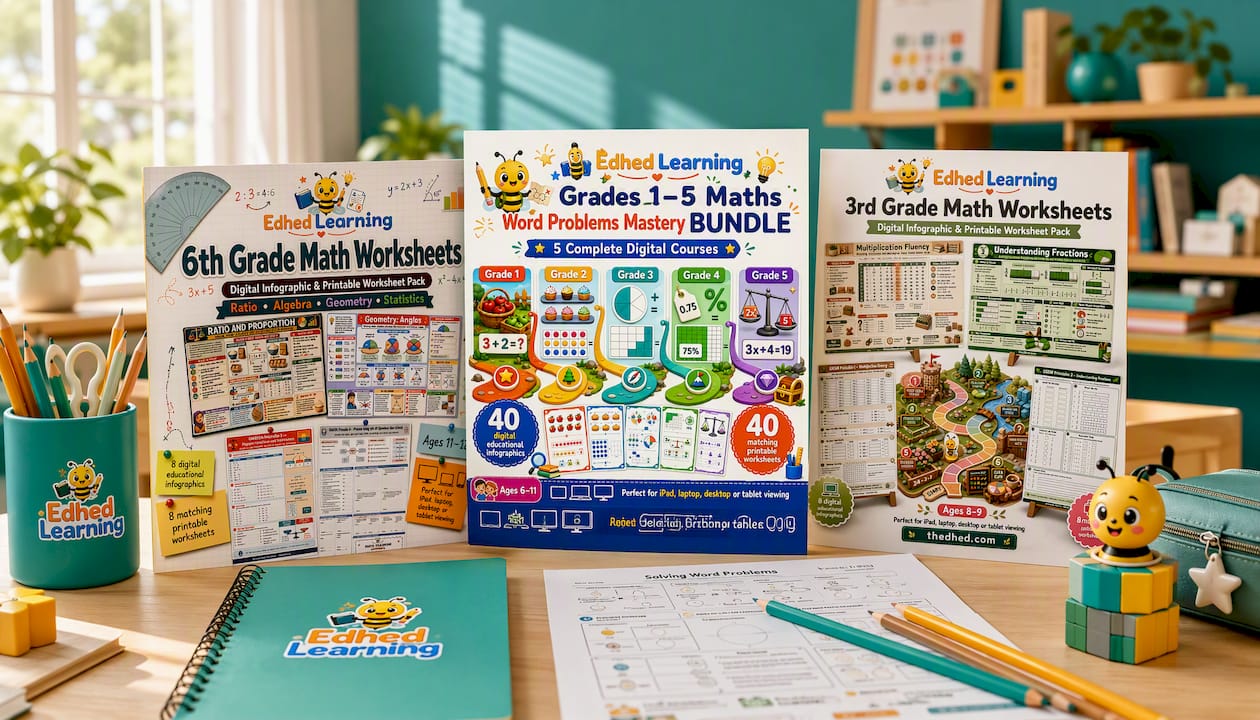
If you teach middle schoolers moving into pre-algebra, the 6th Grade Math Worksheets pack covers the visual scaffolding that topic needs. Running a multi-grade classroom or small group? The Maths Word Problem Worksheets Bundle for Grades 1 to 5 flexes across five grade bands in one purchase. For early elementary foundations, the 3rd Grade Math Worksheets pack builds the multiplication and fraction base that grade depends on.
Every pack includes flexible sizing, so a single file works as a wall poster, a tiled mural, or a notebook-sized handout, and personal classroom use is covered under the standard license. Preview free sample sheets on the Theedhed site before you buy, then download and print in minutes.
Quick reference: where to find quality math posters
- AMS posters: free, professional-quality, best for general inspiration
- YouCubed posters: free, growth-mindset and classroom norms
- Math for Love printable posters: low-cost, concept-specific visuals like the Prime Climb chart
- Chapman University’s interesting math posters roundup: free, curated list of standout designs
- Hamkins’ counting to infinity poster: free, advanced and decorative
- PBS LearningMedia classroom posters: free, best for early elementary grades
A note on visuals and math confidence
Posters work because kids notice patterns before they understand rules. A hundreds chart with color-coded factors teaches multiplication relationships before a student can define “prime number.” I’ve seen the same shift happen with a single well-placed anchor chart: confusion turns into recognition, then into confidence, often within a week of daily exposure.
— Shaun
Sources
Recommended
- Times Tables & Multiplication – Kids Digital Infographic Course & Printable Worksheet Pack
- Early Maths, Numbers & Shapes - Kids Course
- Early Maths, Counting & Measuring – Kids Digital Infographic Course & Printable Worksheet Pack
- Visual Learning and Printable Practice: Why Children Benefit From Both


