

The most effective approach is to reduce what working memory must hold, not try to expand it. Externalize information with notes and visual cues, chunk instructions into smaller steps, add short retrieval practice, keep routines predictable, and protect sleep. This combination works for teachers, parents, and caregivers because it targets how working memory actually fails, and it’s backed by research on memory and learning rather than trendy “brain training” promises.
TL;DR:
- Chunking tasks into smaller, clearly visible steps significantly reduces working memory load and improves task completion for children.
- External tools like checklists, visual schedules, and labeled storage help offload information that would otherwise rely on active memory.
- Practice retrieval through short quizzes and spaced repetition enhances long-term retention more effectively than passive rereading.
- Ensuring adequate sleep and regular movement boosts working memory capacity, preventing fatigue and stress from limiting cognitive performance.
- Formal working memory assessments and tailored strategies should target specific memory types, like verbal or visuospatial, for more effective support.
Table of Contents
- Working Memory Strategies You Can Use Today
- Classroom and Home Setups That Lighten the Load
- What Working Memory Training Can and Cannot Do
- Sleep, Movement, and Focus Windows That Protect Memory
- Build a 4-Week Starter Plan and Track What’s Working
- How Edhed Learning Resources Fit This Plan
- How Do You Actually Test a Child’s Working Memory?
- The Two Types of Working Memory (And Why the Difference Matters)
- Where Working Memory Breaks Down (And What Actually Fixes It)
- What the Research Actually Supports (And What It Doesn’t)
- Ready-Made Tools to Put This Plan Into Action Tonight
- Sources
Working Memory Strategies You Can Use Today
Working memory is the mental workspace that holds and manipulates information for a few seconds while you use it. A child holding “carry the 2” while still reading the next digit in a subtraction problem is running working memory at full capacity. When that workspace overflows, information drops out. The fix isn’t asking kids to “concentrate harder.” It’s reducing the load and strengthening how information gets stored and pulled back out.
Here’s what works, roughly in order of impact:
- Chunk big tasks into small steps. Break a four-step math problem into four visible steps instead of one instruction. “Clean your room” becomes “put books on the shelf, then clothes in the hamper, then toys in the bin.” Chunking groups information into meaningful units, which lowers the mental effort needed to hold it all at once.
- Externalize everything you can. One notebook, one whiteboard, one checklist system, used consistently. Notes, reminders, and routines act as scaffolds that offload information the brain would otherwise have to hold active.
- Build associations, not raw facts. Mnemonics, short stories, and concept maps work because they convert abstract ideas into structures kids can actually retrieve, rather than isolated bits of data floating with no anchor.
- Practice retrieval, not rereading. A 90 second self-quiz, “teach it back to me,” or a pause-and-recall moment beats passive review every time.
- Space it out and mix it up. Five minutes today, five tomorrow, interleaved with a different topic, builds retention that one long cram session never does.
- Cut multitasking. One task, one window of time, phones and tablets out of sight.
Retrieval practice and spaced, interleaved study consistently outperform rereading and massed cramming for long-term retention, even though it feels harder in the moment.
- Keep instructions to three steps or fewer at a time for younger children.
- Post visual step cards where kids can see them without asking.
- Rotate two subjects in one study block instead of drilling one for 20 straight minutes.
Pro Tip: Ask “what were the three steps I just gave you?” immediately after instructions. That ten-second retrieval check catches a dropped step before it becomes a meltdown.
Classroom and Home Setups That Lighten the Load
Compensatory strategies work because they don’t ask a child to remember more. They change the environment so less needs to be remembered. A step-by-step checklist taped to a desk does the same job a working memory would otherwise struggle to do alone.
Practical setups that hold up in real classrooms and real living rooms:
- Visual schedules posted at eye level, updated weekly, not buried in a folder.
- Labeled bins and shelves so “where does this go” never becomes a decision.
- A shared calendar (paper or digital) that parents and teachers both check.
- Personal checklists taped inside a desk lid or on a bathroom mirror.
- Timers for transitions, so “five more minutes” has a visible countdown instead of a verbal reminder that gets lost.
A quick assignment tweak that helps almost every learner: split a worksheet into two columns and cover the second until the first is done. A reading assignment can be chunked into three short sections with a one-line recall prompt after each.
Watch for signs that call for more than classroom scaffolds: a child who loses instructions within seconds even with visual supports, who cannot complete two-step tasks despite consistent practice, or whose working memory struggles show up across every subject and setting. That pattern is worth raising with a school psychologist or pediatrician rather than treating with more worksheets.
Pro Tip: Put the checklist where the task happens, not in a binder. A memory aid nobody sees while working is not an aid.
What Working Memory Training Can and Cannot Do
Training a specific task, like a digit-span game, reliably improves performance on that exact task. This is called near transfer, and it’s well documented. What’s far less certain is whether that gain carries over to unrelated skills like reading comprehension or math reasoning. Evidence for that kind of broad far transfer remains limited, so treat training as a supplement to scaffolds, never a replacement for them.
A realistic protocol:
- Practice 5 to 15 minutes daily, no longer. Working memory tasks are mentally taxing.
- Match the modality to the goal: verbal recall drills for reading and language gains, spatial puzzles or block tasks for visuospatial gains.
- Increase difficulty only as accuracy improves, never on a fixed schedule.
Sample activities that fit a school day or a kitchen table:
- A simplified running memory task: recite a growing list of items, adding one each round.
- Teach-back scripts: “Explain what we just covered like you’re teaching your little brother.”
- Short written recall: three sentences about what was just read, closed book.
Brief daily practice with rising difficulty tends to show measurable task gains within two to six weeks. Expect improvement on the trained skill, not a general cognitive upgrade.
Sleep, Movement, and Focus Windows That Protect Memory
Working memory runs on a well-rested, well-moved body more than any app or worksheet can compensate for. Two consecutive nights of under six hours of sleep can drop cognitive performance to a level comparable to mild alcohol intoxication. Aim for 7 to 9 hours of consistent sleep and about 150 minutes of moderate aerobic activity weekly.
- Build five minute movement breaks into any lesson longer than 20 minutes.
- Protect single-task windows. Interruptions force working memory to reset, losing whatever was being held.
- Use visible timers instead of verbal countdowns to reduce “what did you say” moments.
- Keep bedtime and wake time consistent, even on weekends.
Build a 4-Week Starter Plan and Track What’s Working
Start small, track simply, and adjust based on what the numbers actually show.
- Week 1: Introduce one externalization tool (checklist or visual schedule) and one daily 5 minute retrieval practice. Nothing else changes yet.
- Week 2: Add chunked instructions to one subject or one home routine. Keep tracking.
- Week 3: Layer in spacing, two short sessions on different days instead of one long one.
- Week 4: Review what stuck and drop what didn’t.
Track it with tools this simple:
- Task completion rate without prompting (aim for improvement week over week).
- A two-minute oral recall of three key facts from the day’s lesson.
- On-task minutes during independent work.
If none of that moves after two weeks, troubleshoot before adding more: switch from verbal to visual cues, shorten the retrieval prompt, or move practice earlier in the day when attention is fresher.
Pro Tip: Track just one number for two weeks before judging a strategy. Switching tactics every three days makes it impossible to know what’s actually working.
How Edhed Learning Resources Fit This Plan
Printable, visual resources work well as the externalization layer this plan calls for, since a scaffold only helps if a child actually looks at it.
- Visual reminder and routine posters give kids a fixed cue instead of a repeated verbal instruction.
- Retrieval-practice worksheets build the self-quiz habit directly into schoolwork instead of adding a separate task.
- Instant digital downloads mean a checklist or chunked worksheet can go from browser tab to classroom wall in minutes.
Many parents, teachers, and therapists have used materials like visual reminder and routine posters to turn screen time into structured practice, a proof point worth remembering when picking tools for this plan.
How Do You Actually Test a Child’s Working Memory?
A quick classroom observation tells you more than most people expect. If a child can repeat back three unrelated words immediately but loses the third one after a 30 second distraction, that’s a working memory gap worth noting, not a focus problem.
Formal assessment typically comes from a school psychologist or licensed clinician using standardized tools like digit span tasks (repeating numbers forward and backward), the Corsi block-tapping test for visuospatial memory, or subtests within broader cognitive batteries. These measure capacity, how many units a child can hold, and manipulation, how well they can rearrange or use that information while holding it.
Informal, low-stakes checks work well as first-pass screening at home or in class:
- Give a three-step verbal instruction with no repeats and see how much survives.
- Read a short list of items and ask for immediate recall, then recall again after a two-minute distraction task.
- Watch for a pattern rather than a single miss: does the child consistently lose the middle step of instructions, or specifically struggle when instructions are verbal but not when they’re written?
A single bad day doesn’t mean a deficit. A consistent pattern across settings and weeks is what justifies a referral for formal testing.
The Two Types of Working Memory (And Why the Difference Matters)
Working memory isn’t one single system. Researchers split it into at least two specialized components, and mixing up which one a child struggles with means picking the wrong strategy.
The phonological loop handles verbal and auditory information: spoken instructions, numbers read aloud, the sound of words while sounding them out. A child who forgets a three-part spoken instruction but follows a picture schedule perfectly has a phonological loop bottleneck, not a general memory problem. Strategies that help here lean on rehearsal and sound: repeating instructions back, chunking numbers the way phone numbers get grouped, and turning spoken directions into short, rhythmic phrases.
The visuospatial sketchpad handles mental images and spatial layout: remembering where a shape belongs, mentally rotating an object, tracking a path on a map. A child who struggles here benefits from diagrams, physical manipulatives, color-coded steps, and letting them draw out a problem instead of holding it mentally.
Mismatching strategy to system is a common mistake. Giving more verbal reminders to a child with a visuospatial weakness won’t help much; giving them a diagram might fix it in one try. Watching which type of task trips a child up, spoken versus spatial, is often more useful than a general “working memory is weak” label.
Where Working Memory Breaks Down (And What Actually Fixes It)
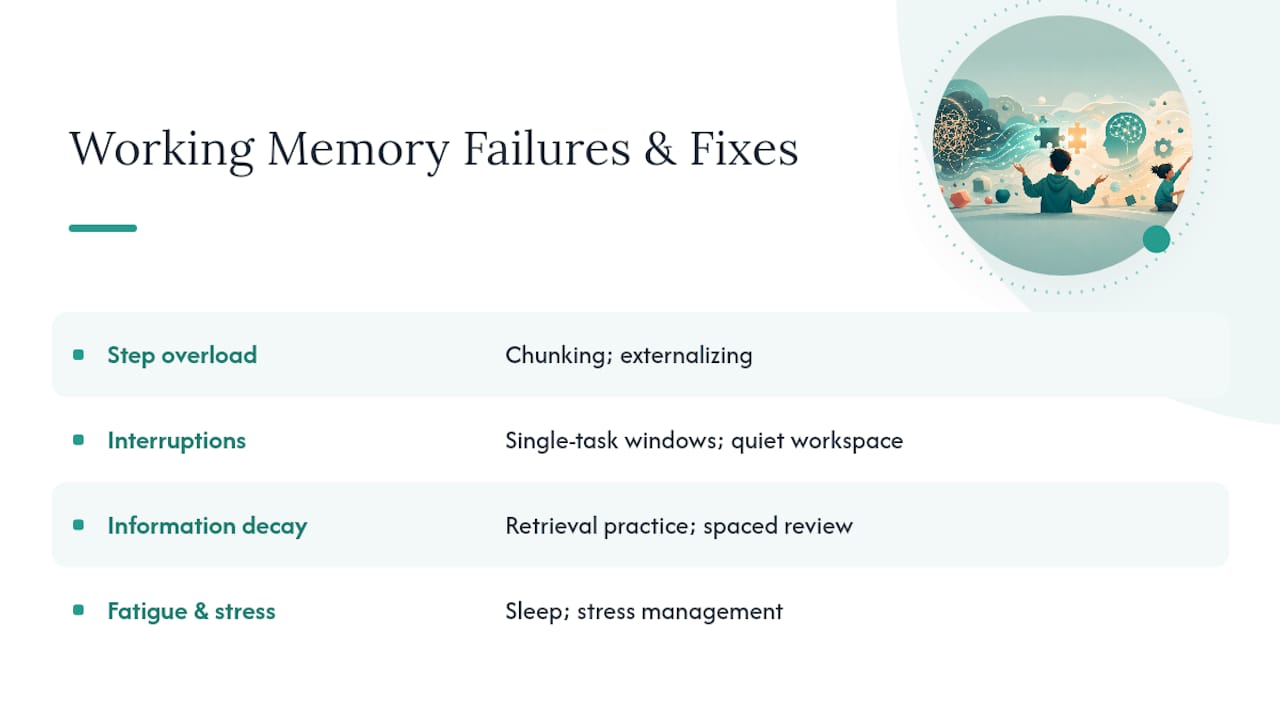
Working memory has a small, fixed capacity, most researchers estimate somewhere around three to five items for children, and every strategy in this article exists because of that hard limit. Understanding exactly where it breaks helps target the fix instead of throwing every tactic at every problem.
Overload from too many steps at once. This is the most common failure and the easiest to fix. Chunking and externalizing solve it directly by reducing what needs to stay active in the first place.
Interruptions wiping the slate. A hallway noise, a sibling’s question, a notification, any of these can force working memory to reset entirely, losing whatever was being held before the interruption. Single-task windows and quiet workspaces address this directly.
Fading without reinforcement. Information held briefly disappears fast unless it gets used. Retrieval practice and spaced review are the direct countermeasure. Rote repetition alone rarely fixes this because meaning-based encoding anchors new material to existing knowledge far better than repetition does.
Fatigue and stress narrowing capacity further. A tired or anxious child has less working memory available, not the same amount used less efficiently. This is why sleep and stress management aren’t wellness add-ons here. They’re capacity issues.
No single strategy fixes all four. That’s the practical case for combining scaffolds, retrieval, and lifestyle support instead of picking one tactic and expecting it to cover every gap.
What the Research Actually Supports (And What It Doesn’t)
The honest reading of the research is less exciting than most working memory programs want it to be: you can reliably help a child perform better on the specific tasks they practice, but broad claims about “growing” working memory capacity itself don’t hold up well under scrutiny. That gap between marketing and evidence is where a lot of families waste time and money on training apps promising general cognitive gains.
What actually moves the needle is less glamorous. Reducing load through externalization and chunking tends to produce bigger day-to-day improvements than isolated training drills, because it addresses the bottleneck directly instead of hoping a skill transfers sideways. Retrieval practice and spacing come second, not because they’re weaker, but because they need the load problem solved first to work well.
If you take one thing from this article, prioritize the checklist over the brain-training app. Build the routine before you chase the training gain. Scaffolds first, practice second, sleep and movement underneath both. That order matters more than most guidance admits, and it’s the order that holds up when the school week gets chaotic and the tidy morning plan falls apart by Wednesday.
— Shaun
Ready-Made Tools to Put This Plan Into Action Tonight
You don’t need to build every checklist and cue card from scratch. The Neurodivergent Focus & Regulation Worksheets Bundle gives you visual cues and regulation routines ready to print, exactly the externalization layer this plan depends on.
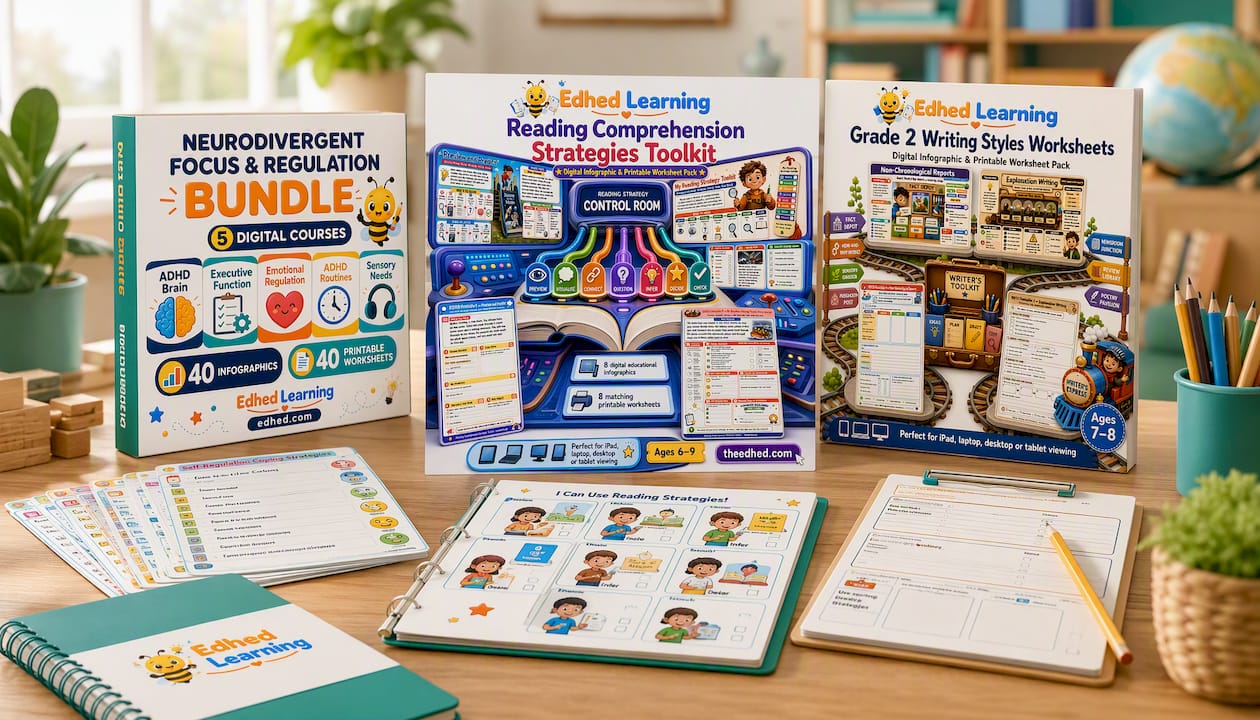
For retrieval practice and chunked reading tasks, the Reading Comprehension Strategies Toolkit breaks comprehension into short, self-quiz-friendly sections instead of one long passage a working memory has to hold all at once. And if writing assignments are where instructions keep getting lost mid-task, the Grade 2 Writing Styles Worksheets turn multi-step writing into small, sequenced steps a child can follow without asking “what’s next” five times.
Every pack is an instant digital download, so a checklist or worksheet can be on a desk or kitchen table within minutes of purchase. Browse the full library of resources or grab a free sample sheet at Edhed Learning to see how the visuals fit your specific classroom or home routine before committing to a full bundle.
Sources
- OpenStax — Psychology 2e: Ways to enhance memory
- Psychology Today — Quick strategies to boost working memory
- PMC — Evidence-based strategies to improve memory and learning
- Mayo Clinic — Memory loss: 7 tips to keep your memory sharp


