

Here are all 50 U.S. states and their capitals, plus seven quick ways to teach and practice them with kids. Below, you’ll find the full state→capital list for instant reference, a “big-city trap” tip that fixes the mistake most kids make, and game-based activities that an expert recommends for turning ten minutes of practice into real, lasting recall.
TL;DR:
- Prioritize learning the outlier capitals like Montpelier, Pierre, Dover, and Bismarck, as they cause the most confusion among students.
- Use regional chunking and reverse-question quizzing techniques, which improve durable recall far better than rote memorization.
- Spend about ten minutes daily on practice, focusing more on capitals students struggle with rather than reviewing all 50 equally.
- Incorporate game-based activities such as matching cards, map click races, and speed rounds to make practice engaging and memorable.
- Begin with the free Map Skills for Kids taster pack to build foundational knowledge through map pairing and handwriting reinforcement.
Table of Contents
- The Full List of States and Capitals Kids Need to Know
- Seven Teaching Methods That Actually Stick
- Games and Quizzes That Make Practice Feel Like Play
- Printables, Maps, and Videos: Which Tool Fits Which Moment
- Why Edhed Learning’s Approach Works for Real Classrooms
- What Actually Matters When Teaching This Topic
- Start With the Free Taster Pack
- Sources
- FAQ
The Full List of States and Capitals Kids Need to Know
Every child learning U.S. geography hits the same wall eventually: memorizing 50 states and 50 capitals feels like a lot until you break it into a simple reference sheet. Use the table below for flashcards, quiz prep, or a quick check during homework time.
The tricky part isn’t the list itself. It’s what psychologists and quiz sites both call the “big-city trap.” Kids naturally assume the biggest, most famous city in a state must be the capital, and that guess is wrong more often than you’d think. New York City isn’t the capital of New York (Albany is). Los Angeles isn’t California’s capital (Sacramento is). This pattern shows up so often that Sporcle’s timed capitals quiz uses it to flag exactly which capitals people miss most.
| State | Capital |
|---|---|
| Alabama | Montgomery |
| Alaska | Juneau |
| Arizona | Phoenix |
| Arkansas | Little Rock |
| California | Sacramento |
| Colorado | Denver |
| Connecticut | Hartford |
| Delaware | Dover |
| Florida | Tallahassee |
| Georgia | Atlanta |
| Hawaii | Honolulu |
| Idaho | Boise |
| Illinois | Springfield |
| Indiana | Indianapolis |
| Iowa | Des Moines |
| Kansas | Topeka |
| Kentucky | Frankfort |
| Louisiana | Baton Rouge |
| Maine | Augusta |
| Maryland | Annapolis |
| Massachusetts | Boston |
| Michigan | Lansing |
| Minnesota | Saint Paul |
| Mississippi | Jackson |
| Missouri | Jefferson City |
| Montana | Helena |
| Nebraska | Lincoln |
| Nevada | Carson City |
| New Hampshire | Concord |
| New Jersey | Trenton |
| New Mexico | Santa Fe |
| New York | Albany |
| North Carolina | Raleigh |
| North Dakota | Bismarck |
| Ohio | Columbus |
| Oklahoma | Oklahoma City |
| Oregon | Salem |
| Pennsylvania | Harrisburg |
| Rhode Island | Providence |
| South Carolina | Columbia |
| South Dakota | Pierre |
| Tennessee | Nashville |
| Texas | Austin |
| Utah | Salt Lake City |
| Vermont | Montpelier |
| Virginia | Richmond |
| Washington | Olympia |
| West Virginia | Charleston |
| Wisconsin | Madison |
| Wyoming | Cheyenne |
If you’re printing this for flashcards, set the page to landscape mode, shrink the font to around 10 or 11 points, and cut along the rows. That layout fits two states per card without wasting paper.
Seven Teaching Methods That Actually Stick
Kids don’t memorize capitals through repetition alone. They memorize them because a method gave the fact a hook to hang onto. Here are seven that work, in the order most teachers reach for them:
- Songs and chants. A simple sung list (“Montgomery, Juneau, Phoenix, Little Rock…”) uses rhythm to carry information your child’s brain would otherwise drop. Even a made-up tune helps more than silent reading.
- Regional chunking. Split the 50 states into five groups (Northeast, Southeast, Midwest, Southwest, West) and master one region before moving to the next. Interactive map tools built around region-based study report faster, more durable recall than trying to learn all 50 at once.
- Mnemonics. For tricky pairs, invent a silly sentence. “Albany’s Almost Never the answer they expect” reminds kids that New York’s capital isn’t New York City.
- Story hooks. Attach a small historical detail to a state, the same way flag history gives context to a design kids might otherwise ignore. A resource like Ultimate Flags’ history of the U.S. flag shows how a single fun fact can make an entire topic memorable.
- Map pairing. Point to a state’s shape and location while saying its capital out loud. Spatial memory and verbal memory reinforce each other, which is why map-based practice tools pair the two by design.
- Spaced practice. Ten minutes a day beats one long Sunday cram session. Review missed capitals more often than ones your child already knows.
- Handwriting tie-ins. Writing a capital by hand, especially in cursive, slows a child down just enough to encode the word rather than skim it.
Jumping between all 50 too early is the single biggest reason review sessions stall out.*
Games and Quizzes That Make Practice Feel Like Play
Drilling capitals from a worksheet gets old fast. These four games turn the same content into something kids actually ask to play again.
- Matching cards. Split a deck into state cards and capital cards, then flip pairs like a memory game. Works for one child or a small group.
- Capital Go Fish. Deal state cards and ask “Do you have the capital of Ohio?” instead of matching suits. It disguises drilling as a card game your child already knows.
- Map click race. Using an online interactive map, call out a capital and race to click the correct state before a timer runs out.
- Speed rounds. Set a two-minute timer and see how many correct state→capital pairs your child can name. Track the score weekly to show real progress.
For screen-based practice, Britannica’s U.S. State Capitals quiz tests recall in both directions, state-to-capital and capital-to-state, which matters more than it sounds. Quiz platforms that offer reverse mode consistently catch gaps that one-directional drilling misses entirely, since a child can often recognize “Austin” without being able to produce it when asked “What’s the capital of Texas?”
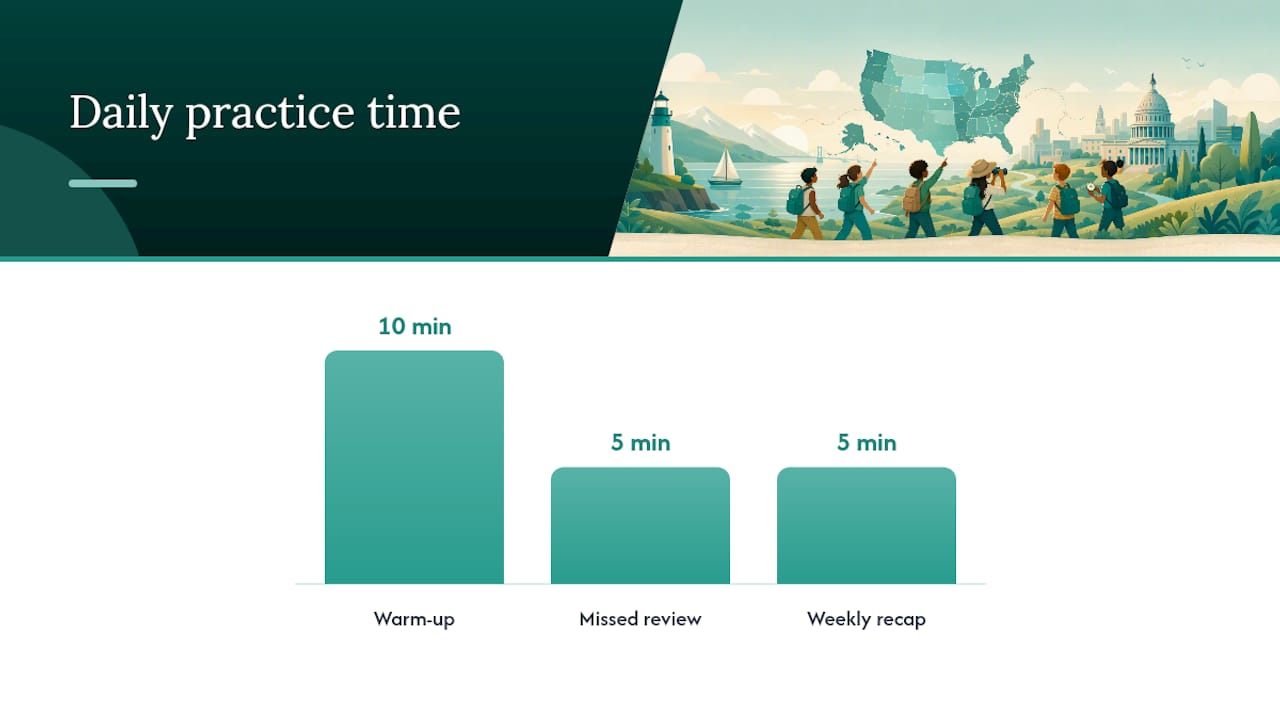
A simple daily routine works well: ten minutes warming up on known states, five minutes hammering the ones missed last time, then a five-minute recap once a week to check retention. For kids who are struggling or younger than seven, cut the region size in half and stick to multiple-choice quizzes before switching to open recall.
Printables, Maps, and Videos: Which Tool Fits Which Moment
Printables win when a child needs handwriting practice or when you’re running a classroom station that doesn’t have a screen. Interactive tools win for self-checking, on-demand quizzing, and independent practice once a child already has some capitals down.
Several resources cover both sides of that split:
- The FREE Map Skills for Kids taster is an instant-download pack with three short lessons and printable worksheets built for pairing state locations with their capitals, best suited for kindergarten through third grade.
- Cursive Capitals A–Z reinforces capital-letter handwriting, useful once a child is old enough to write state and capital names by hand as part of review, typically grades 2 through 4.
- Cursive Lowercase A–Z rounds out letter formation for younger learners still building the fine motor skills that make handwritten capital-name practice possible.
For extra reference, National Geographic Education offers reliable state facts and maps, and a dedicated states-and-capitals app gives kids independent, age-filtered quizzing between homework sessions.
Why Edhed Learning’s Approach Works for Real Classrooms
Bright, visual infographics and printable worksheets designed to make hands-on practice the default, not screen time as an afterthought. Many packs ship as instant digital downloads, so a teacher setting up a station or a parent prepping a Sunday review doesn’t wait on shipping.
Many parents, teachers, and therapists have used these resources, and the recurring theme in their feedback is simple: kids stop treating geography drills as homework and start treating them as a game they want to win.
Shaun, who leads Edhed Learning’s content development, built the states and capitals materials around the same principle that guides every Edhed pack: pair a visual hook with a hands-on task, and recall follows naturally.
What Actually Matters When Teaching This Topic
Most advice on this topic treats all 50 states as equally hard to learn, and that’s the mistake worth fixing first. A handful of capitals, Montpelier, Pierre, Dover, Bismarck, cause almost all the trouble, while the rest fall into place with basic repetition. Spend disproportionate time on the outliers instead of running every state through the same drill at the same pace.
The bigger gap is testing direction. Plenty of kids can rattle off “Sacramento” when you say “California,” then freeze completely when asked “What state has Sacramento?” That’s not mastery. It’s one-directional memorization dressed up as knowledge, and it falls apart the moment a test or quiz flips the question. Reverse-mode quizzing isn’t optional polish. It’s the actual test of whether the information stuck.
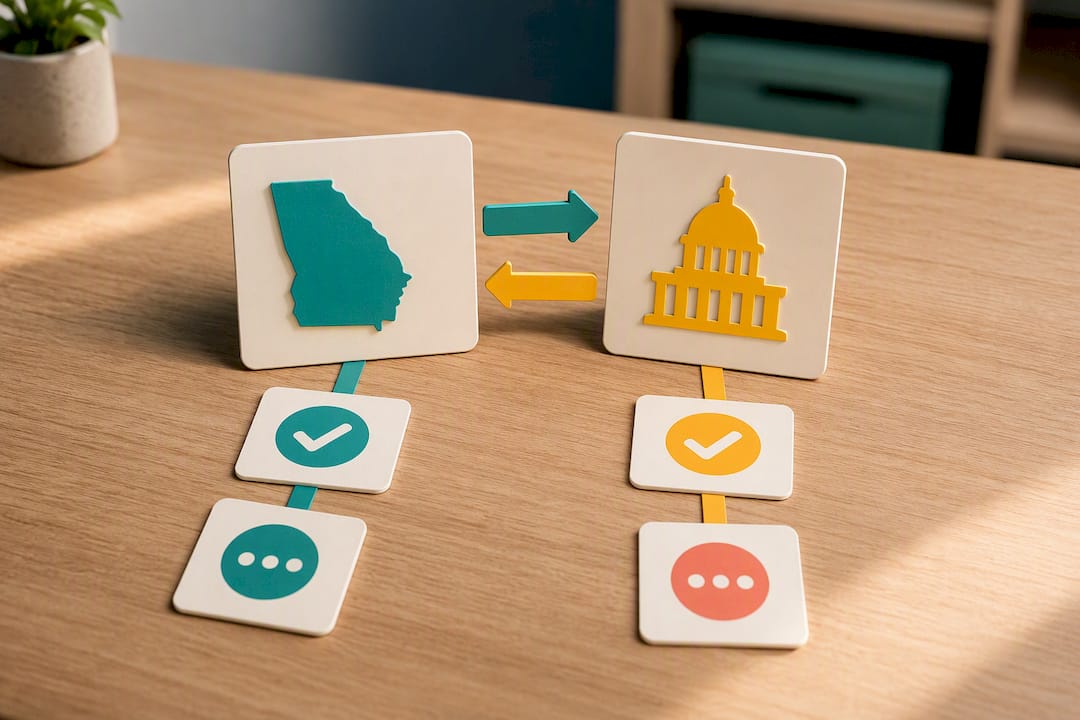
Regional grouping deserves more credit than it usually gets, too. Treating the Southeast as one unit of eight or nine states is far less intimidating than staring down a list of 50, and it mirrors how kids already organize other information, in clusters, not alphabetically.
Prioritize direction-flipped quizzing and small regional chunks before anything else on this list.
— Shaun
Start With the Free Taster Pack
If your child needs a low-pressure way to start, the free Map Skills for Kids taster is the easiest first move. It’s an instant download with three short lessons and printable worksheets built around the exact map-pairing and capital-recall activities covered above, no cost, no commitment, ready to print tonight.
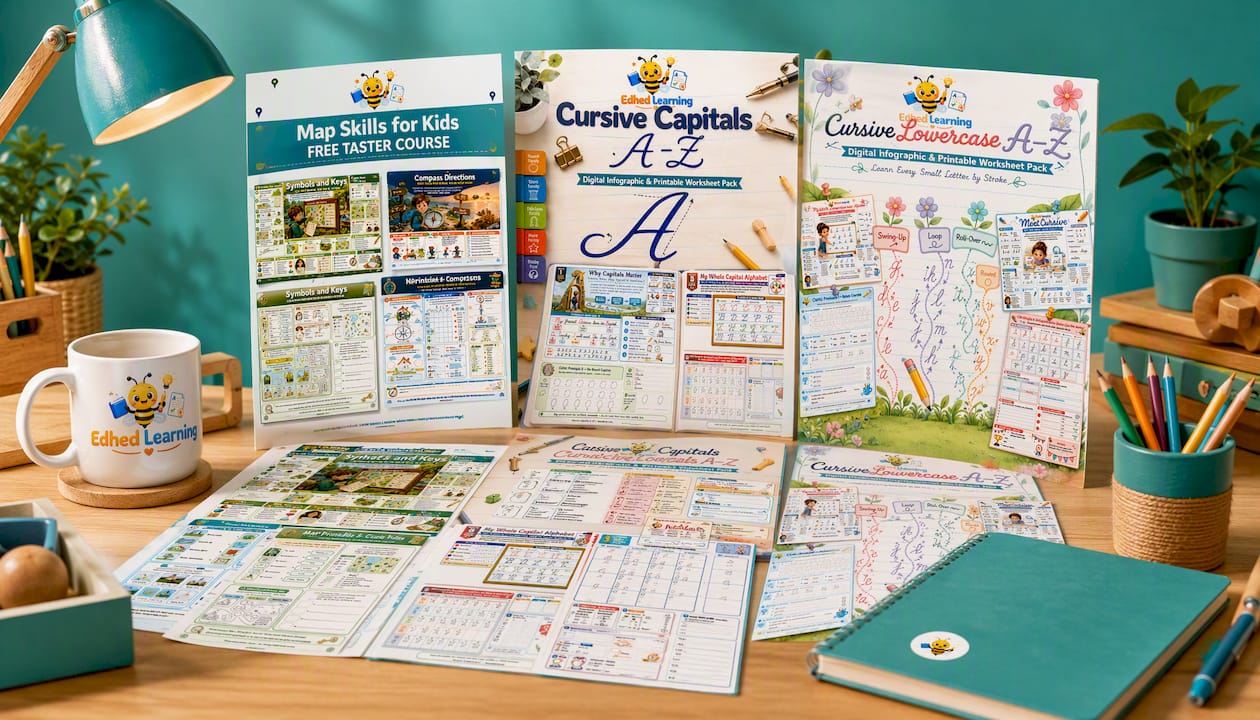
Once your child is comfortable pairing states with capitals, handwriting practice locks that knowledge in further. The Cursive Capitals A–Z pack has kids write out state and capital names by hand, which slows down recall just enough to make it stick, and the Cursive Lowercase A–Z pack builds the letter-formation foundation younger learners need before they tackle that kind of writing practice. Download the free taster today and see which lesson your child wants to try first.
Sources
- National Geographic Education
- U.S. State Capitals Quiz | Britannica
- Map of the United States: Interactive 50 States & Capitals Map | Free Tool
- US Capitals Quiz — Sporcle
FAQ
What are all 50 states and their capitals?
The full list runs alphabetically from Alabama (Montgomery) to Wyoming (Cheyenne), and you’ll find every state paired with its capital in the reference table above.
What grade do kids typically learn states and capitals?
Most curricula introduce states and capitals starting in third grade, with deeper map and geography work continuing through fifth grade and sometimes into middle school review.
What’s the fastest way to learn all 50 states for kids?
Break the states into five regional groups, master one region at a time, and practice for ten minutes daily rather than cramming, since region-based, spaced practice consistently outperforms one long study session.
How can I help my child stop confusing capitals with big cities?
Focus review time specifically on the “big-city trap” states, like New York (Albany), California (Sacramento), and Illinois (Springfield), where the largest city isn’t the capital, since quiz data shows these are the most commonly missed answers.
What’s a good first resource for teaching states and capitals at home?
The free Map Skills for Kids taster from Edhed Learning pairs three short lessons with printable worksheets and works well as a first step for kindergarten through third grade.


