

The quickest effective approach is this: pause for a few seconds, name what you’re feeling out loud or in your head, then pick a strategy that matches the moment. Use grounding or breathing when arousal is high, reappraisal when it’s low to moderate, and acceptance when the situation is outside your control. That one decision rule, timing, intensity, and controllability, does more work than any single technique on its own.
TL;DR:
- High arousal requires grounding or breathing techniques, while low to moderate intensity emotions are best managed through reappraisal or acceptance.
- Combining regulation strategies, such as pairing paced breathing with acceptance phrases, generally produces better results than using a single technique alone.
- Effective regulation depends on context variables like timing, intensity, and controllability, and following a three-step flow (pause, match, act) improves decision-making in real time.
- Practicing micro-skills such as noticing, naming, and focusing on physical cues builds long-term emotional regulation ability, especially when embedded in daily routines.
- Visual tools and repetition support children’s emotional vocabulary and regulation skills better than verbal instruction alone, especially in stressful or unpredictable situations.
Table of Contents
- What Is Emotion Regulation, and What Models Explain It?
- Research-Backed Strategies Grouped by Mechanism
- How Do You Choose the Right Strategy in the Moment?
- Micro-Skills and Practice Routines That Build Regulation Over Time
- Teaching Emotion Regulation to Kids: Visuals, Labeling, and Rehearsal
- What the Evidence Actually Shows, and Where It Runs Out
- The Long-Term Payoff of Practicing This Consistently
- Making Emotion Regulation Part of Your Actual Daily Routine
- Cultural Differences in Emotion Regulation Worth Knowing
- The Brain Science Behind Why These Strategies Work
- Why I Think Most Emotion Regulation Advice Misses the Point
- Start With the Free Course, Then Build From There
- Sources
What Is Emotion Regulation, and What Models Explain It?
Emotion regulation is the set of skills you use to influence which emotions you have, how intense they get, and how you express them. It’s not about suppressing feelings or forcing positivity. It’s about having enough flexibility to respond to a triggering moment instead of just reacting to it, which matters for everything from workplace conflict to a toddler’s tantrum.
The most widely used framework in this field comes from psychologist James Gross, often called the process model of emotion regulation. It breaks the emotional process into stages, situation, attention, appraisal, and response, and argues that you can intervene at any point along that chain. Strategies that step in early, before an emotion fully takes hold, are called antecedent-focused. Strategies that step in after the emotion has already surfaced are called response-focused. Harvard Health’s guide on self-regulation frames this same split in practical terms: reframing a situation before it upsets you versus managing the upset once it’s already there.
There’s a second distinction worth knowing, and it’s one most guides skip:
- Intrapersonal regulation is what you do inside your own head, like reappraising a stressful email before you reply.
- Interpersonal regulation involves another person, like a friend who talks you down after a bad meeting, or a parent who narrates a child’s feelings during a meltdown.
Both matter. A person who’s strong at solo reappraisal but never asks for support, or vice versa, tends to hit a ceiling. Most people default to whichever style fits their personality, but the research consistently favors flexibility over specialization.
Research-Backed Strategies Grouped by Mechanism
Not every strategy targets the same problem. Some strategies calm your body. Others change your thinking. Others change your behavior or bring in another person. Knowing which lever you’re pulling is what separates someone who has “a few coping tricks” from someone who can actually regulate on demand.
1. Attention regulation
This group works by redirecting where your mind is pointed, away from the trigger and toward something neutral or grounding.
- The 5-4-3-2-1 grounding drill: name five things you see, four you can touch, three you hear, two you smell, one you taste.
- Sensory anchors: a cold water splash, an ice cube held in the palm, or pressing feet flat on the floor.
- Brief distraction: a short walk, counting backward from 100 by sevens, or shifting focus to a simple task.
Distraction gets a bad reputation, but used briefly and deliberately, it buys time for arousal to drop before you try to think your way out of anything.
2. Arousal modulation
When your body is flooded, cognitive strategies won’t land yet. Evidence on emotion regulation and mental health supports addressing physiological arousal first, then moving to cognitive work once your nervous system has settled enough to think flexibly.
- Paced breathing: inhale for four counts, hold for four, exhale for six. The longer exhale is what slows your heart rate.
- Progressive muscle relaxation: tense and release each muscle group, starting at your feet and working up.
- Movement: a fast walk, stairs, or even shaking out your hands. Physical discharge lowers cortisol faster than sitting still and thinking about it.
3. Cognitive change
This is where reappraisal lives, and it’s the most studied strategy in the field.
- Reappraisal scripts: ask “what’s another way to see this?” or “what would I tell a friend in this exact situation?”
- Decatastrophizing prompts: “What’s the actual worst realistic outcome? What’s the most likely one?”
Reappraisal works best on low-to-moderate intensity emotions. Try to reappraise your way out of a panic attack and you’ll usually fail, because your prefrontal cortex isn’t fully online yet.
4. Acceptance and willingness
Sometimes the goal isn’t to change the emotion at all. It’s to stop fighting it.
- A short acceptance phrase: “This is a hard moment. Hard moments pass.”
- A self-compassion prompt: “Anyone would struggle with this. I don’t have to handle it perfectly.”
Acceptance-based strategies matter most when the trigger is genuinely uncontrollable, grief, a diagnosis, a decision already made by someone else.
5. Behavioral selection
Sometimes regulation means changing what you do next, not what you feel.
- Problem-solving: break the trigger into one solvable piece and act on that piece.
- Boundary-setting: leaving a conversation, ending a call, or saying no.
- Choosing the smallest workable action instead of the biggest possible one.
6. Relational regulation
Regulation doesn’t have to happen alone.
- Seeking soothing from a trusted person instead of white-knuckling it solo.
- Perspective-taking: asking someone else how the situation looks from outside your head.
- Social modeling: watching how a calm person handles a similar trigger and borrowing their approach.
Pro Tip: Combine at least two categories when the moment is intense. Pairing paced breathing with a brief acceptance phrase outperforms either one alone, because you’re calming the body and reframing the mind at the same time.
How Do You Choose the Right Strategy in the Moment?
Picking a strategy isn’t guesswork if you track three variables: timing, intensity, and controllability. Anxiety recommends exactly this kind of context matching over defaulting to one favorite technique.
Timing asks whether you’re acting before, during, or after the emotional spike. Before the event, antecedent strategies like reappraisal or planning work well. During a spike, you need fast physiological tools. After the fact, reflection and problem-solving take over.
Intensity asks how activated you currently are. Grounding and breathing are the right call at high intensity. Reappraisal and problem-solving fit low-to-moderate intensity, when you still have access to flexible thinking.
Controllability asks whether you can actually change the situation. If yes, lean toward problem-solving or boundary-setting. If no, acceptance-based strategies tend to outperform anything aimed at changing an outcome you don’t control.
A few rules of thumb make this easier to apply without overthinking it:
- High arousal, low control: ground first, accept second.
- Low arousal, high control: reappraise, then solve the problem directly.
- Uncertain or shifting situation: pause, name the feeling, then reassess after 60 seconds.
Here’s a three-step flow worth memorizing or printing near a desk or fridge: Pause (take one slow breath before reacting), Match (ask what intensity and controllability tell you to reach for), Act (apply the strategy, then check if the emotion has shifted enough to move on). If it hasn’t, layer a second strategy instead of abandoning the first.
Micro-Skills and Practice Routines That Build Regulation Over Time
Strategies only work if the underlying micro-skills are already there. Four are worth training on purpose.
Notice and name is the skill of catching a feeling early, before it becomes a full reaction. Labeling with specificity goes a step further: “frustrated” is useful, but “frustrated because I feel unheard” gives you something to actually work with. Interoception, the ability to sense internal body cues like a tight chest or clenched jaw, is often the earliest warning sign an emotion is building. Attention anchoring is the trained ability to redirect focus on command, the same muscle grounding techniques rely on.
None of these develop from reading about them. They develop from short, repeated practice.
- A 2 to 5 minute daily check-in: name one emotion and one body sensation, no analysis required.
- Pause-and-plan rehearsal: mentally walk through a known trigger (a difficult meeting, a sibling argument) and rehearse the response before it happens.
- Habit stacking: attach the practice to something you already do, like naming one feeling while your coffee brews.
Worksheets earn their reputation here because they turn a chaotic internal moment into a short, structured sequence of decisions. Structured worksheet exercises help separate the urge to react from the actual choice of how to respond, which is often the entire battle. A workable template includes these fields:
| Field | What to record |
|---|---|
| Event | What happened, in one sentence |
| Body cues | Where you felt it physically |
| Feeling | The specific emotion, not just “bad” or “fine” |
| Story | What you told yourself about the event |
| Urge | What you felt like doing |
| Capacity | How much control you actually had over the situation |
| Response | What you chose to do instead |
Fill it out after the fact at first. Once the sequence feels familiar, you can run through it mentally in real time, which is the whole point.
Teaching Emotion Regulation to Kids: Visuals, Labeling, and Rehearsal
Children regulate differently than adults, mostly because their prefrontal cortex is still under construction. That means visuals and repetition do more work than explanation ever will.
Label emotions out loud, in real time. When a child is melting down, naming it for them (“You’re frustrated because the tower fell”) does more than asking them to calm down. Adult labeling and modeling directly build a child’s emotional vocabulary and support their own emotional literacy, which is the foundation every later regulation skill sits on.
Use visuals instead of relying on words alone. Emotion wheels, stoplight visuals (“red means stop and breathe”), and flipbooks give kids something concrete to point at when they don’t have the words yet. Visual supports paired with behavior skills training are considered effective for teaching regulation to children, including those on the autism spectrum, and they generalize better across settings than verbal instruction alone.
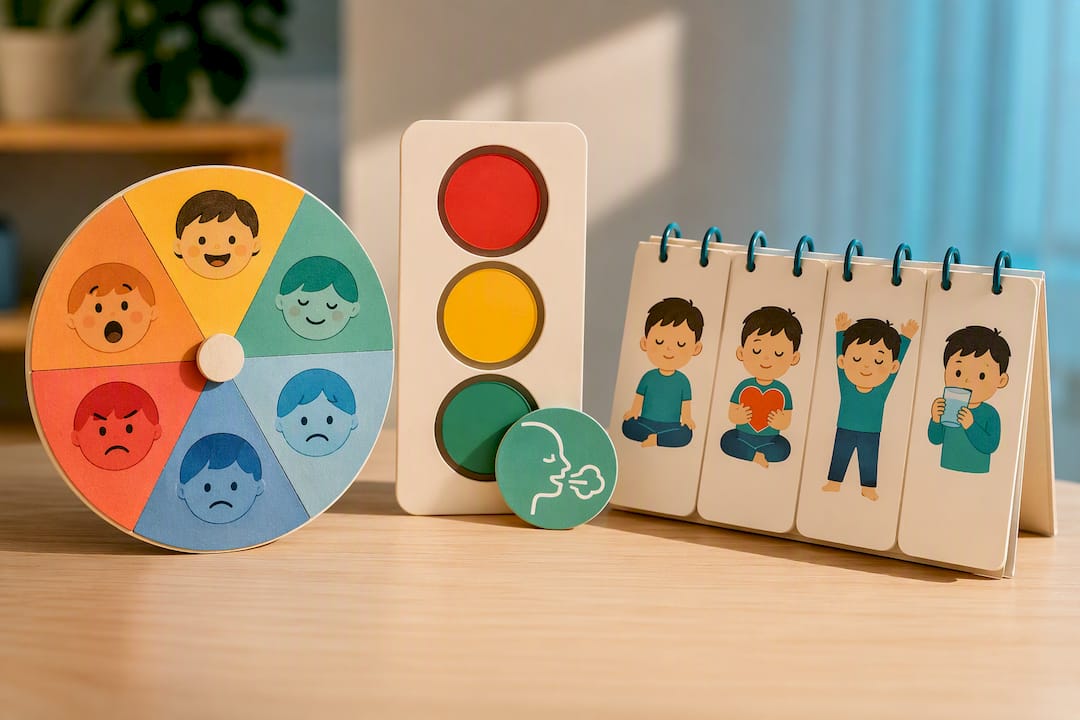
Practice when calm, never mid-meltdown. Rehearsing a calm-down routine during a tantrum is like trying to teach swimming in a rip current. Teach it at breakfast, during a car ride, anywhere the child is relaxed enough to absorb it. Tie the rehearsal to an existing daily transition, like right before school or right after recess, so the skill becomes linked to a real-life cue instead of floating unattached in memory.
Reinforce effort with small, specific praise. “I saw you take a breath instead of yelling, that’s exactly the skill” lands better than generic praise, because it names the exact behavior worth repeating.
Different children need different entry points. Edhed Learning’s free three-lesson taster course works well as a first introduction to labeling and visuals. Sensory-sensitive or ADHD-affected kids often need a more targeted neurodivergent-focused worksheet bundle built around sensory cues rather than pure verbal reasoning. And for classrooms already working on comprehension skills, a reading-focused strategies toolkit can fold regulation practice directly into existing lesson routines instead of adding a separate block of time. For families managing frequent meltdowns specifically, a calm-down and regulation resource built around visual pause routines tends to get used more consistently than a purely verbal script. Related discussion of boundaries and adult modeling in early childhood, covered by Baby Bare Essentials, reinforces the same core idea: kids absorb regulation skills largely by watching the adults around them practice it first.
What the Evidence Actually Shows, and Where It Runs Out
Reappraisal, acceptance, and DBT-style skills training all have real support behind them. A 2024 review of emotion regulation and mental health found that ER-focused interventions produce meaningful effects across several psychiatric conditions, and that improvement in regulation skills specifically is what drives symptom reduction, not just general therapy engagement. That’s a transdiagnostic finding: the same skill set helps across depression, anxiety, and other conditions, rather than being narrowly specific to one diagnosis.
But the evidence comes with real limits worth naming honestly:
- No strategy is universally adaptive. A comprehensive analysis of adaptive versus maladaptive regulation found that even reappraisal, generally considered one of the healthiest strategies, becomes counterproductive when used rigidly regardless of context.
- Strategy combinations tend to outperform any single technique used in isolation, which is part of why acceptance paired with breathing works better than either alone.
- Some strategies produce a brief uptick in distress before they help, particularly acceptance-based approaches, which can feel discouraging if you expect instant relief.
Self-guided practice has a ceiling. If dysregulation is frequent and severe, involves self-harm, or leans on substances to manage feelings, that’s the point to bring in a licensed therapist rather than continuing to troubleshoot alone. Worksheets and grounding drills are genuinely useful tools, not substitutes for clinical support when the pattern is that serious.
The Long-Term Payoff of Practicing This Consistently
People who practice regulation strategies consistently, not just when things fall apart, tend to see benefits that compound over months rather than showing up overnight. The mechanism is fairly simple: every successful regulation attempt reinforces a slightly faster, slightly less effortful version of the same skill next time.
Over time, consistent practice tends to correlate with lower baseline anxiety, because the nervous system spends less time in prolonged high-alert states. It also tends to support steadier relationships, since fewer interactions escalate before either person has a chance to think clearly. Chronic stress exposure has real physical costs, and better regulation reduces how often the body sits in that stress response in the first place.
There’s also a compounding effect specific to kids: children who practice regulation early tend to carry stronger self-management skills into adolescence, when the stakes and the triggers both get considerably bigger. The skill doesn’t disappear once the immediate crisis passes. It becomes part of how a person, or a child, automatically meets the next hard moment.
None of this requires perfection. It requires repetition, which is exactly why short daily practices tend to beat occasional, intense self-improvement pushes.
Making Emotion Regulation Part of Your Actual Daily Routine
The strategies in this article only help if they show up outside of a crisis. Building them into existing routines, rather than treating them as a separate task, is what makes that happen.
Attach a short check-in to something that already occurs daily: naming one feeling during a morning commute, or doing a 30-second breathing reset before a recurring meeting that tends to run hot. Predictable friction points, like a nightly homework battle or a Sunday-evening dread, are ideal spots to pre-load a strategy, because you already know they’re coming.
Families benefit from a shared vocabulary. When everyone in a household uses the same emotion words and the same calm-down steps, kids adopt the routine faster because they’re seeing it modeled, not just instructed. The same applies in a classroom: a visual posted in one consistent spot works better than a strategy explained once and never repeated.
Keep the bar low on bad days. A single slow breath before responding to a frustrating text still counts. The goal isn’t a flawless emotional performance every day. It’s a slightly better average response, repeated often enough that it becomes closer to automatic than deliberate.
Cultural Differences in Emotion Regulation Worth Knowing
Not every culture defines “regulated” the same way, and that shapes which strategies actually land. Some cultural contexts emphasize emotional restraint and group harmony, where visible emotional expression is seen as disruptive. Others place higher value on open expression as a sign of authenticity and connection.
This matters practically. A strategy built around expressing feelings assertively might work well in a context that rewards direct communication, and land poorly in a context where indirect, relationship-preserving communication is the norm. Suppression, often flagged as a weaker long-term strategy in Western research, can function differently in collectivist settings where it also serves a genuine social purpose rather than pure avoidance.
The practical takeaway isn’t to discard any one strategy. It’s to notice that “the right strategy” is partly shaped by the environment a person is regulating within, not just their individual psychology. A technique that works beautifully for one family, classroom, or workplace culture may need adjusting, not abandoning, in another. Flexibility, the same trait that matters for choosing between grounding and reappraisal, also applies to reading the room a strategy is being used in.
The Brain Science Behind Why These Strategies Work
Emotion regulation isn’t just a mental habit. It reflects a real, measurable relationship between two brain systems: the amygdala, which drives fast emotional reactivity, and the prefrontal cortex, which handles planning, reappraisal, and impulse control.
When arousal spikes, the amygdala effectively takes over, and the prefrontal cortex’s ability to reason clearly drops. That’s the actual biological reason grounding and breathing come before reappraisal on the decision framework covered earlier: physiological calming techniques help bring the prefrontal cortex back online before you ask it to do complex cognitive work like reframing a situation.
Repeated practice appears to strengthen the connection between these two regions over time, which is part of why consistent practice pays off more than occasional effort. Each successful regulation attempt is, in a sense, light exercise for that prefrontal-amygdala pathway. This is also why regulation skills learned young tend to stick: younger brains have more plasticity, making early rehearsal, especially the kind built into calm moments rather than crisis moments, particularly effective at building durable neural patterns.
Why I Think Most Emotion Regulation Advice Misses the Point
Most regulation advice treats every strategy as a fix for every feeling, and that’s exactly backward. The research is clear that context, timing, intensity, controllability, matters more than which technique you pick. That’s the gap Edhed Learning’s worksheets are built to close: visual, interactive materials that teach kids and the adults supporting them to match the tool to the moment, not memorize one script and apply it everywhere.
What convinces me this approach holds up is scale: over 10,000 parents, teachers, and therapists have used these resources, which suggests the visual-plus-practice method generalizes well beyond any single classroom or home.
If you’re starting from zero, don’t try to overhaul your whole routine. Pick one daily transition, right after school, right before dinner, and attach a single regulation ritual to it. Consistency in one spot beats ambition spread across ten.
— Shaun
Start With the Free Course, Then Build From There
If you’ve read this far, you already know that regulation skills stick better with visuals and repeated practice than with a one-time conversation about feelings. That’s exactly the gap Edhed Learning’s printable worksheets are built to close, giving parents, teachers, and therapists a concrete, ready-made tool instead of having to build labeling charts and calm-down scripts from scratch.
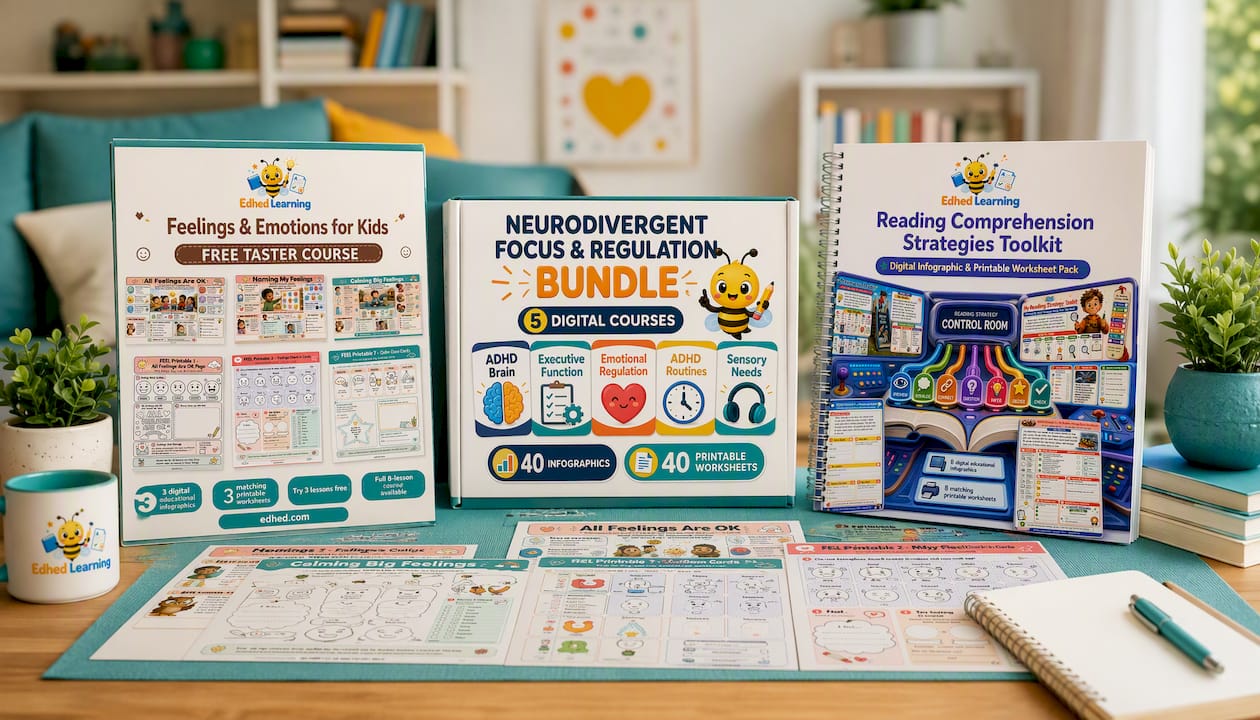
Start with the free three-lesson taster course, which walks through labeling and visual grounding using the exact stoplight-and-emotion-wheel approach covered above. If a child in your care struggles specifically with sensory overload or ADHD-related dysregulation, the neurodivergent focus and regulation bundle gives you sensory-aware worksheets built for that exact profile instead of a generic one-size-fits-all sheet. Working on comprehension skills at the same time? The reading comprehension strategies toolkit folds regulation practice directly into reading routines so you’re not running two separate programs. Every resource downloads instantly, so you can have a printed worksheet in hand before the next difficult moment arrives.
Sources
- Self-regulation for adults: Strategies for getting a handle on emotions and behavior — Harvard Health
- Emotion regulation and mental health: current evidence and beyond — PMC (2024)
- Anxiety
- Teaching emotion regulation — Association for Science in Autism Treatment (ASAT) (2024)


