

A fraction converts to a decimal by dividing the numerator by the denominator, and a decimal converts to a fraction by writing its digits over the matching power of 10 and simplifying. Repeating decimals show up when a fraction’s denominator has prime factors other than 2 or 5. Master those three rules, and every conversion problem you meet becomes a matter of following steps you already know.
TL;DR:
- Converting fractions with denominators that have prime factors other than 2 or 5 results in repeating decimals, often requiring bar notation.
- Repeating decimals can be converted to fractions using algebra, by multiplying and subtracting the original equation to isolate the repeating part.
- Memorizing common fraction-to-decimal pairs like 1/2, 1/4, and 3/4 speeds up calculations and reduces reliance on long division.
- Rounding repeating decimals depends on the problem’s instructions, with exact bar notation preferred unless specified otherwise.
Table of Contents
- How Do You Convert a Fraction to a Decimal?
- How Do You Convert a Decimal to a Fraction?
- Why Do Some Decimals Repeat Forever?
- Common Fraction and Decimal Equivalents to Memorize
- Practice Problems: Test Your Conversion Skills
- Tips and Shortcuts for Faster Conversions
- Why Edhed Learning Teaches Fractions and Decimals Visually
- Which Worksheet Pack Fits Your Practice Needs
- Sources
How Do You Convert a Fraction to a Decimal?
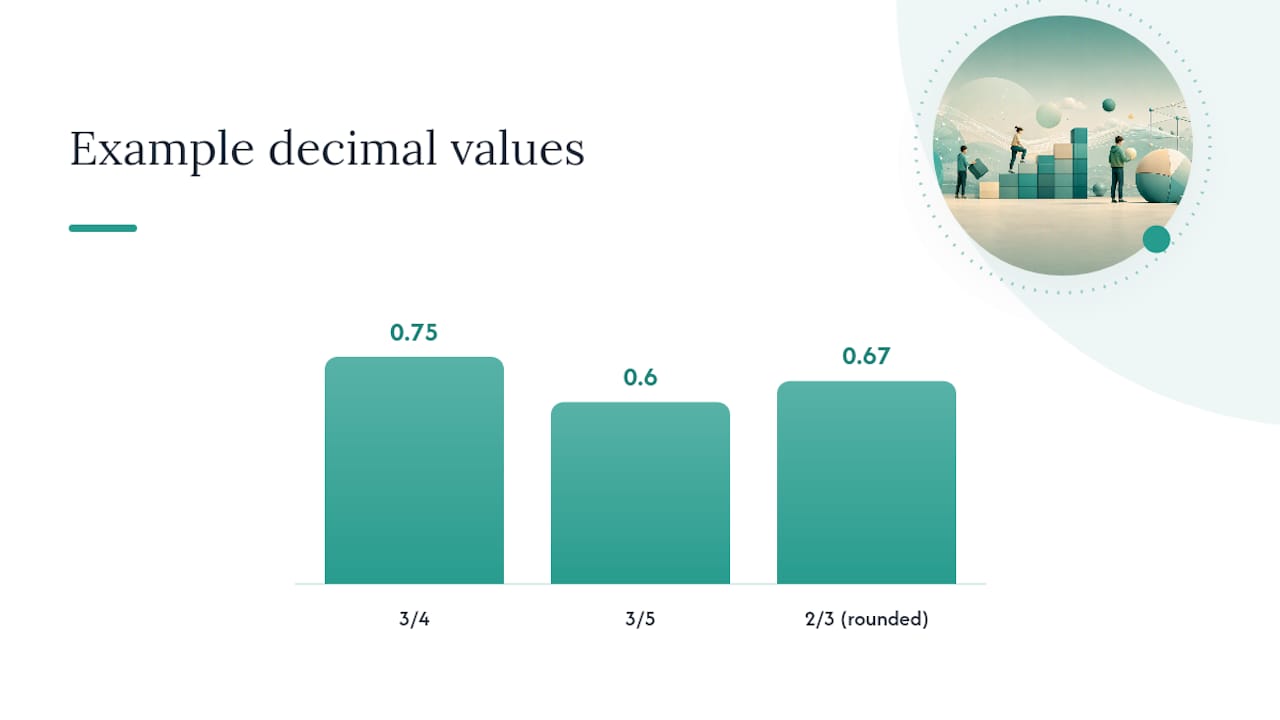
A fraction is really just a division problem wearing a disguise. The line between the numerator and denominator means “divide,” so 3/4 becomes 3 ÷ 4, which equals 0.75. You have three ways to get there, and picking the right one saves time on tests.
- Long division. Divide the numerator by the denominator directly. For 3/4: 3 ÷ 4 doesn’t go evenly, so you add a decimal point and a zero, making it 30 ÷ 4 = 7 with a remainder of 2. Bring down another zero, divide 20 ÷ 4 = 5. Result: 0.75.
- Denominator expansion. If the denominator multiplies cleanly into 10, 100, or 1,000, skip the division entirely. For 3/5, multiply top and bottom by 2 to get 6/10, which is 0.6.
- Simplify first, then divide. A fraction like 20/24 reduces to 5/6 once you divide both numbers by their greatest common factor. Dividing 5 by 6 is easier than wrestling with 20 by 24, and it lowers your risk of a careless mistake partway through.
A calculator is fine once you’ve shown you can do the division by hand. Teachers generally want to see the method on homework and quizzes, but for quick checks or larger numbers, punching it into a calculator is a smart use of your time.
When the division never ends, like 2 ÷ 3, you have two choices: write it with a bar over the repeating digits (0.6 with a bar over the 6) or round it to a set number of places. Which one you use usually depends on what the problem asks for. Some worksheets want the exact repeating form; others are happy with 0.67 rounded to the hundredths place.
How Do You Convert a Decimal to a Fraction?
Every decimal is a fraction already, just written differently. The trick is figuring out which power of 10 belongs underneath it.
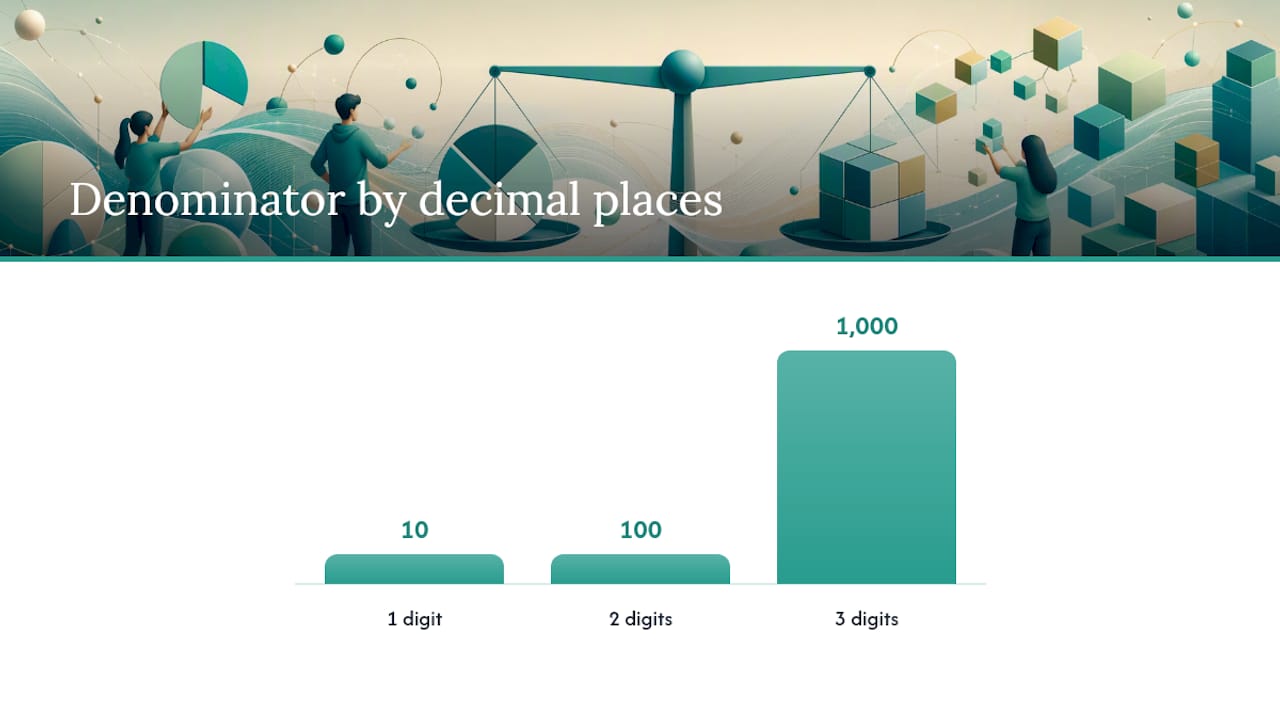
- Count the digits after the decimal point. One digit means the denominator is 10. Two digits means 100. Three means 1,000.
- Write those digits as the numerator, then place them over that denominator.
- Simplify the fraction by dividing numerator and denominator by their greatest common factor.
For example, 0.75 has two digits after the decimal point, so it becomes 75/100. Simplify the fraction by dividing numerator and denominator by their greatest common factor to get 3/4.
Decimals with a whole number attached work the same way, just in two pieces. For 2.75, keep the 2 as a whole number and convert only the .75 part to 75/100, then simplify to 3/4. The final answer is 2 and 3/4, or as an improper fraction, 11/4.
Watch for trailing zeros. A decimal like 0.50 has two digits, so it’s technically 50/100, but it simplifies down to 1/2 just as easily as 0.5 would. Don’t let the extra zero trick you into thinking the value is different.
Why Do Some Decimals Repeat Forever?
Whether a decimal terminates or repeats depends entirely on the denominator of the simplified fraction. If that denominator’s only prime factors are 2 and 5, the decimal terminates, because decimal place values are built on powers of 10, and 10 factors into 2 and 5. Any other prime factor, like 3 or 7, guarantees a repeating pattern.
Bar notation handles the repeat cleanly: 1/3 becomes 0.3 with a bar over the 3, meaning the 3 goes on forever.
Recovering the exact fraction from a repeating decimal takes a bit of algebra:
- Let x equal the repeating decimal (x = 0.6, bar over the 6).
- Multiply both sides by 10 to shift the decimal: 10x = 6.6, bar over the 6.
- Subtract the original equation from this one: 10x − x = 6.6… − 0.6…, which gives 9x = 6.
- Divide: x = 6/9, which simplifies to 2/3.
Pro Tip: For a repeating block with more than one digit, put the repeating digits over a matching number of 9s. A two-digit repeat like 0.45 (bar over both digits) becomes 45/99, which simplifies to 5/11.
On most tests, leave repeating decimals in bar form unless the instructions specifically ask you to round.
Common Fraction and Decimal Equivalents to Memorize
Certain fractions show up so often in schoolwork that memorizing their decimal form beats recalculating them every time.
| Fraction | Decimal |
|---|---|
| 1/2 | 0.5 |
| 1/3 | 0.3 (repeating) |
| 2/3 | 0.6 (repeating) |
| 1/4 | 0.25 |
| 3/4 | 0.75 |
| 1/5 | 0.6 |
| 1/8 | 0.125 |
| 3/8 | 0.625 |
| 5/8 | 0.625 |
| 7/8 | 0.75 |
| 1/10 | 0.6, bar over the 6 |
These pairs, sometimes called the big eight fraction-decimal equivalents, cover most of what shows up on quizzes. A quick memory cue: quarters move in steps of 0.25, and eighths move in steps of 0.125.
Practice Problems: Test Your Conversion Skills
Work through these on your own before checking the solutions. Cover the answers with your hand first.
- Convert 5/8 to a decimal. Divide 5 by 8: 5 ÷ 8 = 0.625.
- Convert 2/3 to a decimal. Divide 2 by 3: 2 ÷ 3 = 0.6, bar over the 6 (repeating).
- Convert 0.6 to a fraction. One digit after the point means the denominator is 10: 6/10, which simplifies to 3/5.
- Convert 3.4 to a fraction. Keep the whole number 3, convert .4 to 4/10, simplify to 2/5. Final answer: 3 and 2/5.
Notice that problem 2 didn’t resolve into a clean number, which is exactly the point. Recognizing a repeating case before you start dividing saves you from erasing a page of work.
Once these feel comfortable, time yourself: five problems, five minutes. Speed on conversions comes from repetition, not memorization alone, and a timed set forces you to trust the steps instead of second-guessing every line.
Tips and Shortcuts for Faster Conversions
- Learn the big eight equivalents cold. That alone eliminates most of the long division you’d otherwise need.
- Simplify before you divide. Smaller numbers mean fewer steps and fewer chances for arithmetic slips.
- Check the denominator’s prime factors before you start. Only 2s and 5s mean the decimal terminates.
- Decide up front whether the problem wants bar notation or a rounded answer, and match your final line to that expectation.
Pro Tip: If you’re unsure how many decimal places to round to, look at the problem’s other numbers. Matching the given precision usually keeps your answer in line with what’s expected.
Why Edhed Learning Teaches Fractions and Decimals Visually
Numbers on a page rarely stick the first time a child sees them. That’s why Edhed Learning builds fraction and decimal lessons around visuals kids can point to, not just rules they’re told to memorize. Many parents, teachers, and therapists have used this hands-on approach to help children move past confusion and into confidence.
If a child needs the concept broken down even further before tackling conversions, the visual guide to teaching fractions walks through the same ideas with pictures and hands-on activities. Pair it with the Fractions for Kids worksheet pack for printable practice that reinforces every rule covered here.
— Shaun
Which Worksheet Pack Fits Your Practice Needs
Reading through the steps above gets you halfway there. The other half is repetition, and that’s where a printed set of problems with an answer key you can check yourself makes the difference between “I think I understand” and “I know I’ve got this.”
If your child is just starting to connect fractions with decimals, the 4th grade math worksheet pack covers the foundational conversions with printable problems, a full answer key, and visual infographics that match the step-by-step methods in this guide. Once the basics click and a learner is ready for mixed numbers, longer repeating decimals, and faster fluency drills, the 5th grade math worksheet pack picks up right where the 4th grade set leaves off. Both packs land as instant digital downloads, ready to print for the kitchen table or a classroom desk. Pick the pack that matches where your learner is right now, and start the next practice session with problems built for exactly this skill.
Sources
- Converting fractions and decimals — MathWords
- Fraction to decimal calculator — Symbolab
- 5.3 Decimals and fractions — OpenStax Prealgebra
- Fraction to decimal conversion table — RapidTables


