

A writing graphic organizer is a visual tool that turns scattered ideas into a clear plan for a story, essay, or paragraph. It works by giving students a structure to fill in before they draft, so the blank page stops feeling like a wall. You’ll find grade-ready templates below, plus specific ways to adapt them for kids with dysgraphia, ADHD, or executive-functioning challenges.
TL;DR:
- Most graphic organizers are best used as planning tools for drafting and revision rather than as standalone assignments to prevent students from stagnating after completion.
- Selecting the right organizer depends on the writing type, such as story maps for narratives or Venn diagrams for compare and contrast, to match the task’s structure.
- Adapting organizers with larger boxes, icons, sentence starters, and micro-tasks helps students with dysgraphia, ADHD, or executive-function challenges better manage the planning process.
- Teachers should model transforming organizer boxes into sentences and emphasize the conversion step to develop students’ independent writing skills.
- Ready-made templates from sources like Edhed Learning, HMH, and Canva simplify customization, enabling quick use across multiple grade levels and writing assignments.
Table of Contents
- What Is a Writing Graphic Organizer, and When Do You Use One?
- Which Organizer Fits Which Type of Writing?
- How to Choose, Create, and Use a Graphic Organizer
- Adapting Organizers for Dysgraphia, ADHD, and Executive-Functioning Challenges
- Where to Find and Customize Printable Templates
- Who’s Behind This Guide
- The Real Value of Graphic Organizers (and Where Teachers Overuse Them)
- Ready-Made Organizers for Grades 1 Through 5
- Sources
- FAQ
What Is a Writing Graphic Organizer, and When Do You Use One?
A writing graphic organizer gives a student’s thinking a shape before it becomes sentences. Instead of staring at a blank page, the student fills boxes, bubbles, or a chart, and the structure of that layout mirrors the structure the final piece needs. That’s the whole mechanism: writing feels hard partly because a writer has to plan and compose at the same time, and an organizer lets a student separate those two jobs.
You’ll get the most out of an organizer if you match it to the right stage of the writing process:
- Brainstorming — mind maps and idea webs pull loose thoughts onto paper before any sentence gets written.
- Organizing — sequence charts, story maps, and outlines sort those loose thoughts into an order.
- Drafting — the organizer becomes a scaffold; each box or section turns into a sentence or paragraph.
- Revising — students return to the organizer to check whether the draft still matches the plan, and add or cut boxes as needed.
Common organizer names worth knowing: the story map, the persuasion map, the sequence chart, the Venn diagram, the T-chart, and the RACE or Hamburger paragraph organizer. Each one is built for a specific kind of writing, which is exactly what the next section breaks down. Reading Rockets notes that these visual frameworks are especially helpful for students with dysgraphia and executive-functioning challenges, since they make the invisible steps of writing visible and concrete.
Which Organizer Fits Which Type of Writing?
Picking the right template starts with one question: what is the student actually trying to write? Story, opinion, informational report, and comparison pieces each call for a different shape.
Story and narrative writing relies on sequence. A story map breaks a narrative into setting, characters, problem, events, and resolution, which works well for grades 1 through 4. A sequence chart (first, next, then, last) fits younger writers who need a simpler beginning, middle, and end structure before they’re ready for a full story map.
Opinion and persuasive writing needs a claim backed by reasons. A persuasion map walks a student from their opinion to three supporting reasons to a conclusion. The RACE organizer (Restate, Answer, Cite evidence, Explain) and the closely related Hamburger paragraph organizer do similar work for short-response writing: the top bun is the topic sentence, the middle layers are evidence and explanation, and the bottom bun wraps it up.
Informational and research writing usually starts messier, so it benefits from a mind map or concept map that lets students cluster facts around a central topic before sorting them into paragraphs. A five-paragraph outline organizer works once the research is gathered and it’s time to sequence intro, three body paragraphs, and a conclusion.
Compare/contrast and analytical writing needs organizers built for relationships between ideas. A Venn diagram shows overlap and difference between two subjects. A T-chart does the same job in a simpler two-column format. A cause-and-effect chart maps how one event leads to another, which is useful for both narrative analysis and science writing.
Quick classroom uses that take 5 to 15 minutes:
- Fill a T-chart comparing two characters right after a read-aloud.
- Sketch a five-box sequence chart for a personal narrative before writing time.
- Build a persuasion map as a warm-up for a debate topic.
- Use a Venn diagram to compare two nonfiction texts on the same subject.
These groupings echo how HMH organizes its free templates, by purpose rather than by grade, which makes it easier to grab the right tool fast instead of hunting through a folder of similar-looking worksheets.
How to Choose, Create, and Use a Graphic Organizer
Before you print anything, run through a short decision checklist: What’s the writing goal? How old is the student, and how much writing stamina do they have? How much space will they need to write legibly? Does the task call for a simple two-column layout or something more layered, like a five-paragraph outline? And finally, paper or digital?
Once you’ve answered those, the process itself follows a clear sequence:
- Pick the purpose — narrative, persuasive, informational, or comparative.
- Choose the layout that matches it (story map, persuasion map, Venn, and so on).
- Label the boxes in plain language a student can act on (“What happens first?” rather than “Introduction”).
- Model it once in front of the class or your child before asking them to fill one out solo.
- Convert it to an outline, reading each box aloud as if it were already a sentence.
That last step is where organizers earn their keep. Teach the mapping explicitly: box one becomes the topic sentence, the middle boxes become supporting sentences, and the final box becomes the conclusion. Sentence starters like “One reason is…” or “This shows that…” help a student bridge from a fragment in a box to a full sentence on the page.
A workable classroom routine, drawn from common practice: model a five-minute fill-in on the board, have students pair-share their maps to compare thinking, then give them 10 to 15 minutes to draft independently straight from the organizer. Edutopia’s guidance on graphic organizers makes a point worth repeating: the biggest mistake is treating the organizer as a one-time planning worksheet instead of a tool students return to during drafting and revision.
Pro Tip: Keep a stack of blank organizers in a classroom folder or on the fridge at home. When a student gets stuck mid-draft, a fresh organizer for just the paragraph they’re stuck on often unlocks more progress than re-reading the whole assignment prompt.
Adapting Organizers for Dysgraphia, ADHD, and Executive-Functioning Challenges
Writing asks a student to hold a lot in their head at once: spelling, handwriting, grammar, and ideas, all simultaneously. A graphic organizer reduces that load by externalizing the organizational part, so a student with dysgraphia or executive-functioning difficulty only has to manage one piece at a time. Reading Rockets frames this directly: these tools are built to support students who struggle with the planning and sequencing demands of writing, not just students who are behind on content knowledge.
A few adaptations make a real difference without requiring a redesign of the whole worksheet:
- Enlarge the boxes. A student with dysgraphia needs more physical space per idea, even if that means one organizer per page instead of four.
- Add icons and light color coding to mark each section, but keep it minimal. The IRIS Center’s training materials warn that over-decorating an organizer adds visual noise that competes with the thinking it’s supposed to support.
- Build in sentence starters for students who freeze when a box is blank.
- Break steps into single micro-tasks — one box per skill, such as “name the character” separate from “describe the character,” so ADHD students can check off progress instead of facing one large, vague box.
For a persuasion map, that might mean turning “Reason 1” into “Reason 1: because ___,” with an icon marking it as evidence. For a sequence chart, it might mean four separate pages instead of four boxes on one page, each with a single sentence starter underneath.
Digital fillable versions work well for students who type more easily than they write by hand, while a quick hand-drawn organizer is often faster and less intimidating for younger children who get overwhelmed by a polished printable. Match the format to the kid, not the other way around.

Where to Find and Customize Printable Templates
Free organizer collections cover most classroom needs, and paid bundles earn their price when they add sequencing across a full grade level or bundle multiple organizer types with matching worksheets. HMH’s free template library groups organizers by purpose, which is faster to browse than a generic search. For editable versions you can tweak on the fly, Canva’s graphic organizer templates let you resize boxes, swap fonts for younger readers, and even run a shared whiteboard version for group brainstorming.
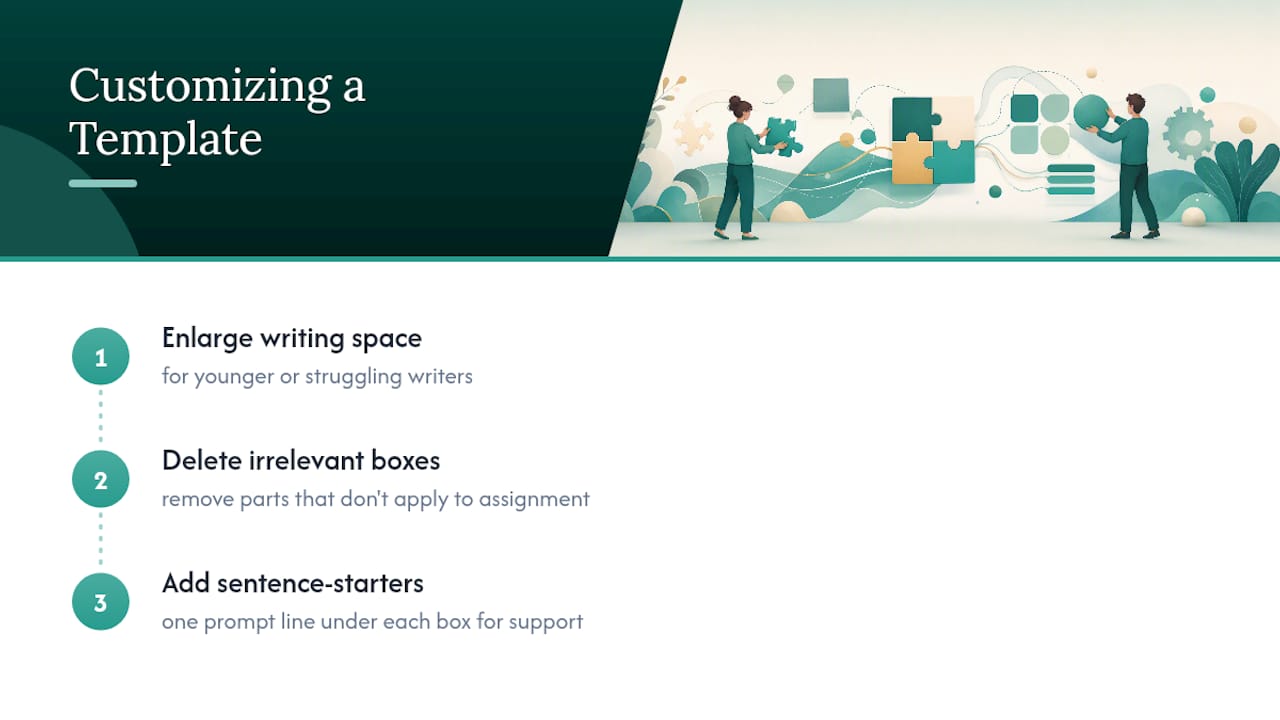
Customizing a template usually takes three moves: enlarge the writing space for younger or struggling writers, delete boxes that don’t apply to this specific assignment, and add a sentence-starter line under each box for students who need the extra prompt.
On printing: single-page organizers work fine for a quick warm-up, but multi-step writing pieces do better as a small packet, one organizer per stage. Laminating a story map or T-chart and pairing it with a dry-erase marker turns a one-time printable into a reusable station tool, which saves paper across a whole school year.
For story-specific planning, a dedicated story writing course with printable worksheets gives young writers a sequence already built around beginning, middle, and end, so there’s less setup before drafting starts.
Who’s Behind This Guide
This guide was written by Shaun, an educational content creator at Edhed Learning. Edhed Learning builds infographic-based courses and printable worksheet packs that turn tricky school concepts, math, science, English, geography, social-emotional learning, into visual, hands-on resources for home, classroom, and therapy use.
A few things worth knowing about how Edhed Learning approaches this work:
- Resources combine visual and interactive learning rather than plain text worksheets.
- The catalog has received positive feedback from parents, teachers, and therapists.
- Every pack is a digital download, available for immediate printing after purchase.
Kids don’t struggle with writing because they lack ideas. They struggle because nobody showed them where to put the ideas first. A good organizer is that “where.”
That belief shapes every organizer template in this guide, and it’s why the recommended worksheets below lean on visual structure instead of blank lines.
The Real Value of Graphic Organizers (and Where Teachers Overuse Them)
The research on graphic organizers is pretty clear: they work best as a bridge to drafting, not as an assignment in themselves. That’s where a lot of well-meaning instruction goes sideways. A teacher hands out a beautifully designed story map, students fill it in carefully, and then it gets stapled to the final essay and forgotten. The organizer did its job as a thinking tool, but nobody taught the next step: turning boxes into sentences.
I’d push back on one piece of conventional advice, too: more detailed organizers aren’t automatically better organizers. A five-paragraph outline with fifteen labeled sections looks thorough, but for a second grader, three big boxes with a sentence starter in each will produce more actual writing. Complexity should scale up with the student’s stamina, not with how impressive the worksheet looks pinned to a bulletin board.
If you take one thing from this guide, prioritize the conversion step. Model out loud how a box becomes a sentence, every single time, until students can do it without you. That’s the skill that actually transfers, long after the specific organizer is forgotten.
— Shaun
Ready-Made Organizers for Grades 1 Through 5
If you’d rather skip building organizers from scratch, Edhed Learning’s creative writing worksheets come with the planning templates already built into each lesson. The Grade 1 Creative Writing Worksheets pack uses simple, big-box organizers designed for early writers who need short sequence charts and picture-supported prompts rather than dense outlines.
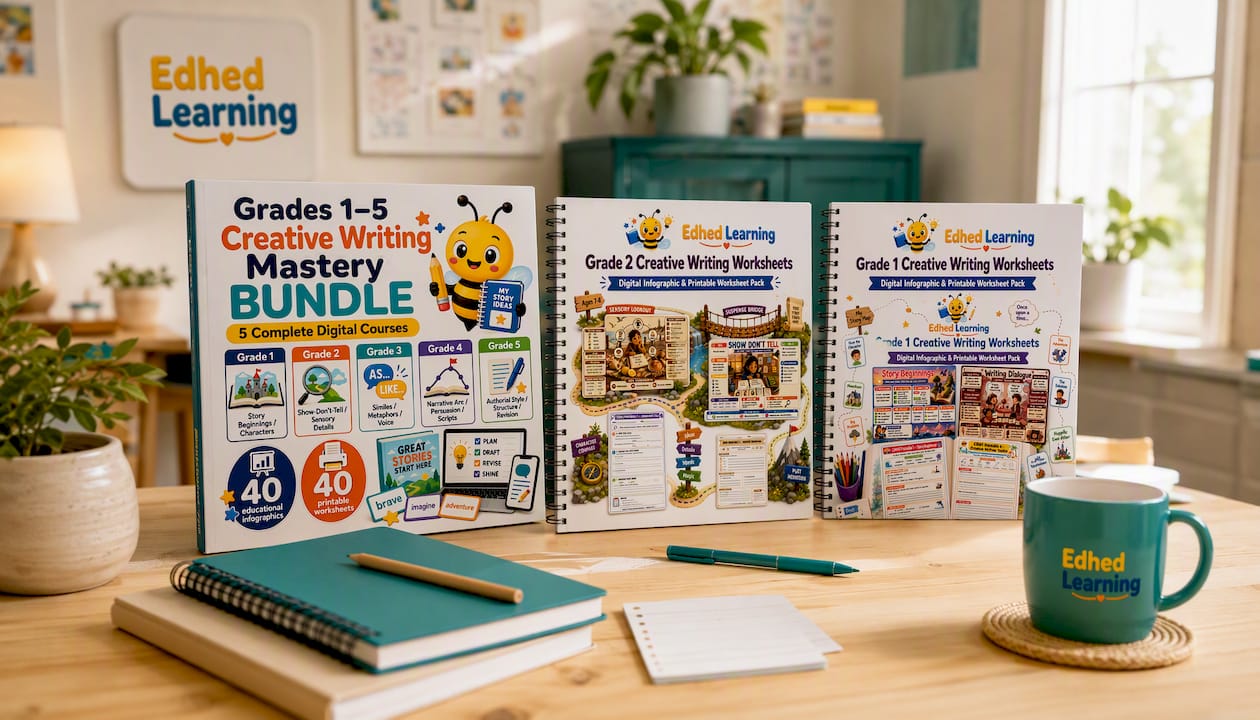
The Grade 2 Creative Writing Worksheets pack steps up the complexity slightly, adding story maps and beginning persuasion structures as students get ready for longer paragraphs. If you’re supporting several grade levels at once, whether that’s a multi-grade classroom, a homeschool with more than one child, or a tutoring practice, the Creative Writing Worksheets Bundle for Grades 1–5 covers the full range in one purchase, so you’re not piecing together organizers from five different sources.
Every pack is an instant digital download you can print immediately for classroom or home use, and each one is built around the same visual, hands-on approach that Edhed Learning uses across its math, science, and social-emotional learning worksheets. Grab the grade level that matches your writer, or start with the bundle if you’re planning across a full school year.
Sources
A few external hubs are worth keeping on hand alongside your own printable stock:
- Graphic Organizers to Help Kids With Writing | Reading Rockets
- Free Graphic Organizer Templates | HMH
- Graphic Organizers | IRIS Center
- Using graphic organizers correctly | Edutopia
- Free printable graphic organizer templates to customize | Canva
FAQ
What are graphic organizers for writing?
They’re visual tools, boxes, charts, or diagrams, that help students structure ideas before turning them into sentences and paragraphs. Reading Rockets notes they’re particularly effective for students with dysgraphia or executive-functioning challenges because they make abstract planning steps visible.
What are the 7 types of graphic organizers?
Definitions vary slightly by source, but common categories include story maps, sequence charts, persuasion maps, Venn diagrams, T-charts, mind maps, and cause-and-effect charts. HMH groups its templates by purpose rather than a fixed list of seven, which is a more useful way to choose one.
What are some common examples of graphic organizers?
Widely used examples include the story map, sequence chart, persuasion map, RACE or Hamburger paragraph organizer, Venn diagram, T-chart, mind map, concept map, five-paragraph outline, and cause-and-effect chart. Each maps to a specific writing purpose, narrative, persuasive, informational, or comparative, covered earlier in this guide.
How do I create a graphic organizer?
Start by picking the writing purpose, then choose a layout that matches it, label each box in plain language, and model how to fill it in before students try it alone. Simple hand-drawn versions often work better for younger students than polished printables, since less visual complexity can reduce overwhelm for kids who struggle with writing tasks.


