

A token economy for kids is a reward system where children earn tokens, like stickers, chips, or points, for specific behaviors, then trade those tokens for privileges or prizes they actually want. It works best for teaching new routines, building focus in kids with attention or executive-function challenges, and creating consistent expectations at home or in a classroom. Used well, it’s a teaching tool with a clear end date, not a permanent bribe system.
TL;DR:
- Token economies are most effective when the system is simple, with only one to three target behaviors and low-cost rewards that can be earned quickly.
- Physical tokens like stickers or chips retain motivation better for younger children, while older kids and classrooms benefit from digital points or marble jars.
- For children with ADHD, increasing reinforcement frequency and using tangible tokens helps improve on-task behavior and engagement.
- Regular monitoring and adjusting reward prices or token values prevent boredom and ensure the system remains motivating over time.
- Starting with a short pilot using free worksheets and a single behavior fosters better implementation and helps identify whether the approach benefits the child.
Table of Contents
- How Do You Set Up a Token Economy at Home or School?
- Which Tokens and Rewards Actually Motivate Kids?
- What Do Token Economy Examples Look Like?
- Does a Token Economy Work for ADHD and Other Needs?
- What Are the Dos and Don’ts of a Token Economy?
- How Do You Track Progress and Eventually Fade the System?
- How Edhed Learning Worksheets Support a Token Economy
- An Educator’s Take on What Actually Works
- Try a Free Worksheet Pack Before You Buy Anything
- Sources
- FAQ
How Do You Set Up a Token Economy at Home or School?
Start with observation, not tokens. Watch the child for a few days and write down how often the target behavior already happens. This baseline tells you whether your system is actually working later.
- Pick 1 to 3 target behaviors you can see and count, like “puts shoes in the bin” or “starts homework within 5 minutes,” not vague goals like “be good.”
- Choose your token type. Physical tokens (poker chips, stickers, punch cards) work well for younger kids who need something tangible. A points app or paper chart suits kids age 9 and up who can grasp numbers abstractly.
- Decide where tokens live. A token board taped to the fridge, a marble jar on the counter, or a laminated card in a homework folder all work, as long as it’s visible and consistent.
- Set the rules and pair tokens with praise. Deliver the token immediately after the behavior, and say specifically what earned it: “You started your homework right away, here’s your token.”
- Choose backup reinforcers and price them. Small rewards should cost 1 to 3 tokens; bigger ones cost more. Early on, keep prices low so the child wins fast and trusts the system.
- Teach it before you launch it. Walk the child through a short script: “Every time you [behavior], you’ll earn a token. When you collect [number], you can trade it for [reward]. Let’s practice once right now.”
University classroom guidance recommends stocking up before you start. One widely cited procedural guide for classroom systems suggests keeping roughly 100 tokens per student on hand at launch so you never run out mid-lesson and undercut the system’s credibility.
Pro Tip: Run a 3-day trial with just one target behavior before adding more. Kids (and adults) learn the system faster when there’s only one thing to track.
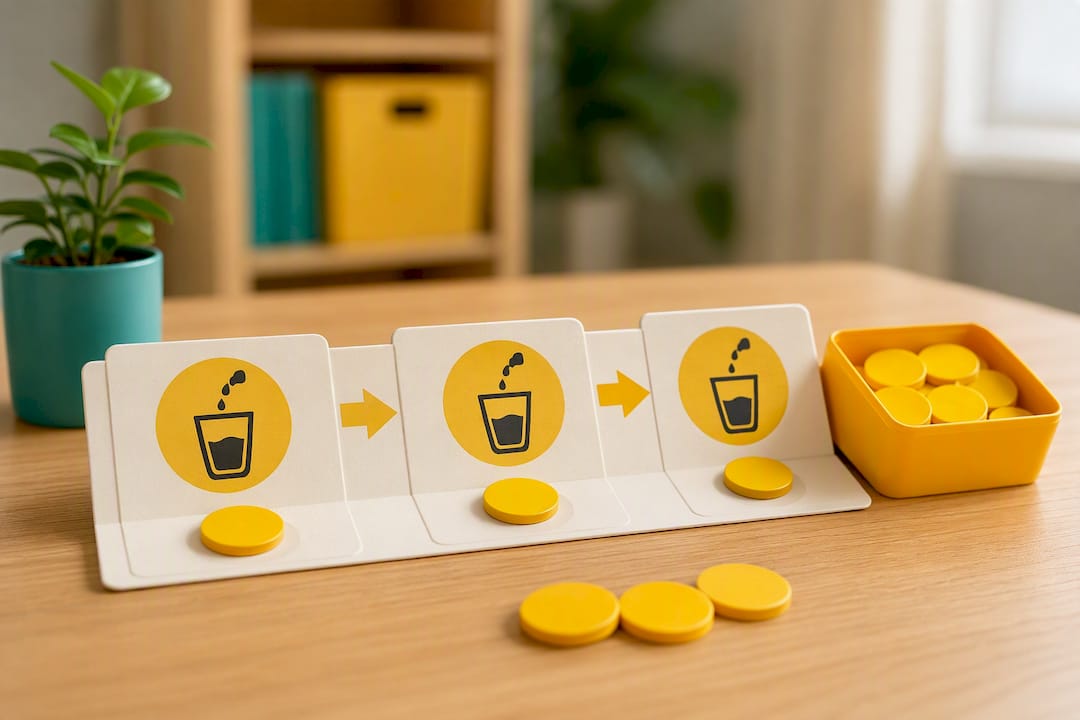
Which Tokens and Rewards Actually Motivate Kids?
The token itself matters less than what it buys. Here’s how the common options compare:
- Stickers or stamps — simple, cheap, and great for kids age 4 to 7, but they can’t be “spent” gradually since each one is permanent.
- Poker chips or tokens in a jar — reusable and satisfying to physically move, ideal for kids who like tangible progress.
- Points on a chart or app — scales well for older kids and lets you track bigger totals without clutter.
- Marble jar (class-wide) — good for group behavior in a classroom, since the whole class earns toward one shared reward.
For rewards, elementary-age kids respond well to extra screen time, choosing the family movie, or a trip to the park. Middle schoolers often prefer social currency: hanging out with friends, later curfew on weekends, or skipping one chore. Set your early token-to-reward ratio low, something achievable within a day or two, so the child experiences a win before motivation fades. In classrooms, keep the reward menu physically stocked (stickers, pencils, extra recess minutes) so kids can cash in the same day they earn.
What Do Token Economy Examples Look Like?
A home chart for a 6-year-old might track two behaviors: “gets dressed without reminders” and “uses kind words with siblings,” each worth one token, with a two-tier reward menu of small (3 tokens: pick the bedtime story) and big (10 tokens: extra 20 minutes of outdoor play).
Classroom versions often run as a one-week pilot before scaling up.
| Element | Home version | Classroom version |
|---|---|---|
| Who earns tokens | One child | Whole class or small group |
| Token type | Stickers or jar chips | Class points or marble jar |
| Reward “store” | Household privileges | Class store: stickers, extra recess |
| Who manages it | Parent or caregiver | Teacher, sometimes with a classroom aide |
For a printable token board, adapt the grid size by age: younger kids do best with 5 to 8 large boxes to fill in one sitting; older kids can handle a 20 box weekly chart. Introduce it with a short script, then run the pilot for a full week before changing anything.
Does a Token Economy Work for ADHD and Other Needs?
The evidence behind token systems is strong for the age group most parents and teachers ask about. A meta-analysis covering token economy research from 2000 to 2019 found large effect sizes for improving on-task and prosocial behavior in kindergarten through fifth grade classrooms, including special education settings.
For children with attention-deficit/hyperactivity disorder specifically, the CDC recommends parent training in behavior management as the first-line approach for young children, with token economies fitting inside that broader behavior therapy framework rather than standing alone.
A few adaptations help kids with ADHD or executive-function challenges get more out of the system:
- Increase reinforcement frequency, since these kids often need faster feedback loops than a once-a-day check-in.
- Use visual, physical tokens rather than abstract point totals, which can be harder to track without working memory support.
- Coordinate with teachers or clinicians so home and school rules stay consistent, and keep simple written records of progress.
If progress stalls after several weeks of consistent use, or the behavior challenges affect the child’s safety or schooling significantly, that’s the point to bring in a behavior analyst, therapist, or pediatrician rather than tweaking the chart further on your own.
What Are the Dos and Don’ts of a Token Economy?
Use tokens to teach a skill, always pairing them with instruction and specific praise, not just a silent handoff. University guidance is direct on this: token systems should only come into play after simpler tools like praise and clear environmental cues have already been tried and haven’t worked well enough on their own.
Don’t ever make basic needs, meals, or bathroom access contingent on tokens. A subtle but common mistake is letting a token system creep into controlling things that were never up for negotiation in the first place; ethically sound programs keep basic rights separate from earned privileges.
Common pitfalls include token inflation (prices creeping up so nothing feels earnable), overly complex pricing that confuses the child, and inconsistent responses between two parents or a teacher and an aide.
- Fix inflation by reviewing prices monthly, not daily.
- Fix inconsistency with a one-page written rule sheet everyone follows.
- Let the child pick 1 or 2 rewards on the menu themselves. Buy-in matters.
Pro Tip: If a reward stops motivating your child after a few weeks, that’s not failure. It’s a sign to rotate the reward menu, not to add more tokens.
How Do You Track Progress and Eventually Fade the System?
Tracking doesn’t need to be complicated. A simple tally of how often the target behavior happens each day, alongside how many tokens you’re actually handing out, tells you almost everything you need early on.
- Check your notes weekly for the first month, watching for behavior increasing and token counts staying steady rather than climbing.
- Adjust reward prices or token values if the child seems bored or if earning has gotten too easy.
- Once the behavior is consistent, shift from rewarding every instance to rewarding it intermittently, every third or fourth time.
- Layer in natural rewards, like the good feeling of a clean room or a finished assignment, so the routine survives once tokens fade out entirely.
When the child keeps up the behavior without prompting or tokens for a couple of weeks straight, that’s your sign the system has done its job.
How Edhed Learning Worksheets Support a Token Economy
Printable worksheets speed up the “teach it” step most systems skip. Edhed Learning’s emotional regulation lessons and social skills materials give kids the vocabulary and practice they need before you ever hand over a token. Start with a free taster pack, pilot it for a week alongside your token board, and layer in printable routine charts as the behavior sticks.
An Educator’s Take on What Actually Works
Start with one behavior, not five. The families and teachers who stick with a token economy long enough to see results are the ones who expect to tweak it, week one included, and treat every adjustment as data, not defeat.
— Shaun
Try a Free Worksheet Pack Before You Buy Anything
Before you invest in a full token economy setup, pilot it with something free. The FREE Feelings & Emotions for Kids taster course gives you three ready-to-go lessons and worksheets that slot directly into a token board: use the emotional check-in sheet as your daily tracking chart, and let the lesson activities double as your first backup reinforcer.
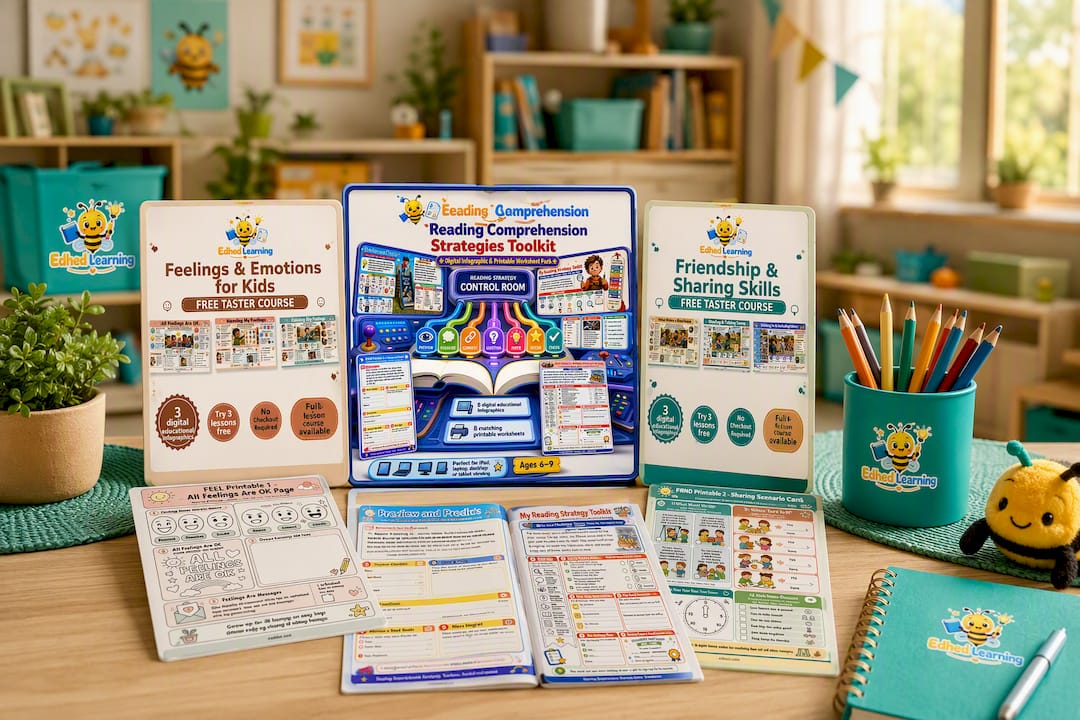
Edhed Learning built this pack (and the matching Friendship & Sharing Skills taster course) specifically for the 7-day pilot window most parents and teachers actually run before committing to a full system. Unlike building a chart from scratch, you get printable visuals and lesson structure already done for you, so your first week is about consistency, not design work. If your child responds well to skill-based rewards, the Reading Comprehension Strategies Toolkit makes a strong backup reinforcer for school-aged kids who like earning “learning time” instead of screen time. Download the free taster pack today and start your one-week pilot this weekend.
Sources
- Effect Size for Token Economy Use in Contemporary Classroom Settings: A Meta-Analysis
- Parent Training in Behavior Management | Attention-Deficit / Hyperactivity Disorder (ADHD) | CDC
- Token economy systems in the classroom: Recommendations for teachers (University guidance)
FAQ
Is a Token Economy Effective for Kids With ADHD?
Yes, when it’s part of a broader behavior therapy approach. The CDC lists parent training in behavior management as first-line treatment for young children with ADHD, and token systems work as one tool inside that framework rather than a standalone fix.
What Are Some Good Token Economy Ideas for a Classroom?
A marble jar the whole class fills together, individual point charts tied to a classroom store, or a token board with stickers for on-task behavior all work well. Classroom guidance recommends starting with a one-week pilot and simple written rules before scaling to a full-term system.
Do Token Boards Work for Kids With ADHD?
Token boards tend to work especially well for kids with ADHD because they make progress visible and immediate rather than abstract. Pairing the board with frequent, fast reinforcement helps kids who struggle with delayed gratification stay engaged.
Can You Give an Example of a Token Economy?
A simple example: a child earns one sticker each time they complete a homework block without a reminder, and trades 5 stickers for 20 minutes of extra outdoor time. Edhed Learning’s free emotional skills worksheets can serve as both the tracking chart and an early reward activity in this kind of setup.


