

Simple machines are six basic tools that make work easier: the lever, wheel and axle, pulley, inclined plane, wedge, and screw. They do not reduce how much total work gets done. Instead, they trade force for distance, letting kids push less hard over a longer path. This guide breaks down each machine in plain language, walks through hands-on activities you can run at home or in class, and points you toward printable worksheets that make the lesson stick.
TL;DR:
- Most objects identified as simple machines fall into six basic types, not ten, with many lists including compound tools like scissors or wheelbarrows.
- Kids can find tangible examples of each type in everyday objects, such as doorknobs for wheel and axle or knives for wedges, within a short activity.
- The main misconception is that simple machines reduce total work, but they only trade force for distance, which is crucial for understanding their true function.
- Hands-on activities, like ramp races and pulley lifts, reinforce understanding by encouraging building, testing, and redesigning, rather than passive reading.
- Classroom pacing should focus on covering two or three machines per session with brief, exploratory rotations and quick assessments to ensure comprehension.
Table of Contents
- What Are the Six Simple Machines Kids Should Know?
- Why Do Simple Machines Make Work Feel Easier?
- Hands-On Simple Machines Activities Kids Can Build
- How Should Teachers Pace a Simple Machines Lesson?
- Who Invented Simple Machines, and When?
- Where Do Simple Machines Show Up in Modern Technology?
- What Do Kids Get Wrong About Simple Machines?
- Why Visual and Hands-On Teaching Sticks With Kids
- Printable Worksheets That Pair With These Activities
- Sources
- FAQ
What Are the Six Simple Machines Kids Should Know?
Every simple machine does the same basic job: it changes the amount of force needed or the direction you push, so a task feels lighter. There are exactly six recognized types, and once kids can name and spot them, they start seeing machines everywhere.
- Lever: A stiff bar that pivots on a fixed point called a fulcrum. A see saw on the playground is a lever in action, and so is a pair of scissors.
- Wheel and axle: A wheel attached to a rod that turns together. Bicycle wheels and doorknobs both use this pairing to reduce friction and effort.
- Pulley: A wheel with a rope or belt that changes the direction of a pull. Flagpoles and blinds use pulleys to let you pull down instead of climbing up.
- Inclined plane: A flat, slanted surface that spreads a lift over a longer path. A wheelchair ramp or a moving truck’s loading ramp are everyday versions.
- Wedge: Two inclined planes joined back to back, used to split things apart. A doorstop and a kitchen knife both work as wedges.
- Screw: An inclined plane wrapped around a cylinder. Jar lids and light bulbs both turn a small twisting force into strong holding power.
Try this: hand a child a butter knife and ask which simple machine it might be. Most guess wedge right away once they picture the blade splitting through bread.
Why Do Simple Machines Make Work Feel Easier?
Work, in the scientific sense, means force multiplied by distance. A simple machine never shrinks that total. It just rearranges the split between how hard you push and how far you push it, which is the whole idea behind mechanical advantage.
A ramp shows this better than any explanation can. Lifting a toy truck straight up onto a shelf takes a hard, short push. Rolling it up a ramp to the same shelf takes a much gentler push, but the truck travels a longer path to get there. Set up two ramps at different angles, a steep one and a shallow one, and let kids push the same toy up each. They will feel the shallow ramp take less muscle, even though the truck ends up in the exact same spot.
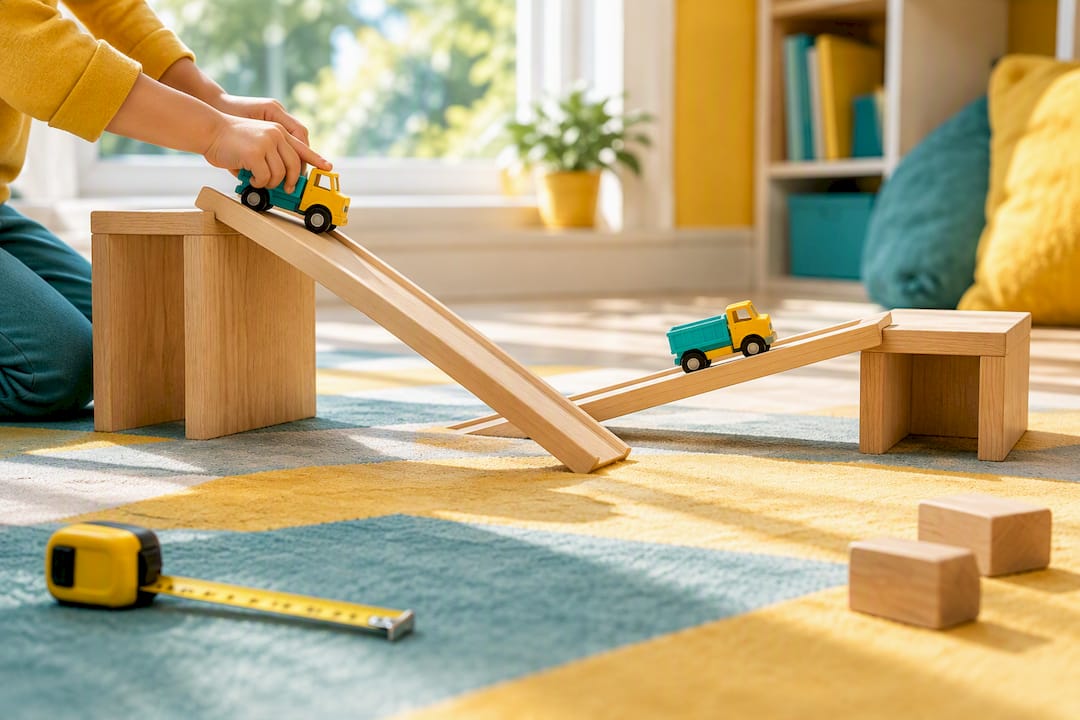
Pro Tip: Say this line out loud during the demo: “It’s easier because you push less, but you push for longer.” Kids remember short, rhythmic phrases like that far better than a definition.
Ask them why the shallow ramp felt lighter. Most will say “it’s a smaller hill,” which is exactly the intuition you want before introducing the vocabulary.
Hands-On Simple Machines Activities Kids Can Build
Reading about levers and pulleys only goes so far. Kids understand mechanical advantage once they build something, test it, and try to make it better. Classroom research on engineering design lessons backs up what most teachers already suspect: building, reflecting, and rebuilding teaches more than any worksheet alone.
- Model seesaw (lever): Balance a ruler on a small block or eraser. Place coins on each end and slide them until the ruler balances. Materials: ruler, pencil or eraser, coins. Time: 10 minutes. Learning goal: moving weight farther from the fulcrum changes the balance point.
- Ramp race (inclined plane): Prop a board against a stack of books at two different heights and roll a toy car down each. Materials: board, books, toy car. Time: 10 minutes. Learning goal: steeper ramps speed up motion but demand more control.
- Pulley lift (spool and string): Thread string over a spool fixed to a chair back or doorframe, then use it to lift a small cup of pennies. Materials: thread spool, string, small cup, pennies. Time: 15 minutes. Learning goal: a pulley changes the direction of a pull without reducing the load.
- Wedge test (clay): Push a butter knife and a flat ruler edge into a ball of soft clay and compare how easily each splits it. Materials: clay or play dough, plastic knife, ruler. Time: 10 minutes. Learning goal: a sharper wedge angle needs less force to split material.
- Screw demo (pencil and paper): Wrap a strip of paper around a pencil at a slant and trace the spiral it makes. Materials: pencil, paper strip, marker. Time: 5 minutes. Learning goal: a screw is really an inclined plane curled around a cylinder.
- Wheel and axle race (toy cars): Roll two toy cars, one with the wheels taped still and one free to spin, down the same ramp. Materials: two toy cars, tape, ramp. Time: 10 minutes. Learning goal: free wheels cut friction and speed up the whole vehicle.
End each build with a short redesign prompt: “What is one thing you would change to make this work better?” That single question turns a craft project into an engineering lesson, and it lines up with the reflection step PTA STEM-at-Home recommends for playground-style challenges.
How Should Teachers Pace a Simple Machines Lesson?
Cramming all six machines into one sitting overwhelms most elementary students. Cover two or three machines per session instead, and rotate stations every 10 to 15 minutes so nobody sits idle waiting for a turn, a pacing pattern that matches classroom lesson guidance built around exploration and redesign.
- Pack a shared kit ahead of time: spools, string, straws, cardboard scraps, tape, and rubber bands cover almost every activity above.
- Let kids request one extra material during redesign time instead of handing out everything up front. That small scarcity forces real problem-solving.
- Close with a 60-second written or verbal check: name the machine, explain how it changes force or distance, and suggest one redesign idea.
- Keep a spare timer at each station so rotations happen without you calling out the clock every few minutes.
Pro Tip: Laminate a one-page station card for each machine with the definition, the example, and the redesign question printed right on it. Kids read it themselves, and you stop repeating instructions five times an hour.
A simple rubric works better than a long quiz here. Ask three things: Can the student name the machine? Can they explain the trade-off in their own words? Did they propose a redesign, even a silly one? Three yeses means the lesson landed.
Who Invented Simple Machines, and When?
Nobody invented the lever or the wedge the way someone invents a video game. People discovered them by trial and error thousands of years before anyone wrote the physics down, and ancient builders used levers and inclined planes to move stone blocks long before they had a name for either one.
The Greek thinker Archimedes gets credit for explaining the lever mathematically around 260 BCE. He is famous for a bold claim: give him a long enough lever and a place to stand, and he could move the world. Ancient Egyptian workers used ramps and pulleys to raise pyramid stones centuries earlier, without any written theory at all. Ancient Mesopotamian potters are often credited with early wheel and axle use for pottery wheels and carts.
The screw came later. Historians often point to Archimedes again for the screw pump used to move water uphill, a device still echoed in some irrigation tools today. Wedges are older than recorded history. Early humans shaped stone hand axes into wedge form to split wood and bone long before metal tools existed.
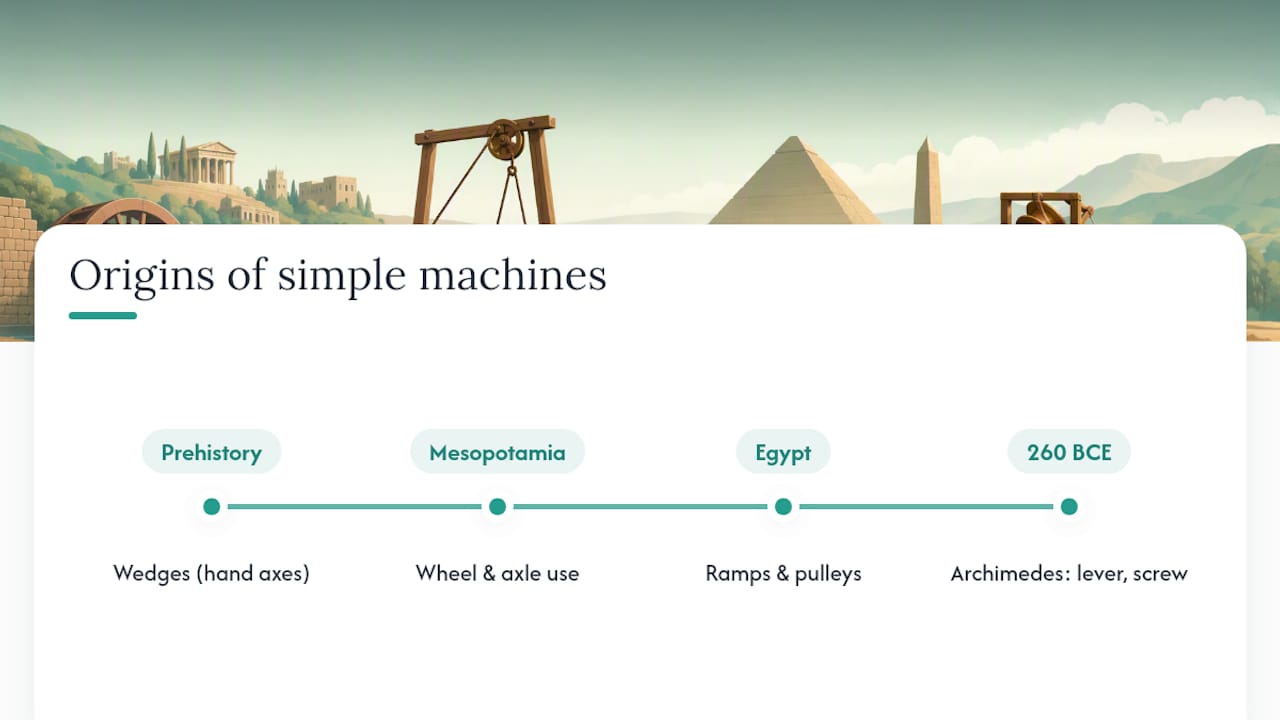
Tell kids this: the science came after the invention, not before. People built ramps and levers because they worked, and it took centuries before anyone explained exactly why.
Where Do Simple Machines Show Up in Modern Technology?
Every complicated machine kids see today, from a car engine to a robot arm, is built from combinations of the same six simple machines. A pair of scissors mixes two levers, a wheelbarrow mixes a lever with a wheel and axle, and a car jack stacks a screw on top of a lever.
Elevators rely on pulley systems to lift heavy cabins with motors that would otherwise need far more raw power. Modern construction cranes combine multiple pulleys, a setup that can multiply lifting force by roughly the number of supporting ropes involved, based on mechanical advantage principles that also apply to smaller classroom pulley demos. Wheelchair ramps, escalators, and even parking garage spirals are all inclined planes doing the same job a playground slide does, just scaled up.
Bicycle gears use wheel and axle combinations to trade speed for pedaling effort, which is the exact same force-versus-distance trade-off kids test with a ramp. Space missions depend on these basics too. Rocket launch gantries use pulleys and levers to move heavy equipment safely, a connection worth mentioning if a child has already explored space and the solar system in another lesson. Even a laptop hinge is a lever, and a spiral staircase is a screw you can walk up.
What Do Kids Get Wrong About Simple Machines?
The biggest misconception is thinking a machine reduces the actual work required. It does not. A ramp does not make lifting a box require less total effort, it just spreads that effort over a longer push, a distinction backed by NASA’s classroom guidance on simple machine learning objectives. Kids often assume “easier” means “less work,” when it really means “less force at any one moment.”
Another common mix-up: kids expect exactly ten or twenty distinct simple machines because that is the number they see in some online lists. Only six fundamental types exist. Longer lists usually come from splitting lever types into three classes or counting compound machines like scissors or wheelbarrows as separate entries, when those are really combinations of two or more of the six basics.
Kids also tend to think a machine has to look mechanical, with gears and moving parts, to count as a machine at all. A doorstop, a butter knife, and a flagpole rope all qualify, and none of them have a single moving gear. Clear this up early by asking kids to find five “boring” objects around the room and name which simple machine each one hides. A doorknob, a stapler, and a jar lid usually surprise them.
Why Visual and Hands-On Teaching Sticks With Kids
Kids remember a ramp they built far longer than a definition they read. That is the whole logic behind pairing a hands-on activity with a clear visual explanation, rather than handing a child a paragraph and hoping the idea sticks. Worksheets can be built around exactly that combination: bright infographics that show a concept at a glance, paired with printable pages that ask kids to apply it right away. The classroom activities in this guide work the same way the brand’s resources do, learn a piece, then build something with it, then reflect on what would make it better.
— Shaun
Printable Worksheets That Pair With These Activities
If today’s ramp race and pulley lift went well, a ready-made worksheet pack turns that momentum into a full lesson without extra prep work on your end. A Science Worksheets collection includes printable activity guides built the same way the projects above are, a clear visual explanation followed by a hands-on student page and an extension task for kids who finish early.
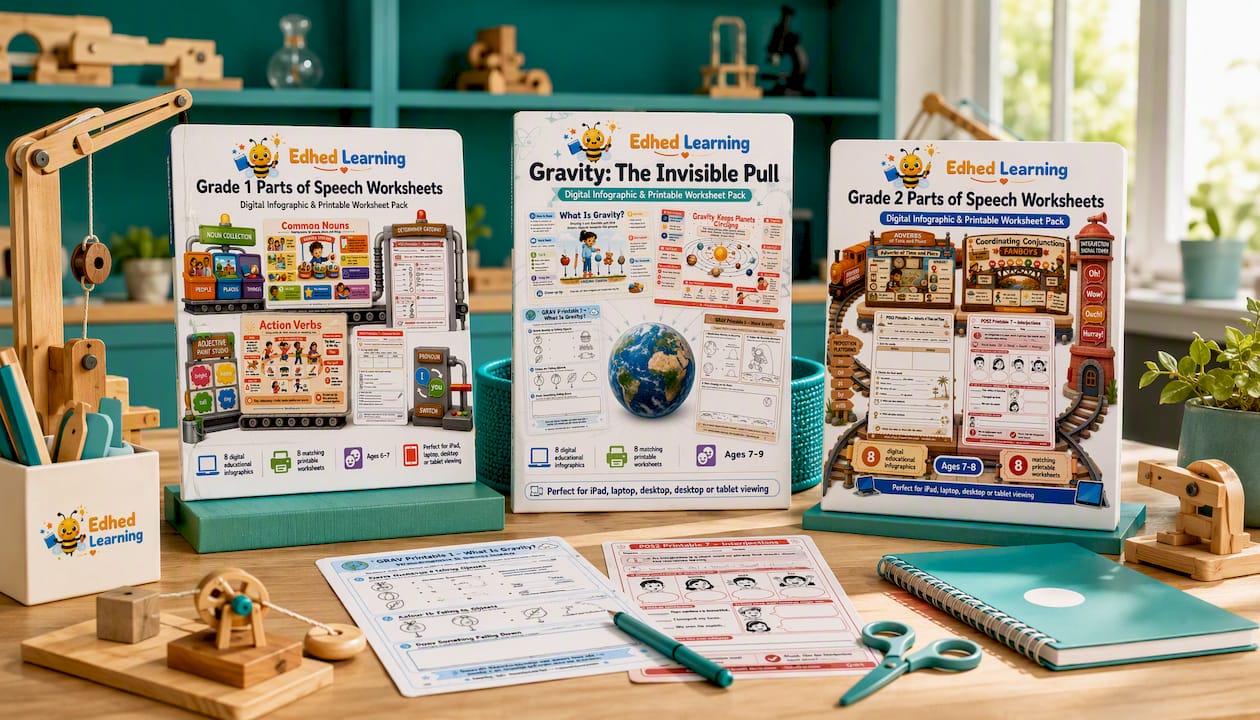
For a natural next step after simple machines, the Gravity: The Invisible Pull course covers another force concept kids will recognize from the ramp demo, since gravity is exactly what a ramp is fighting against. Teachers building a full physical science unit can round it out with reading-support materials like the Grade 1 Parts of Speech Worksheets or Grade 2 Parts of Speech Worksheets for cross-subject station days. Every pack comes as an instant digital download, and free sample sheets are available on the Edhed Learning site if you want to test the format before committing to a full pack. Head to the Science Worksheets collection to browse what is available for your next lesson.
Sources
- Simple machine | Britannica
- The Advantage of Simple Machines | TeachEngineering
- Simple Machines Classroom Connection | NASA
- LESSON 2: Simple Machines (UNH Leitzel Center)
- 9.5 Simple machines | OpenStax
FAQ
Can You Explain Simple Machines to Kids Simply?
A simple machine is a basic tool that makes a task feel easier by changing how much force you use or which direction you push. There are six of them: lever, wheel and axle, pulley, inclined plane, wedge, and screw, and kids can find examples of every single one in a normal kitchen or playground.
What Are Some Simple Machines Kids Can Make?
A ruler-and-eraser seesaw models a lever, a spool-and-string setup models a pulley, and a paper strip wrapped around a pencil shows how a screw works. Each build uses items already sitting in most homes, and every one doubles as a quick five to fifteen minute activity.
What Are 10 Simple Machines?
Only six fundamental simple machines actually exist: lever, wheel and axle, pulley, inclined plane, wedge, and screw. Lists claiming ten or more are usually counting lever classes separately or including compound machines like scissors and wheelbarrows, which combine two or more of the six basics.
Can You Give 20 Examples of Simple Machines?
Twenty or more examples show up easily once you count everyday objects: a doorknob and bicycle wheel (wheel and axle), a ramp and staircase (inclined plane), a knife and axe (wedge), scissors and a see saw (levers), a flagpole rope and window blind (pulleys), and a jar lid and drill bit (screws). Many longer lists mix in compound machines such as a wheelbarrow or a can opener, which are really two or more simple machines working together.
Does Edhed Learning Offer Printable Simple Machines Worksheets?
A Science Worksheets collection includes printable packs built around the same visual-plus-hands-on approach used throughout this guide. Current prices and free sample downloads are listed directly on the product pages.


