

Math fact fluency means a student can recall or quickly figure out basic facts using flexibility, efficiency, accuracy, and real conceptual understanding, not just speed. A common benchmark is recalling a basic fact in about two seconds, roughly 30 facts in 60 seconds. The single best move you can make is short, daily retrieval practice paired with explicit strategy instruction, not longer worksheets or more timed drills.
TL;DR:
- Short, daily retrieval practice paired with explicit strategy instruction is the most effective way to develop math fact fluency.
- Fluency involves flexibility, efficiency, accuracy, and conceptual understanding, not just speed or memorization.
- Using visual models and strategy-based games helps maintain conceptual understanding and strategy use alongside practice.
- Observation and strategy-focused assessments reveal more about a student’s fluency than timed drills alone.
- Consistent, brief routines with tracking progress support students at different skill levels without overwhelming them or causing anxiety.
Table of Contents
- What Math Fact Fluency Actually Means
- Why Fact Fluency Shapes Bigger Math Success
- The Three Stages of Building Fluency
- Strategies and Games That Actually Build Fluency
- Choosing the Right Way to Assess Fluency
- A Two-Week Starter Routine You Can Run Tomorrow
- Differentiating Fluency Instruction by Skill Level
- Where Digital Tools Fit Into Fluency Practice
- Getting Parents and Caregivers Genuinely Involved
- What the Research Actually Supports
- An Editorial Take on Visual, Hands-On Fluency Support
- Printable Worksheets That Match Your Fluency Routine
- Sources
- FAQ
What Math Fact Fluency Actually Means
Fluency is bigger than fast answers. Fluency has four working parts: flexibility (choosing a strategy that fits the problem), efficiency (getting there without excessive steps), accuracy (getting the right answer consistently), and conceptual understanding (knowing why the answer works, not just that it does). Automaticity, by contrast, is only the speed piece: instant recall with no thought about strategy.
That distinction changes how you should teach. A student who instantly blurts “12” for 7+5 but cannot explain how they got there has automaticity without full fluency. Common misconceptions worth clearing up:
- “Mad minute” timed drills build fluency on their own. They mostly measure existing speed and can penalize kids who reason well but slowly.
- Fluency means memorizing every fact by rote. Many facts are more efficiently derived (9+6 as 10+5) than memorized cold.
- Speed always signals understanding. A fast, wrong answer pattern often reveals a memorized error, not a fluency gap.
Why Fact Fluency Shapes Bigger Math Success
Working memory is limited, and every second spent computing 8+7 is a second not spent tracking the steps of a multi-part word problem. When basic facts are automatic, that freed-up mental space goes toward higher-level problem solving instead of getting eaten by arithmetic.
This is why fourth graders who struggle with multiplication facts often stall on long division and fractions, even when they understand the underlying concepts fine. The computation load crowds out the reasoning load. There’s also a confidence angle: kids who have to labor over every fact tend to see themselves as “bad at math,” while those with strong fact fluency approach new problems with less anxiety and more willingness to try a strategy before giving up.
The Three Stages of Building Fluency
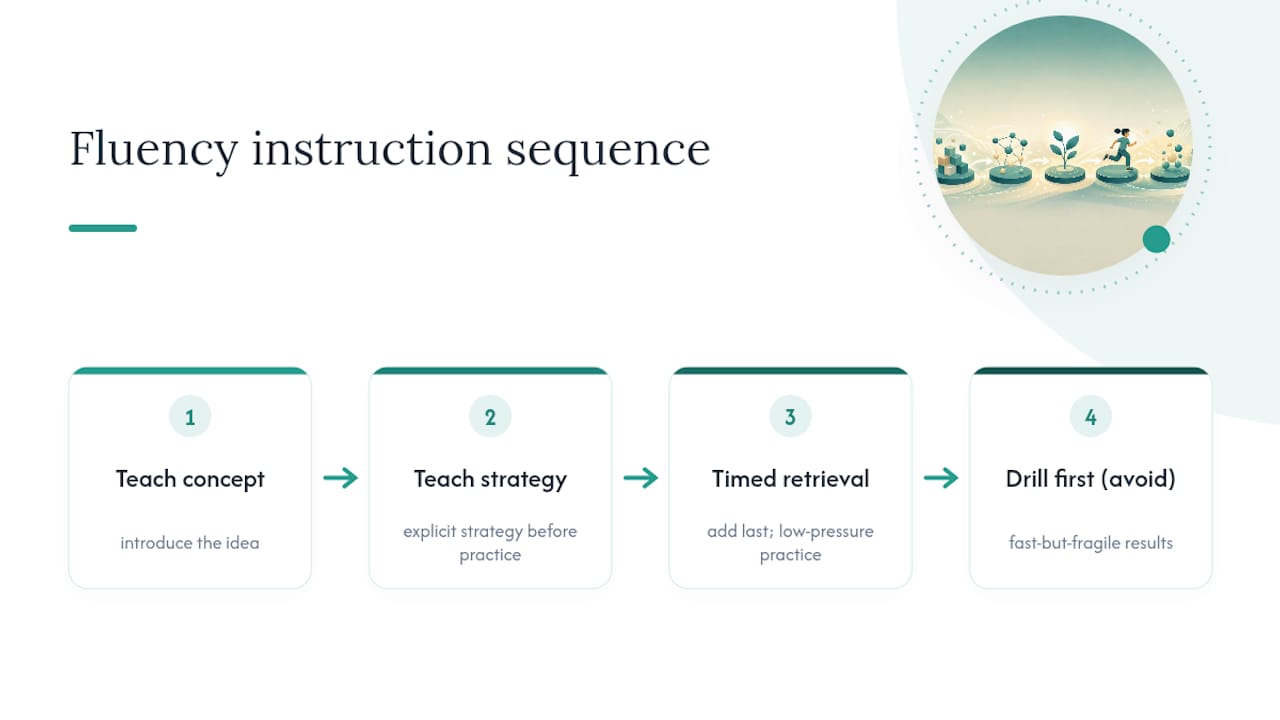
Fluency develops in a sequence, and skipping stages is the most common mistake in both classrooms and living rooms. Education researchers describe a progression that starts with concrete representation, moves to strategy instruction, and only then adds retrieval practice — protecting conceptual understanding instead of racing past it.
- Conceptual learning: Kids use counters, ten-frames, or number lines to see what 6+7 actually represents before they memorize it.
- Strategy instruction: You teach specific, named strategies (making ten, doubles, counting on) so students have a reliable path to an answer.
- Memorization and automaticity: Only after strategies are solid does spaced retrieval practice lock facts into long-term memory.
Grade-level expectations track this arc: kindergarten through second grade focuses on addition and subtraction within 20, while third and fourth grade shifts weight toward multiplication and division facts. Manipulatives and visual models should never fully disappear. Even fifth graders benefit from a quick array drawing when a multiplication fact gets shaky.
Strategies and Games That Actually Build Fluency
Incremental rehearsal is one of the most reliable techniques for embedding facts in long-term memory, and it’s simple enough to run with an index card stack. Here’s how it works:
- Build a stack of three cards: two facts the student already knows cold, one new fact.
- Quiz the stack in quick succession, always ending on the new fact.
- Once the new fact is answered correctly several times in a row, swap in another new fact and shift one known fact out.
- Gradually widen the ratio of known to unknown facts as accuracy climbs, spacing out review instead of cramming it.
This spacing reduces cognitive load and helps facts stick, because the brain keeps meeting the new information inside a context of things it already knows.
Beyond incremental rehearsal, a handful of named strategies do most of the heavy lifting. Counting on works for facts like 8+2 (start at 8, count up two). Doubles anchors facts like 6+6 as a single memorized landmark that near-doubles (6+7) can lean on. Decomposition breaks 9+6 into 9+1+5, using ten as a friendly stepping stone.
Games matter because they let you watch which strategy a student reaches for under mild pressure, which is diagnostic gold you don’t get from a worksheet. The Math Fact Fluency companion site organizes games by foundational strategies (addition and subtraction) and derived strategies (multiplication and division), and examples like Salute, Bears Race to 10, and Doubles Bingo scale up naturally from first grade counting games to fourth grade multiplication practice. For home use, our own roundup of fun math games to play at home adapts several of these ideas with materials most families already own.
Pro Tip: Keep incremental rehearsal sessions under five minutes. The technique works because it’s frequent and low pressure, not because it’s long.
Choosing the Right Way to Assess Fluency
Not every assessment reveals the same thing, and picking the wrong one can hide exactly the information you need. A timed worksheet tells you who’s fast; it tells you almost nothing about who’s flexible.
- Math running records: One-on-one interviews where you ask a student to solve a fact and explain their thinking, revealing strategy use and flexibility more clearly than a timed test alone.
- Observation during games: Watching which strategy a student defaults to under game conditions, without the artificial pressure of a stopwatch.
- Timed checks: Useful for tracking automaticity over time, but contested when overused since they can spike anxiety in students who reason correctly but slowly.
Reaction time matters less than the pattern behind it. A student who pauses on every fact is different from one who’s fast on doubles but stalls on subtraction, and error patterns (always missing 7 fact-family problems, for instance) point you straight to the strategy gap. Track two things over several weeks: raw speed on a small, repeated fact set, and a running note on which strategies the student uses without prompting.
A Two-Week Starter Routine You Can Run Tomorrow
Short, consistent sessions beat long, occasional ones. Five to ten minutes of adaptive daily practice outperforms a 20-minute worksheet done twice a week, largely because spaced retrieval gives the brain repeated, low-stakes exposure instead of one long grind.
- Days 1 to 3: Introduce a small set (5 to 8 facts) using concrete models, then run incremental rehearsal for three to four minutes.
- Days 4 to 7: Add a quick game (Salute or a doubles-matching game) for two to three minutes to build flexibility under mild pressure.
- Days 8 to 10: Introduce a beat-your-own-time check on the original fact set. Track the time, not a grade.
- Days 11 to 14: Rotate in three new facts while keeping the mastered set in rotation, expanding the pool only once accuracy holds steady.
Keep a simple log: the child’s time on the set, plus a one-line note on strategy (“still counting on fingers for 8+5” or “switched to doubles unprompted”). That qualitative note usually tells you more than the stopwatch does.
Differentiating Fluency Instruction by Skill Level
No single pace fits every student, and treating fact fluency as one-size-fits-all is where a lot of well-intentioned practice breaks down. Start by sorting students into rough bands based on where they sit in the three-stage progression, not by grade level alone. A third grader still counting on fingers for single-digit addition needs stage-one concrete work, even if classmates have moved to multiplication.
For students below grade-level expectations, shrink the fact set and lean harder on manipulatives before adding any retrieval practice. Five facts done well beats fifteen done sloppily. For students who’ve mastered the basics, widen the fact set and raise the complexity of the strategy work instead of just speeding up drills. A student fluent in single-digit multiplication is ready for two-digit decomposition strategies, not more of the same flashcards at a faster pace.
Tiered worksheets are one of the most practical tools here, because they let a mixed-ability classroom or a family with kids in different grades work from the same routine at different depths. A tiered approach might give one student a worksheet built around counting-on strategies while another works decomposition problems on the same topic, both practicing the same underlying skill at their own level. Differentiating worksheets this way avoids the two failure modes: bored advanced students and overwhelmed struggling ones sitting through the identical assignment.
Watch for students who mask a gap with a workaround, like always counting on fingers instead of using a faster strategy. That’s not laziness. It usually means the strategy stage was rushed, and the fix is to step back to concrete models rather than push more speed drills.
Where Digital Tools Fit Into Fluency Practice
Apps and digital drill tools have a real place in a fluency routine, mostly because they automate the bookkeeping that makes spaced retrieval hard to run by hand. Adaptive tools that adjust based on which facts a student misses can implement the same spacing logic behind incremental rehearsal without a teacher or parent tracking index cards manually. Resources like Num Drill build practice sessions around this kind of adaptive repetition, which is a reasonable stand-in for hand-run rehearsal when time is tight.
Digital tools are weakest exactly where classroom observation is strongest: they can’t watch a student’s face while they solve a problem or ask “how did you get that?” A screen can log that a student took four seconds on 8+6, but it can’t tell you whether that pause was strategic thinking or panic. That’s why digital practice works best as a supplement to strategy instruction, not a replacement for it.
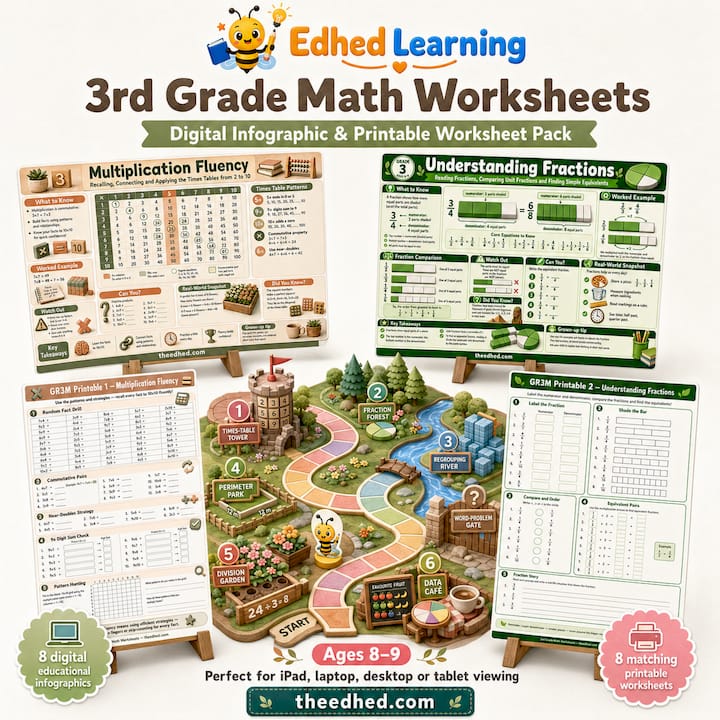
Printable, visual worksheets solve a different problem than apps do. A worksheet lets you see a student’s scratch work: the tally marks, the crossed-out attempts, the number line they sketched in the margin. That paper trail is often the clearest window into which strategy a student actually used, which matters more than whether the final answer was right. For families and classrooms building a fluency routine, a mix of a short digital drill session and a printed practice sheet covers both the automaticity side and the reasoning side.
The best setups treat technology as the speed and consistency layer, and human interaction (or paper trails) as the diagnostic layer. Neither one alone gives you the full picture.
Getting Parents and Caregivers Genuinely Involved
Fluency practice sticks better when it doesn’t stop at the classroom door, but most parent involvement efforts fail for a simple reason: they ask for more than five minutes, and busy families quietly stop doing it within a week. The fix is to make the ask small and specific from the start.
Send home a short, named routine rather than a vague suggestion to “practice math facts.” Tell parents exactly which five facts to work on this week, which strategy to use (counting on, doubles), and how long to spend (five minutes, not twenty). Specificity is what makes a home routine survive a busy Tuesday.
Frame timing exercises for parents the same way you’d frame them in class: beat-your-own-time, never a race against a sibling or a classmate. A parent who turns fact practice into competition with a sibling can accidentally build the exact math anxiety you’re trying to avoid. Our parent guide to keeping practice motivating walks through how to keep a home routine light without letting it slide into pressure.
Give parents a way to see progress that isn’t just a grade. A simple chart or log of times and strategy notes lets a parent watch real growth, which keeps them engaged longer than a single test score ever will. And when possible, loop caregivers in on vocabulary: if the classroom uses “making ten” as a strategy name, send that exact phrase home so a parent’s help reinforces the same mental model a teacher is building, instead of introducing a competing method.
What the Research Actually Supports
Strip away the marketing claims around math apps and programs, and the evidence-backed core is narrower than most products suggest: short sessions, explicit strategy instruction before drill, and low-pressure retrieval practice. Education Week’s reporting on fact fluency development lays out expert consensus that timed exercises carry real tradeoffs. They can strengthen retrieval, but they can also spike anxiety when used as the primary teaching tool rather than an occasional check.
The strongest support exists for sequencing: teach the concept, then the strategy, then add timed retrieval last. Programs and curricula that skip straight to timed drills tend to produce fast-but-fragile performance, students who do fine on a familiar worksheet format but fall apart when a fact is presented differently. That’s a flexibility failure, not a speed failure, and it’s exactly what the four-part definition of fluency is designed to catch.
Spaced retrieval, the mechanism behind incremental rehearsal, has broad support as a memory-encoding principle, and its application to math facts follows the same logic that makes flashcard spacing work for vocabulary or spelling. The practical takeaway for a classroom or a kitchen table is consistency over intensity: five focused minutes most days beats an ambitious hour-long session once a week, almost every time.
An Editorial Take on Visual, Hands-On Fluency Support
The fluency research keeps landing on the same conclusion: kids need to see and manipulate a concept before they’re asked to recall it instantly. That’s precisely why visual, printable practice earns its place in a routine rather than getting treated as a nostalgic alternative to apps.
A worksheet that shows decomposition as a broken-apart ten-frame, or a doubles fact as a mirrored array, gives a student the same concrete anchor a counter or number line provides, minus the setup time. It also leaves a paper trail of reasoning that a screen rarely does. That’s the gap Edhed Learning’s visual worksheets are built to fill inside the routines described above, not as a replacement for strategy instruction, but as the concrete and practice layer that makes the rest of it stick.
— Shaun
Printable Worksheets That Match Your Fluency Routine
Some worksheet providers offer resources that combine a visual, hands-on layout with fluency strategies, avoiding the need to piece together printables from multiple sources.
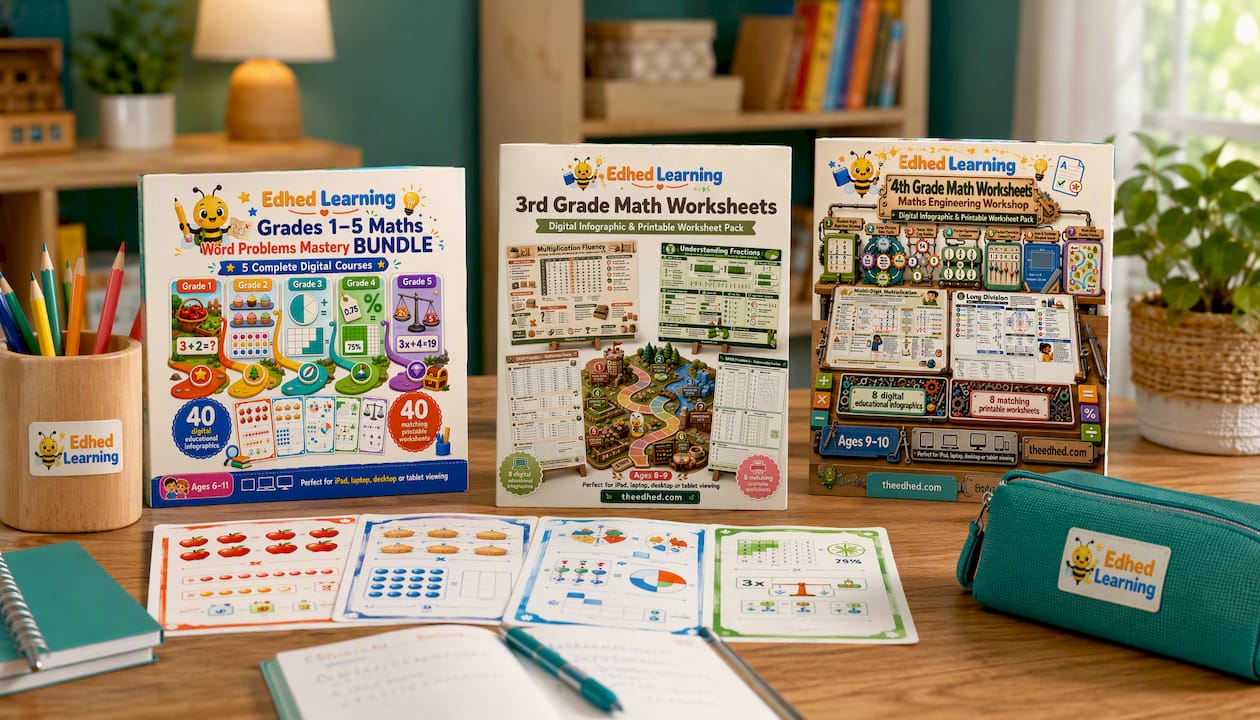
Three resources map directly onto the routines in this guide. The Maths Word Problem Worksheets Bundle for Grades 1–5 takes fact fluency a step further by applying it inside real word problems, which is exactly the multi-step context where freed-up working memory pays off. The 3rd Grade Math Worksheets pack focuses on the multiplication fact work that dominates that grade band, and the 4th Grade Math Worksheets pack builds on it with multiplication and division consolidation.
All three are instant digital downloads, so there’s no shipping wait between deciding to start a routine and actually starting it. Browse the full Maths Worksheets collection to find the grade-specific pack that fits your student’s current fact set, and start this week’s five-minute routine with a printable sheet already in hand.
Sources
The Hoboken Public School District’s math fact fluency guide lays out the four-component definition and the two-second benchmark used throughout this guide. The Math Fact Fluency companion website is worth exploring for its full library of strategy-grouped games. Education Week’s feature on how fact fluency develops covers the cognitive case for fluency and the debate over timed drills, and Num Drill’s practice guidance is a solid reference for adaptive, spaced digital practice.
- Math Fact Fluency: Everything You Need To Know - Hoboken Public School District
- Math Fact Fluency Companion Website
- What Is Math ‘Fact Fluency,’ and How Does It Develop? — Education Week
- Math fact practice — Num Drill
FAQ
What is math fact fluency?
Math fact fluency is the ability to solve basic math facts with flexibility, efficiency, accuracy, and conceptual understanding, not just fast recall. A common benchmark is recalling a basic fact in about two seconds, or roughly 30 facts in 60 seconds.
What is a good IEP goal for math fact fluency?
A strong IEP goal names the specific fact family, the strategy expected, and a measurable target, such as accurately solving addition facts within 20 using a named strategy across a set number of trials. Goals should track both accuracy and strategy use, not speed alone, since flexibility and understanding are core to fluency, not just recall speed.
What are good math fact fluency games?
Games organized by strategy work best, such as Salute, Bears Race to 10, and Doubles Bingo, because they let you observe which strategy a student reaches for under mild pressure. Simple index card incremental rehearsal also works as a low-prep, high-repetition option.
How can I improve my math fact fluency at home?
Run short, five to ten minute sessions daily rather than long occasional ones, since brief adaptive practice produces stronger gains than extended worksheets. Pair a small set of target facts with a named strategy like counting on or doubles, and track progress with a beat-your-own-time log instead of comparing speed to other kids.
How much does Theedhed’s math worksheet pack cost?
Pricing for grade-specific packs like the 3rd Grade Math Worksheets and 4th Grade Math Worksheets is listed on each product page, since prices vary by pack and bundle.


