

Yes, reliable, age-appropriate screen-free activities you can set up in five minutes exist, and they’re grouped below by age and effort level. The highest-impact categories are the ones you probably already have supplies for: sensory bins, outdoor play, sensory-rich messes, and family games. Pick one low-prep idea below, set a 10 to 20 minute timer, and watch what happens. Age-specific lists and printable pairings follow so you can turn today’s play into tomorrow’s routine.
TL;DR:
- Using household items for activities like muffin tin sorting or tape roads ensures quick setup and long engagement periods for young children.
- Outdoor play routines such as freeze dance or scavenger hunts promote energy burn and sensory input with minimal equipment and supervision.
- Board games and social activities enhance higher-order thinking skills, with tailored options suitable for preschoolers through tweens to support social and cognitive development.
- Establishing simple routines like timers, designated no-screen zones, or swapping activities helps reduce daily screen time without relying on willpower alone.
- Maintaining a stocked grab-and-go bin with versatile supplies and pairing activities with printable worksheets boosts consistent, low-effort screen-free habits.
Table of Contents
- What Screen-Free Activities Work Best at Each Age?
- Screen-Free Activities You Can Set Up in Five Minutes
- Outdoor Play Ideas That Need Almost No Equipment
- Family Board Games and Social Play That Build Real Skills
- Routines That Actually Cut Daily Screen Time
- Build a Grab-and-Go Bin and Pair It With a Printable
- Educational Screen-Free Activities That Build Real Learning
- Craft and DIY Projects for Every Skill Level
- Realistic Screen-Free Habits, Not Perfect Ones
- Turn Today’s Play Into Tomorrow’s Learning With Edhed Printables
- Where to Read More on Screen-Free Play
- Sources
- FAQ
What Screen-Free Activities Work Best at Each Age?
“Screen-free” simply means engaging kids with physical items instead of digital devices: books, board games, art supplies, kitchen tools, and whatever is lying around the backyard. The trick isn’t finding fancier toys. It’s matching the activity to your child’s stage and your own energy level.
Here’s a fast-reference list by age group, with setup time and what each activity actually builds.
- Toddlers (ages 1 to 3): Sensory bins with rice or dry pasta, muffin tin sorting with pom-poms or buttons, and a simple washing station at the sink all buy focused play time. Supervise closely around small objects and water. These low-effort options reliably buy 20 to 30 minutes of concentrated attention without elaborate prep.
- Preschoolers (ages 3 to 5): Painter’s tape roads on the floor, window drawing with dry-erase markers, and a pillow obstacle course take under 10 minutes to set up and build fine motor skills and spatial reasoning.
- Elementary (ages 6 to 9): Simple kitchen experiments (baking soda and vinegar volcanoes), board games, and cooking-helper tasks like measuring ingredients build cognitive skills and turn-taking.
- Tweens (ages 10 to 12): Longer-format projects like journaling, baking from scratch, or a self-directed DIY challenge (build a fort, design a game) give tweens ownership over a bigger block of time.
Caregivers can also think in tiers rather than strict age bands: very short setups, moderate setups, and no-prep games that use only household items or imagination. That framework matters more on a hard day than any specific activity list, because it lets you pick based on how much energy you actually have left.
Screen-Free Activities You Can Set Up in Five Minutes
Some activities earn their spot on every parent’s shortlist because the payoff-to-effort ratio is so lopsided. These five need almost nothing beyond what’s already in your kitchen drawers.
- Muffin tin sorting. Drop small toys, buttons, or dried beans into a muffin tin and hand your toddler tongs or a spoon. Setup: 2 minutes. Engagement window: 15 to 25 minutes.
- The treasure dump. Empty a junk drawer or toolbox onto a towel and let your child explore, sort, and invent. Setup: 1 minute. Engagement window: 20+ minutes.
- Tape roads. Painter’s tape on any hard floor becomes a road system for toy cars. Setup: 3 minutes. Engagement window: 20 to 30 minutes.
- Spray-bottle painting. Fill a spray bottle with diluted washable paint and let kids “paint” paper taped to a fence outdoors. Setup: 5 minutes. Engagement window: 15 to 20 minutes.
- Sticker pages. Blank paper plus a sheet of stickers is enough for a preschooler to build a whole scene. Setup: under 1 minute. Engagement window: 10 to 15 minutes.
Pro Tip: Rotate one item in your activity rotation each week instead of buying anything new. A muffin tin that’s been “resting” for a month feels brand new the moment it reappears, which is exactly why novelty rotation works better than a constant stream of new toys.
Outdoor Play Ideas That Need Almost No Equipment
Outdoor time solves two problems at once: it burns energy and it delivers sensory input kids don’t get sitting at a table. None of these require special gear.
- Freeze dance: play music (or clap a rhythm), and everyone freezes when it stops. Works in a driveway, a living room, or a park.
- Nature scavenger hunt: list five things to find (a smooth rock, something red, a bug, a leaf with holes) and let kids run the search themselves.
- Puddle stomping: after rain, a puddle is a full sensory event. Keep it to shallow, contained puddles away from traffic.
- Backyard campout: a blanket fort, flashlights, and a snack turn an ordinary yard into an event, even in a tiny urban courtyard.
In cold weather, shrink the same games indoors: freeze dance works in a hallway, and a “scavenger hunt” can search for household colors instead of leaves. Always supervise near water, driveways, or streets, and check a yard for hazards before letting younger kids run free.
Family Board Games and Social Play That Build Real Skills
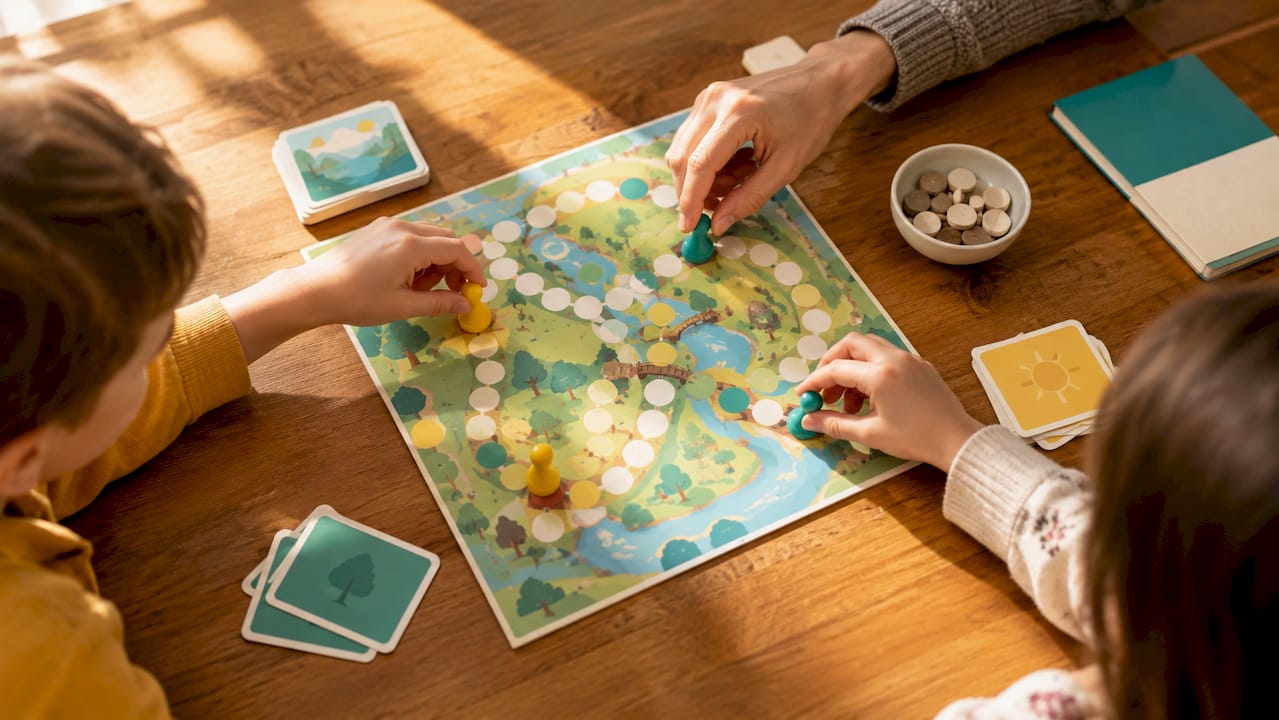
Analog games do something screens generally don’t: they force face-to-face negotiation, turn-taking, and reading another person’s reaction in real time. Research on tabletop play backs this up. Board and card games support higher-order thinking skills tied to social interaction and problem-solving, the kind of skills that don’t show up as clearly in solitary screen use.
The research signal: analog games rank consistently high for the upper levels of Bloom’s Taxonomy (analysis, evaluation, creation) because players have to negotiate rules, read opponents, and adjust strategy on the fly.
Pick by age: memory-matching and simple cooperative games for preschoolers, strategy games like checkers or card-based games for elementary kids, and word or math games for tweens who want a real challenge. A weekly “game night” that replaces one evening’s screen habit is easier to sustain than a daily overhaul, because it only asks for one repeated decision instead of a dozen small ones.
Routines That Actually Cut Daily Screen Time
Strategies work better than willpower. These five routines are ordered from lowest effort to most involved, so pick based on how much bandwidth you have this week.
- Visible timer. Set a physical or phone timer for screen time and place it where your child can see it counting down. Removes the “just five more minutes” negotiation.
- Screen-free zones. Designate the kitchen table or bedrooms as no-screen areas. Consistency matters more than the size of the zone.
- Visible alternatives. Keep the grab-and-go bin (below) somewhere your child can reach it without asking, so boredom has an obvious next step.
- Swap, don’t cut. Replace one screen block a day with a specific alternative rather than a vague “less screen time” goal.
- Sibling staggering. Give each child a different activity at the same time to reduce competition over the same toy or game.
Stressed caregivers default to screens more often, and that’s not a willpower failure. It’s a documented pattern: when stress goes up, screen time goes up. That’s exactly why low-friction alternatives matter more than elaborate ones. A good routine survives your worst days, not just your best ones.
Pro Tip: If a new routine meets resistance in the first week, don’t scrap it. Cut the number of changes in half instead. One new screen-free zone sticks better than three introduced at once. A balanced weekly rhythm helps here too, since routines land better when they’re part of a predictable pattern rather than a one-off experiment.
Build a Grab-and-Go Bin and Pair It With a Printable
Keep one basket in your main living area stocked with six or seven versatile items: painter’s tape, crayons, a die, a muffin tin, stickers, clothespins, and a small ball. This one basket is the single highest-leverage move in this whole article, because it removes the setup barrier entirely.
- Tape → tape roads or an obstacle course
- Muffin tin → sorting, counting, or a simple math game
- Clothespins → fine motor practice, pinning laundry, or a color-matching game
- Chalk → outdoor drawing, hopscotch, or a scavenger hunt map
Pair a quick bin activity with a short printable to stretch play into learning without extra prep. A nature scavenger hunt pairs naturally with Rivers, Lakes & Mountains, and quiet-time sorting pairs well with the FREE Feelings & Emotions for Kids taster course.
Elaborate setups increase caregiver burden over time. Simple, repeatable household-item activities are what actually produce consistent, long-term screen-free habits, according to research tied to parental stress and screen use.
Learn more about pairing analog play with printables in this guide to visual learning and printable practice.
Educational Screen-Free Activities That Build Real Learning
Learning doesn’t require a worksheet or a lesson plan. It happens naturally when a kid measures flour for a recipe, sorts laundry by color, or counts steps on a walk. The educational value is often hiding inside an activity that looks like pure play.
Cooking is one of the strongest examples. Measuring cups teach fractions before a child ever sees the word written down. A muffin tin sorting game teaches one-to-one correspondence, the foundation skill behind counting. A backyard scavenger hunt teaches classification, the same skill that underlies early science education.

Simple non-digital games also carry real instructional weight. Games can be adapted cheaply and used almost anywhere to reinforce a specific learning goal, whether that’s counting, vocabulary, or basic geography. A homemade “I Spy” game built around shapes does the same job as a flashcard app, just without a screen.
For structured practice that still feels like play, a short worksheet session works well right after an activity, while a concept is still fresh. If your elementary-age child just finished sorting coins into a muffin tin, a page from the 3rd Grade Math Worksheets course can turn that five minutes of play into a concrete math lesson. For younger kids just starting to connect numbers to real objects, the 1st Grade Math Worksheets Vol 2 course follows the same logic at an earlier stage.
Craft and DIY Projects for Every Skill Level
Crafting scales easily across ages, which makes it one of the most forgiving categories on this list. A two-year-old and a ten-year-old can both work with paper, glue, and scissors. The project just needs to match their hands.
For toddlers, keep it to tearing paper into a collage or pressing stickers onto a page. Fine motor control is still developing, so the goal is exposure, not precision. For preschoolers, a paper plate mask, a cardboard box car, or simple weaving with yarn through a paper plate all build hand strength and following-directions skills.
Elementary-age kids can handle multi-step projects: a papier-mâché piñata, a friendship bracelet, or a simple sewing project with a plastic needle. These take longer, sometimes across two sessions, which is a good thing. It teaches kids that a project can be paused and picked back up.
Tweens are ready for real tools and real stakes: a woodworking project with adult supervision, a knitting or crochet start, or a from-scratch recipe that takes an afternoon. Giving a tween a project with an actual finished product, something they can use or give away, tends to hold their interest longer than a craft designed purely to fill time.
Whatever the age, keep a small supply box (paper, glue, tape, scissors, yarn) in the same spot as your grab-and-go bin. The barrier to starting a craft is almost always finding the supplies, not deciding what to make.
Realistic Screen-Free Habits, Not Perfect Ones
Parents put pressure on themselves to create Pinterest-worthy setups, and that pressure is exactly what makes screen-free time collapse by week two. Repetition beats novelty. The muffin tin that worked on Tuesday will work again on Friday. Try two activities from this list this week and pay attention to which one your child asks for again, that’s your real answer, not the one that photographs best.
— Shaun
Turn Today’s Play Into Tomorrow’s Learning With Edhed Printables
You’ve got the activities. The next step is turning a few of your child’s favorites into something that sticks, and that’s exactly what printable worksheet packs are built for. Instead of hunting for a workbook that matches what your child is already curious about, you can pick a topic they already love and hand them a page that fits it.
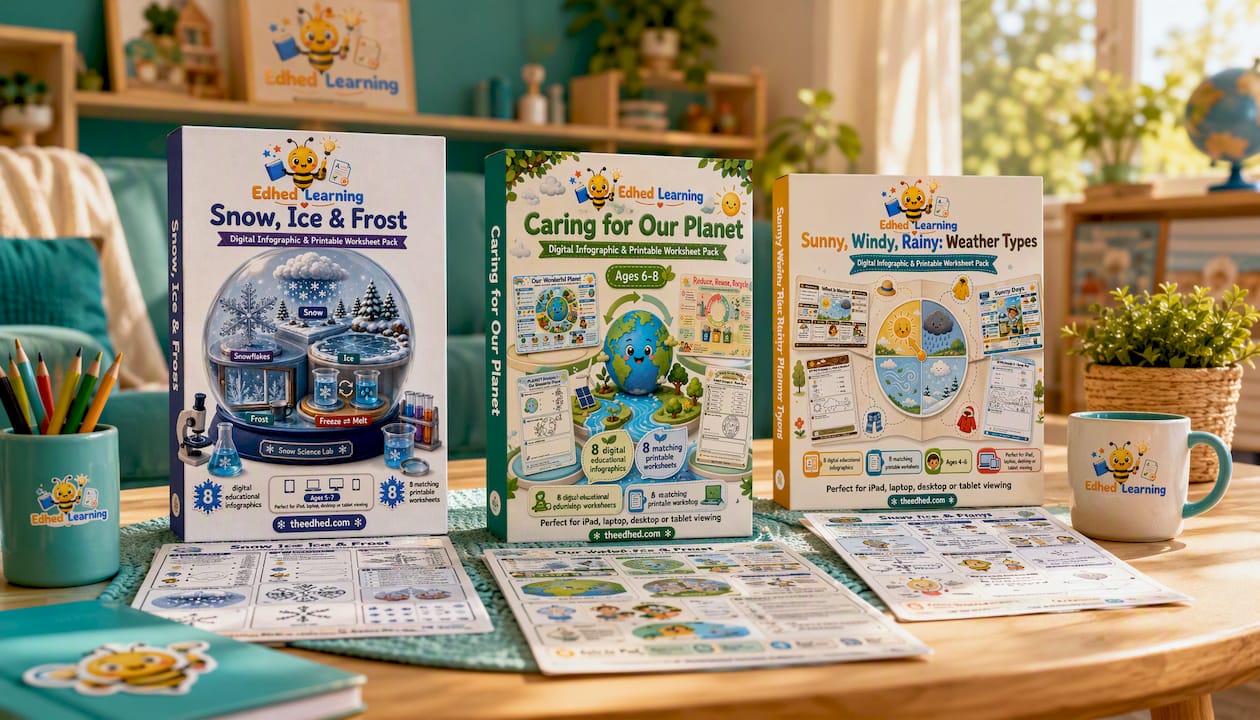
If today’s scavenger hunt sparked questions about the outdoors, the FREE Our Planet Earth taster course is a natural next step, three lessons and worksheets, free to try. If a game night turned into a squabble over turns, the FREE Friendship & Sharing Skills taster course turns that exact moment into a lesson. For families ready to build a full grade-level habit, the Maths Word Problem Worksheets Bundle for Grades 1 to 5 and the Grade 2 Parts of Speech Worksheets course both work well right after a screen-free activity, while the concept is still fresh in your child’s mind.
Start with one of the free taster courses today and see which one your child asks to finish.
Where to Read More on Screen-Free Play
For readers who want to go deeper, these sources shaped the recommendations above.
- Screen Free Activities by Age: a full breakdown of activities by age and effort tier.
- Easy screen-free activities for toddlers: low-effort ideas specifically for the toddler stage.
- 101 Screen-Free Activities: a large, tested list from Screen-Free Week.
- The hidden benefits of board games: the cognitive research behind analog play.
Sources
- Screen Free Activities by Age: Indoor and Outdoor, Babies to Tweens
- Easy screen-free activities for toddlers: Low-effort ideas that buy you 30 minutes - Motherly
- When parents are stressed, kids get more screen time (study)
- The hidden benefits of board games
FAQ
What should kids do when they’re not using screens?
Sort, build, move, or play a game using physical materials. Sensory bins, board games, outdoor scavenger hunts, and simple crafts all fill the same role screens do, just without the device.
How can kids pass time without screens?
Keep a grab-and-go bin of household items (tape, a muffin tin, chalk, stickers) within reach so boredom has an obvious next step instead of defaulting to a device.
What is the most popular screen-free activity for kids?
There’s no single universal favorite, but board games and outdoor play consistently rank among the most engaging options because they combine movement or social interaction with problem-solving.
What does it mean to be screen-free?
Being screen-free means engaging in analog play using physical items like books, board games, art supplies, or natural materials instead of digital devices.
How do I make screen-free activities feel less like a chore to set up?
Keep supplies pre-sorted in one bin so there’s zero setup decision to make in the moment, and pair a five-minute activity with a short printable, like those from Theedhed’s worksheet packs, to stretch the value of the time without adding prep.


