

Start with shapes and position words for kindergarten and first grade, then move to properties like sides, vertices, and symmetry in second and third grade, and save measurement and formulas for fourth grade and up. That sequence follows how young children actually build spatial reasoning: name it, describe it, then measure it. Hands-on practice and visual worksheets speed up every stage of that progression.
TL;DR:
- Children should master shape properties and positional words through hands-on activities before moving to measurement tasks in fourth grade.
- Shape classification works best with comparisons and physical exploration, not just memorization, progressing from naming shapes to understanding symmetry.
- Using everyday objects like food, household items, and outdoor scenes helps children connect shape vocabulary to real-world contexts naturally.
- Measure concepts like radius, diameter, and circumference become meaningful once children understand basic shape properties and are introduced to simple tools.
- Repeated, brief practice with printable worksheets tailored to each stage reinforces geometric vocabulary and understanding without overwhelming young learners.
Table of Contents
- Points, Lines, and Angles: The Building Blocks
- Common 2D Shapes and Polygon Vocabulary
- What Are Radius, Diameter, and Circumference?
- Solid Shapes: Faces, Edges, and Vertices
- Perimeter, Area, and Volume: Kid-Friendly Formulas
- Hands-On Geometry Activities That Actually Work
- Printable Practice That Matches This Progression
- Teaching Spatial Reasoning and Position Words
- Slides, Turns, and Flips: Basic Transformations
- Visual Aids and Manipulatives That Build Real Intuition
- How Geometry Shows Up in Everyday Life
- Author’s Note: Teaching Geometry Without Jargon
- Bring the Practice Home With Printable Geometry Packs
- Sources
- FAQ
Points, Lines, and Angles: The Building Blocks
Before your child can name a triangle, they need the vocabulary that describes what makes a shape a shape. Keep these definitions short and physical:
- A point is a single spot, like a dot on paper or a pin on a map.
- A line goes on forever in both directions; a line segment has two clear endpoints.
- A ray starts at one point and shoots off in a single direction, like a flashlight beam.
- An angle forms where two lines meet at a shared point called the vertex.
- A right angle looks like the corner of a book, an acute angle is narrower (like a slice of pizza), and an obtuse angle is wider (like an open laptop screen).
A favorite micro-activity: have your child stretch their arms into a right angle, then a narrow acute angle, then a wide obtuse angle. Say it out loud as they move: “Your arms make a right angle, just like the corner of the table.” That physical repetition sticks far better than a flashcard.
Common 2D Shapes and Polygon Vocabulary
Once kids know what a line and an angle are, shapes stop being mysterious outlines and start being combinations they can describe. A polygon is any closed shape made of straight sides, and every polygon can be sorted by how many sides and vertices it has.
- Triangle — three sides, three vertices. Think of a slice of pizza or a road-sign warning triangle.
- Square — four equal sides, four right angles. A cracker or a waffle square works well as a prop.
- Rectangle — four sides, opposite sides equal, four right angles. A door or a phone screen.
- Pentagon — five sides. Home plate on a baseball field is the classic example.
- Hexagon — six sides, like a honeycomb cell or a stop sign’s cousin, the yield-shaped hexagon tile.
Here is where nesting relationships matter: every square is a rectangle, because it meets all the rectangle rules, but not every rectangle is a square. Kids grasp this faster through comparison than through explanation. A regular polygon has equal sides and angles (a square); an irregular one does not (a stretched-out rectangle still counts as a quadrilateral, just not a regular one).
A shape scavenger hunt around the house or classroom, sorted onto index cards labeled by side count, turns this into a game rather than a memorization drill.
What Are Radius, Diameter, and Circumference?
A circle has no sides or corners, so it needs its own vocabulary. The center is the fixed middle point, the radius is the distance from center to edge, and the diameter is the distance straight across through the center. The radius is always half the diameter.
- Demo without formulas: press a piece of string from the center of a paper circle to its edge (that’s the radius), then double it across the whole circle (that’s the diameter).
- Use round objects around the house, cups, lids, and plates, to compare radii by eye before introducing measuring tools.
- Save circumference (the distance around the circle) and its formula for fourth grade or later, once basic perimeter concepts are solid.
Solid Shapes: Faces, Edges, and Vertices
Three-dimensional shapes take geometry off the page and into a child’s hands, which is exactly where it belongs. A cube has flat faces, a sphere is perfectly round with no faces at all, a cylinder has two circular faces and one curved side, a cone has one circular face and a point, and a pyramid has a flat base with triangular sides meeting at a point.
- A face is a flat surface, an edge is where two faces meet, and a vertex is where edges meet at a corner.
- Kids frequently miscount faces because they only count what’s visible from one angle. Direct tactile exploration, actually rotating a block in their hands, corrects this faster than any diagram.
- Try a mystery bag: drop in a die, a ball, a can, and a party hat, and have your child identify each solid by touch alone before looking.
Perimeter, Area, and Volume: Kid-Friendly Formulas
Measurement is where geometry starts feeling like math class instead of a shape-naming game, so timing matters. This stage fits best in fourth grade and beyond, once shape vocabulary and basic properties are automatic.
| Shape | Formula | When kids use it |
|---|---|---|
| Rectangle area | length × width | Figuring out how many tiles cover a floor |
| Triangle area | (base × height) ÷ 2 | Comparing two triangle-shaped garden beds |
| Circle area | π × radius² | Estimating pizza size differences |
| Circle circumference | π × diameter | Measuring around a bike wheel |
| Cube volume | side × side × side | Counting how many blocks fit in a box |
Perimeter is the fence around a yard; area is the turf inside it. That single analogy resolves more confusion than an entire worksheet of definitions. For hands-on practice, have kids count unit squares laid over a shape to find area, then use a ruler to measure a book’s edges and add up the sides for perimeter.
Curriculum benchmarks generally place angle measurement, area, and perimeter in the Year 4 to Year 6 range, which lines up with when most children have the number sense to multiply and add multi-digit measurements accurately.
Hands-On Geometry Activities That Actually Work
Reading definitions off a page rarely builds spatial reasoning. Movement does. Recommendations for geometry-in-motion activities consistently point to physical, body-based tasks as the highest-impact way to teach vertices, sides, and angles in early grades.
- Shape body-building: have two or three kids link arms and legs to form a triangle, then a square, calling out the vertex count as they go.
- Geoboard tasks: stretch rubber bands across pegs to build shapes, which makes side-counting and symmetry visible instead of abstract.
- Block constructions: build a cube tower and ask kids to count faces before knocking it down and checking.
- Shape scavenger hunts: send kids around the house or yard hunting for real-world hexagons, cylinders, and rectangles.
- Tangrams: classic puzzle pieces that build decomposition skills, seeing how small shapes combine into bigger ones.
- Treasure map coordinates: draw a simple grid and hide “treasure” at coordinate points, sneaking in early graphing alongside shape play.
For kids who breeze through the basics, extend the task rather than repeating it: ask them to build the same shape two different ways, or find three real objects shaped like a cylinder in under a minute.
Pro Tip: Keep any single geometry activity under 10 minutes for kids under age 7. Short, frequent bursts beat one long session for building lasting spatial memory.
Printable Practice That Matches This Progression
Definitions and activities get you far, but repeated practice on paper is what locks in shape vocabulary long term. Packs are built around the progression covered above, so parents and teachers do not have to guess which worksheet fits which stage.
- Kindergarten Math Worksheets Vol 2 covers shape naming and positional language, matching the K to 1 stage where kids learn to identify and locate shapes.
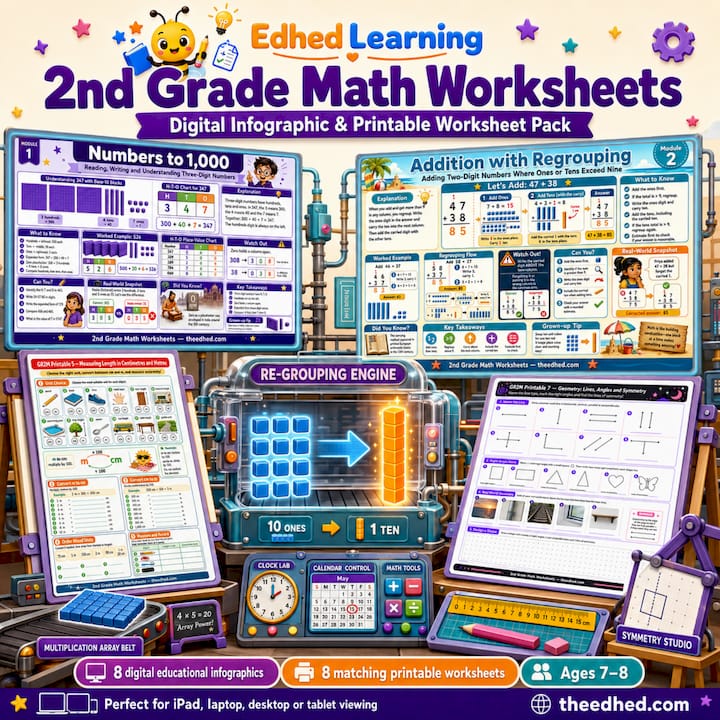
- 2nd Grade Math Worksheets builds on sides, vertices, and symmetry, right where second and third graders start comparing and sorting shapes.
- 3rd Grade Math Worksheets introduces area and perimeter alongside continued shape-property work, bridging into early measurement.
Each pack is an instant digital download, and the methodology behind them combines bright visuals with hands-on tasks to support learning.
Teaching Spatial Reasoning and Position Words
Before a child can classify a hexagon, they need to understand where things are in space, and that skill starts developing well before formal shape lessons begin. Position words, above, below, next to, inside, outside, behind, and between, give kids the language to describe relationships between objects, which is the actual foundation of spatial reasoning.
Guidance for early learners consistently emphasizes that positional language and hands-on play build spatial reasoning more effectively than early technical definitions, especially for ages three to five. A toddler who can tell you the ball is “under the table” or the sock is “inside the drawer” is already doing geometry, even without knowing a single shape name.
Build this into daily routines rather than treating it as a separate lesson:
- During cleanup, ask your child to put the blocks “inside” the bin and the books “next to” the shelf.
- On a walk, point out that the mailbox is “beside” the driveway and the cloud is “above” the tree.
- At snack time, ask whether the cracker is “on top of” or “under” the napkin.
These small, repeated prompts do more for long-term spatial thinking than a single formal lesson ever could, because they happen dozens of times a week without feeling like schoolwork. By kindergarten, most kids who’ve had consistent exposure to position language transition smoothly into using the same vocabulary to describe where shapes sit relative to each other on a page, which is exactly the skill early geometry worksheets test.
Slides, Turns, and Flips: Basic Transformations
Once a child can name a shape and describe its position, the next natural question is what happens when that shape moves. Geometry calls these movements transformations, and there are three that show up constantly in early grade levels: translation, rotation, and reflection.
A translation is a slide: the shape moves from one spot to another without turning or flipping, like sliding a checker piece across a board. A rotation is a turn: the shape spins around a fixed point, like a clock hand moving or a pinwheel spinning in the wind. A reflection is a flip: the shape mirrors itself across a line, the same way your reflection appears in a mirror, reversed but identical in size.
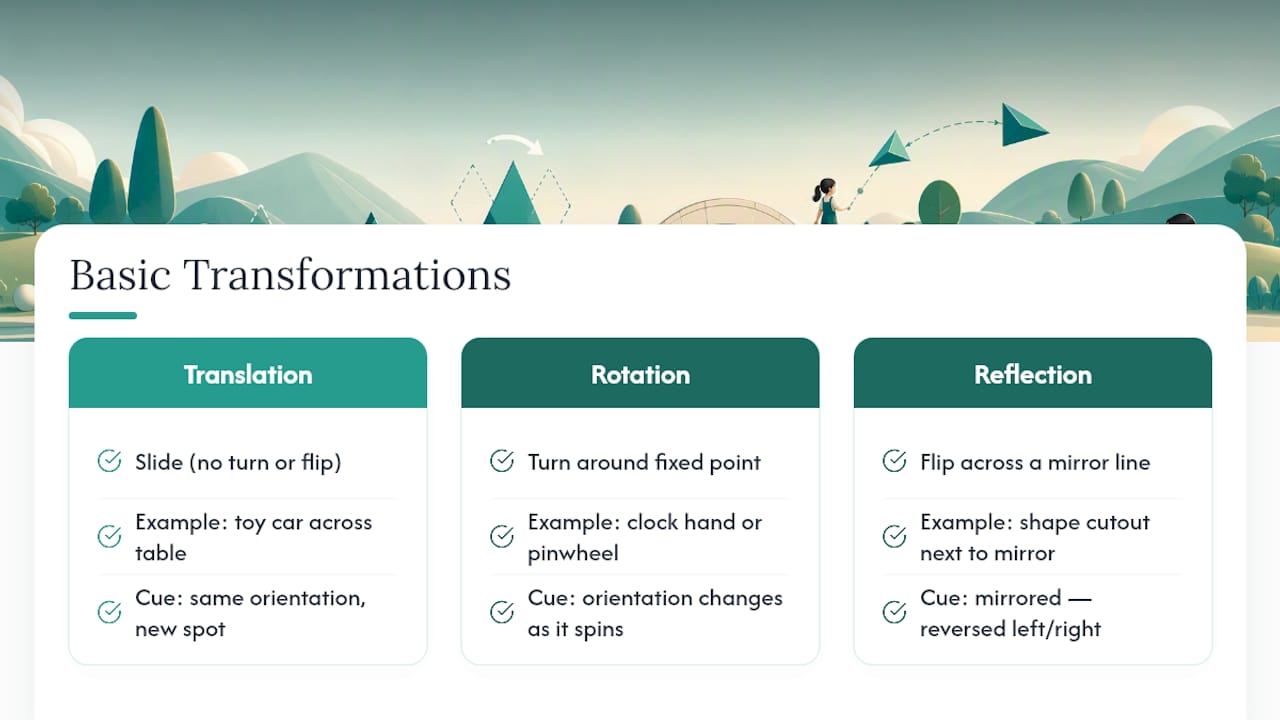
Kids grasp these far faster through play than through diagrams. Slide a toy car across the table and ask, “Did it turn or just move?” That’s a translation. Spin a paper plate and ask what changed. That’s a rotation. Hold up a shape cutout next to a mirror and ask your child to describe what’s different. That’s a reflection, and most kids will notice instantly that the mirrored shape looks backward even though it’s the same size.
For hands-on practice, cut a simple shape out of paper, then have your child slide it, turn it, and flip it on a table, narrating each move as they go. Pattern blocks work well here too: build a small design, then ask your child to recreate it after a slide, a turn, or a flip. This is typically introduced around second or third grade, once shape vocabulary and position words are already comfortable, since transformations build directly on both.
Visual Aids and Manipulatives That Build Real Intuition
Geometry is one of the few math topics where an abstract explanation almost never works as well as something a child can touch, turn, or draw. Manipulatives, geoboards, pattern blocks, tangrams, wooden solids, give kids a physical model to test their ideas against, instead of asking them to hold a shape entirely in their head.
Visual aids extend beyond physical objects, too. A simple picture book with labeled shapes, a poster showing 2D shapes worksheets on the wall, or printable practice sheets that pair pictures with vocabulary all reinforce the same idea from a different angle. Kids who struggle with a verbal explanation often succeed instantly once they see the same concept drawn out or laid in front of them as a physical piece.
The reason this works comes down to how young children process new vocabulary. A word like “vertex” means almost nothing on its own, but pointing to the actual corner of a triangle block while saying the word gives it a permanent physical anchor. That’s part of why classroom-tested geometry-in-motion activities built around geoboards, unit-square counting, and shape decomposition consistently outperform purely verbal instruction.
If you’re choosing where to start, prioritize manipulatives you already own before buying anything new. Building blocks double as solid-shape models, cereal-box lids work as circle demos, and a deck of index cards can become sorting cards for a shape scavenger hunt. Printable shapes worksheets fill the gap for repeated practice once the physical exploration has already built the underlying intuition.
How Geometry Shows Up in Everyday Life
Geometry stops feeling like a school subject the moment a child notices it outside of school, and that moment happens faster than most adults expect. A slice of pizza is a triangle. A stop sign is an octagon. The wheels on a bike are circles, and the box holding a birthday cake is a rectangular prism.
Pointing these out loud, casually and often, does more for retention than any worksheet. Using everyday objects like cups, lids, and boxes to anchor geometry vocabulary in a child’s actual world helps that vocabulary stick, because the words attach to something the child already knows rather than something new to memorize.
Cooking is one of the richest everyday contexts for this. Cutting a sandwich into triangles versus rectangles, measuring a rectangular pan for a cake, or noticing that a pizza box is square while the pizza inside it is a circle all give kids repeated, low-pressure exposure to shape vocabulary. Building with blocks, folding laundry into squares and rectangles, and even parking a car in a rectangular space between two lines all count, too.
The goal isn’t to turn every outing into a geometry lesson. It’s to notice out loud a few times a week: “That window is a hexagon, just like the one in your shape book.” Over months, that casual noticing builds a mental library of real examples that a child can draw on the moment a worksheet asks them to identify a shape they’ve genuinely never thought about in the abstract.
Author’s Note: Teaching Geometry Without Jargon
Keep lessons short, tactile, and low pressure. Five focused minutes with a real object beats twenty minutes of worksheet drilling every time. My favorite daily habit: name one shape out loud during a routine task, like folding laundry into rectangles or cutting a sandwich into triangles. Repetition in real contexts builds vocabulary faster than any single lesson.
— Shaun
Bring the Practice Home With Printable Geometry Packs
Everything covered above works best when it’s followed by repeated, low-stakes practice, and that’s exactly what printable worksheets are built for. Instant access to grade-matched geometry practice is available online without waiting for shipping or searching for the right worksheet level.
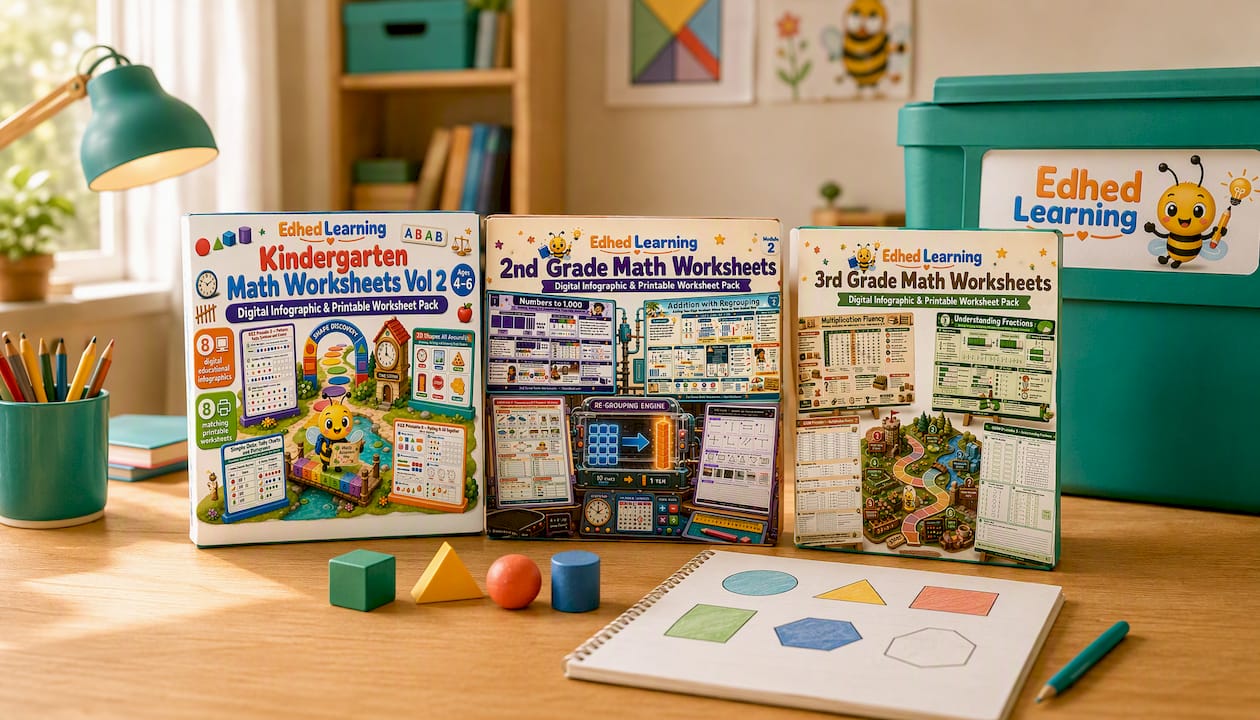
If your child is naming shapes and learning position words, the Kindergarten Math Worksheets Vol 2 pack reinforces exactly that stage. Once they’re comparing sides, vertices, and symmetry, the 2nd Grade Math Worksheets pack picks up right where the classification work in this guide leaves off. And when your child is ready for area and perimeter, the 3rd Grade Math Worksheets pack bridges shape properties into early measurement. For a broader look at shape and symmetry practice across ages, the Shapes, Patterns & Geometry course and worksheet pack covers the full arc in one bundle.
Free sample pages are often available to preview the visual style, and purchases are downloadable and printable for home or classroom use. Pick the pack that matches your child’s current stage and start practicing today.
Sources
- Geometry in Motion — BYU Arts Education (lesson resource)
- Path to Math: Geometric Thinking for Young Children — Illinois Early Learning Project
- Geometry & shapes — Oxford Owl for Home
FAQ
How Can I Explain Geometry to Kids in a Simple Way?
Use concrete, physical language tied to real objects instead of abstract definitions. Say “this has four equal sides” while pointing to a cracker, rather than reciting a textbook rule.
What Should a 7-Year-Old Be Able to Do in Geometry?
By age seven, most kids in second grade are comparing and sorting shapes by their properties, describing basic symmetry, and using position words with confidence. Formal angle measurement and area formulas typically come a year or two later.
What Are the 7 Basic Geometric Shapes Kids Learn First?
Most early curriculums start with the circle, triangle, square, rectangle, pentagon, hexagon, and octagon, since these appear constantly in everyday objects and signs.
What Are 10 Basic Geometric Terms Kids Should Know?
A solid starter list includes point, line, line segment, ray, angle, vertex, side, face, edge, and symmetry, each best taught through a hands-on example rather than a memorized definition.
When Should Kids Start Learning Formulas Like Area and Perimeter?
Most children are ready for basic perimeter and area formulas around fourth grade, once they’re comfortable naming shapes, describing their properties, and multiplying multi-digit numbers.


