

Free and paid printable executive function worksheets exist for working memory, inhibitory control, planning, time management, and self-monitoring. The best results come from skill-targeted mini-packets used in short daily sessions, not long one-off drills. Grab a memory grid, a stop-and-think checklist, or a planning template, then pair it with a real task. If you want to start today, download a free sample packet before you commit to a full bundle.
TL;DR:
- Short, daily sessions with targeted executive function exercises outperform long, infrequent drills for skill improvement.
- Worksheets should match the learner’s age and ability, with playful activities for preschoolers and more complex projects for teens and adults.
- Immediate application of practiced skills to real tasks enhances progress more than simply completing worksheets in isolation.
- Visual, infographic-style worksheets labeled by skill type help maintain engagement and clarify purpose for diverse learners.
- Pairing worksheets with modeling, prompts, and reflection maximizes effectiveness, especially when support is gradually faded over time.
Table of Contents
- What You’ll Find in Executive Function Worksheets
- Executive Function Activities Organized by Skill
- Choosing the Right Worksheet for Age and Ability
- How to Use Executive Function Worksheets Effectively
- How Edhed Learning Designs Executive Function Practice
- What Actually Moves the Needle With These Worksheets
- Try a Free Sample Before You Commit to a Full Pack
- Sources
- FAQ
What You’ll Find in Executive Function Worksheets
Printable executive function worksheets come in a handful of formats, and each one does a different job. Knowing the difference saves you from grabbing the wrong tool for the task at hand.
- Single-sheet checklists work best for quick daily practice, like a morning routine checklist or a stop-and-think prompt before a decision.
- Multi-page mini-packets group several related activities together, useful when you’re targeting one skill over a full week.
- Planners and templates guide a learner through breaking a project into steps, ideal for planning and organization practice.
- Memory grids and puzzles build working memory through recall games and sequencing challenges.
- Time-estimation sheets ask learners to predict how long a task will take, then compare it to the actual time, which sharpens time management.
- Self-monitoring logs track mood, behavior, or task completion over days or weeks.
Most publishers, including therapy-focused libraries like HappyNeuron, offer these as downloadable PDFs meant for printing at home, in a classroom, or in a therapy office. You’ll find versions scaled for young children and separate adult-oriented packets aimed at cognitive rehabilitation or workplace skill-building, since a checklist that works for a seven-year-old rarely fits a 45-year-old client relearning task planning after a brain injury.
Executive Function Activities Organized by Skill
Executive function isn’t one skill. It’s a cluster of related mental processes, and the most useful worksheets target one at a time instead of trying to cover everything at once.
Working memory: Memory grids (recall a sequence of shapes or numbers), sequence-recall worksheets, and multi-step task cards that require holding two or three instructions in mind at once.
Inhibitory control: Go/no-go pages where a learner responds to one cue but withholds response to another, stop-and-think checklists before answering or acting, and delay-of-gratification worksheets that walk through a waiting scenario.
Cognitive flexibility: Classification and switch tasks (sort by color, then suddenly sort by shape), “what-if” scenario worksheets, and perspective-change prompts that ask a learner to consider a situation from someone else’s point of view.
Planning and organization: Project breakdown templates, “plan the trip” planners that force a learner to sequence steps like packing, budgeting, and scheduling, and checklist-with-timer sheets that combine a to-do list with a time limit.
Time management and task initiation: Time-estimation logs, five-minute initiation prompts designed to lower the barrier to starting a dreaded task, and visual timers paired with a worksheet to make elapsed time concrete.
Self-monitoring and emotional control: Reflection logs, combined mood-and-behavior charts, and short self-evaluation checklists filled out at the end of a task or school day.
Play-based practice reinforces every one of these categories. Games like Simon Says, memory card matching, and sequencing games give children ages 5 to 7 the same cognitive workout in a lower-pressure format, which matters when a worksheet alone feels like schoolwork rather than practice.
Pro Tip: Say the skill out loud before starting. “We’re working on inhibitory control right now” sounds small, but naming the target skill helps learners build the metacognitive awareness that makes practice stick.
Choosing the Right Worksheet for Age and Ability
Executive function develops on a long timeline, and a worksheet pitched at the wrong level either bores a capable learner or frustrates one who isn’t ready.
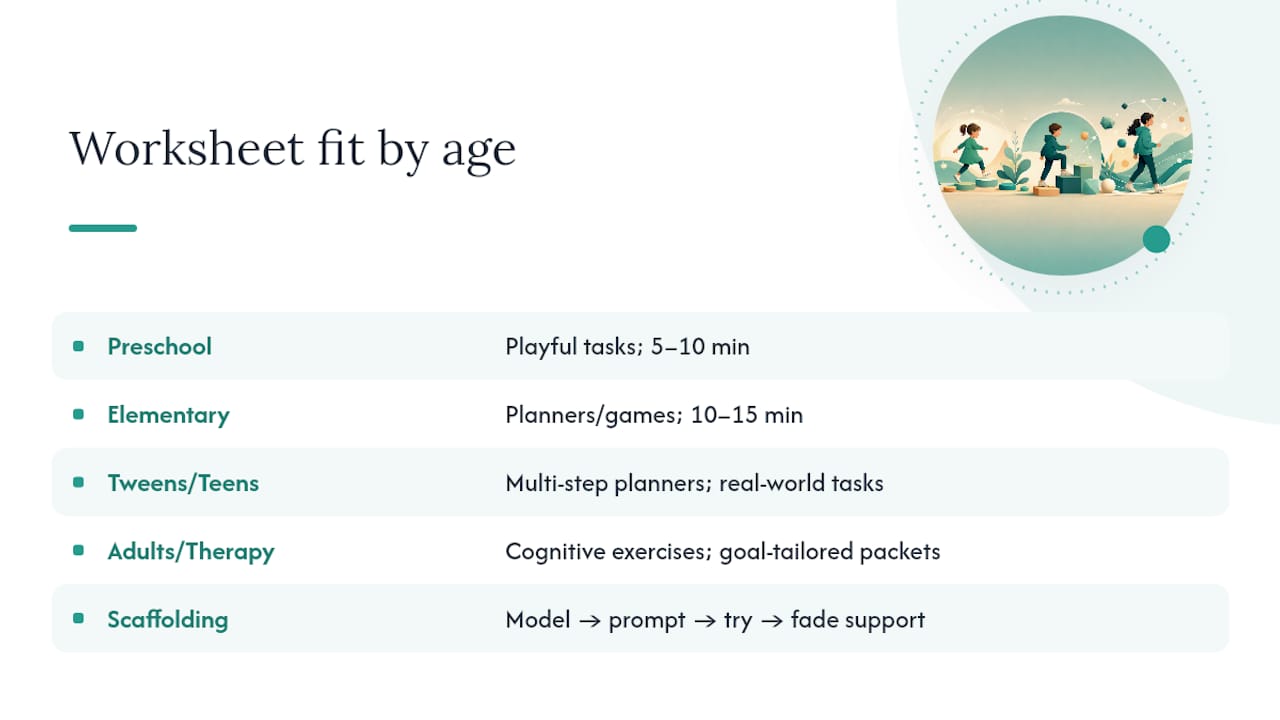
Preschool (ages 3 to 5): Keep sessions playful and under 5 to 10 minutes. Picture sequences, simple matching games, and “what comes next” cards work better than anything text-heavy.
Elementary (ages 6 to 10): Introduce basic planners and card or board games that map directly to EF skills, with sessions running 10 to 15 minutes. This is also the age where checklist-with-timer worksheets start to click.
Tweens and teens: Multi-step project planners, time-blocking templates, and real-world planning worksheets (planning a group project, budgeting for an outing) suit a brain that can now handle abstract, multi-step thinking.
Adults and therapy clients: Cognitive exercises, real-world task simulations, and printable packets tailored to specific goals, such as return-to-work planning after cognitive rehabilitation, fit best.
Scaffolding matters more than the worksheet itself. Model the task first, prompt the learner through a partial attempt, let them try independently, then fade your support as competence builds. If a worksheet feels too easy, add a time constraint or extra step. If it feels too hard, break it into smaller chunks before abandoning it entirely.
How to Use Executive Function Worksheets Effectively
Worksheets are supplemental. Most of the actual skill growth happens through short, frequent, scaffolded practice paired with a real task, not from filling out sheet after sheet in isolation.
A simple five-step session structure works across ages:
- Name the skill you’re targeting out loud.
- Model the task yourself first.
- Practice together using the worksheet.
- Apply the same skill to a real task immediately afterward.
- Reflect briefly on what worked and what didn’t.
Guides that compile dozens of executive functioning activities consistently recommend short, repeated sessions over long, infrequent ones, with age-based duration suggestions running from about 5 minutes for young children up to 20 minutes for older students. Pair a planning worksheet with an actual small project, like organizing a backpack or planning a simple recipe. Use a time-estimation sheet right before a timed task, then compare the prediction to what actually happened.
Track progress with something simple: a five-point rubric, a few reflection questions, or a running log of “wins.” The Harvard Center on the Developing Child frames this kind of scaffolded, repeated practice, starting with adult modeling and gradually withdrawing support, as the mechanism that actually builds executive function over time, not the worksheet in isolation.
How Edhed Learning Designs Executive Function Practice
Worksheets built around a visual, infographic-style layout can help keep a learner engaged longer than a page of plain text, especially for younger children and visual learners who need a concept broken into pictures before it clicks. Most packs label which executive function skill they target, helping users understand whether a worksheet builds working memory or inhibitory control.
Three packs cover the ground most educators and therapists ask about:
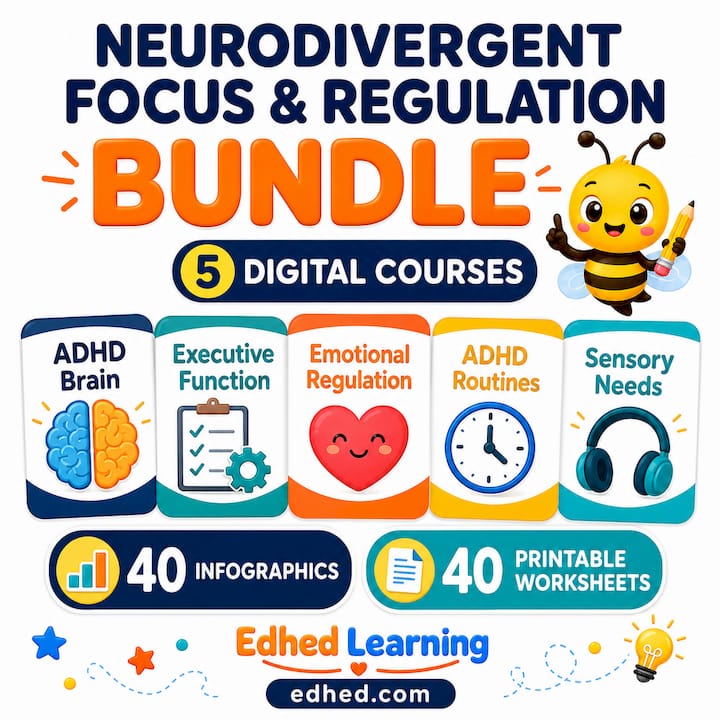
- The Neurodivergent Focus & Regulation Worksheets Bundle targets self-regulation and attention, built for kids who need extra scaffolding around focus, transitions, and emotional control.
- Grade 4 Creative Writing Worksheets builds planning and sequencing skills through story structure, a natural bridge from EF practice into an academic subject.
- Grade 5 Sentence Writing Worksheets reinforces organization and self-monitoring as students structure and revise their own sentences.
Many worksheet packs are available as digital downloads, enabling quick printing before sessions. Free sample sheets may be accessible for those who want to test the format before committing to a full bundle.
What Actually Moves the Needle With These Worksheets
Most articles on this topic treat worksheets like a finished intervention: print it, hand it over, done. That’s backward. A worksheet is a rehearsal space, not the performance. The learners who actually improve are the ones who practice a skill on paper for a few minutes, then immediately turn around and use it on something real, like packing a bag, planning a meal, or estimating how long homework will actually take.
The conventional advice oversells volume. Parents and educators often assume more worksheets equal more progress, when the research points the other way: short, repeated, scaffolded sessions beat long infrequent ones almost every time. A single well-matched five-minute activity, done four times a week and paired with a real task, will outperform an hour-long packet completed once a month.
If you take one thing from this: pick one skill, name it out loud, practice it briefly, then apply it immediately. Everything else, format, brand, page count, is secondary to that loop.
— Shaun
Try a Free Sample Before You Commit to a Full Pack
Edhed Learning gives you instant-download, classroom-ready worksheets built around a single idea: visuals do the heavy lifting that plain text can’t. Every pack labels its target executive function skill up front, so you’re not stuck guessing whether a page builds working memory or self-monitoring.
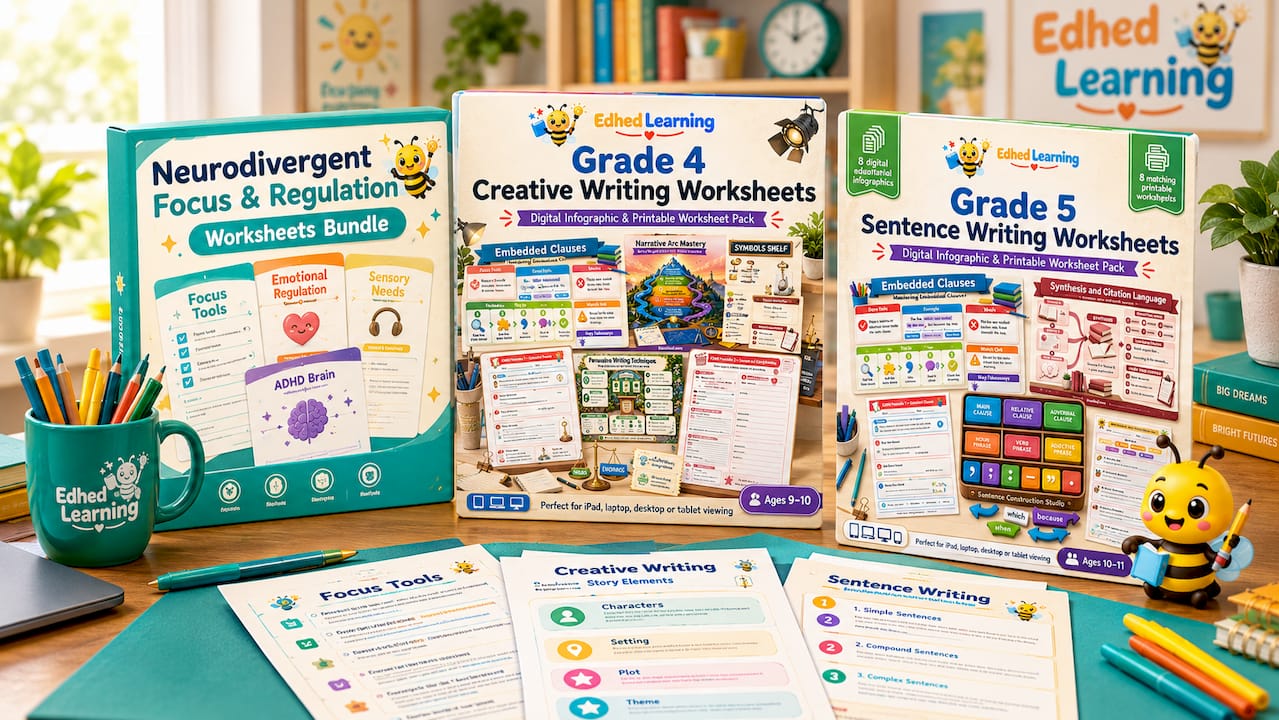
If you’re working with a learner who struggles with focus, transitions, or emotional regulation, the Neurodivergent Focus & Regulation Worksheets Bundle pairs well with a morning routine chart or a homework kickoff ritual, giving that learner a consistent visual anchor across the day. Beyond executive function packs, Edhed Learning also carries subject-specific collections including maths worksheets, English worksheets, science worksheets, geography, history, and culture packs, social-emotional learning worksheets, and life skills worksheets. Download a free sample first, see how the format fits your classroom or session, then decide which bundle matches the skill you’re targeting next.
Sources
- Enhancing and Practicing Executive Function Skills with Children from Infancy to Adolescence
- Executive Function Activities for 5- to 7-year-olds
- Thirty-plus executive functioning activities for students | EduAvenues
FAQ
What Age Should a Child Start Using Executive Function Worksheets?
Children as young as 3 can start with playful, picture-based activities kept under 10 minutes. Formal worksheets tend to work better once a child reaches elementary age and can sit with a task for 10 to 15 minutes.
Are Free Executive Function Worksheets Actually Effective?
Free worksheets can build real skill when used consistently and paired with a real-world task, according to guidance from the Harvard Center on the Developing Child. The worksheet alone rarely does the work; short, repeated practice does.
How Do I Know Which Executive Function Skill to Target First?
Watch for the specific struggle: trouble remembering multi-step directions points to working memory, while trouble starting tasks points to task initiation. Assessment-style checklists that screen for strengths and weaknesses across each skill area can help narrow down where to start.
Can Adults Use Executive Function Worksheets Too?
Yes. Adult-oriented cognitive worksheets support rehabilitation and everyday skill-building, especially when complexity is matched to current functioning and paired with daily routines rather than isolated practice sessions.
Where Can I Find Executive Function Worksheets Tailored to Neurodivergent Learners?
Edhed Learning’s Neurodivergent Focus & Regulation Worksheets Bundle is built specifically for learners who need extra support with focus, transitions, and emotional regulation, with a free sample available before you commit to the full pack.


